 Back
BackOverview of Animal Diversity: Structure, Development, and Body Plans
Study Guide - Smart Notes
 Tailored notes based on your materials, expanded with key definitions, examples, and context.
Animal Diversity and Characteristics
Defining Features of Animals
Animals are multicellular, heterotrophic eukaryotes whose tissues develop from embryonic layers. While exceptions exist, several characteristics collectively define the animal kingdom:
Nutritional Mode: Animals ingest food and digest it internally, unlike plants (autotrophic) and fungi (external digestion).
Cell Structure & Specialization: Animal cells lack cell walls and are supported by structural proteins such as collagen. Unique tissues—nervous and muscle—are defining features.
Reproduction & Development: Most animals reproduce sexually, with a dominant diploid stage. Sperm and eggs are produced by meiosis, and embryonic development includes cleavage, blastula, and gastrulation.
Symmetry: Animals exhibit various forms of symmetry, which relate to their lifestyle and movement.
Tissues: Most animals possess specialized tissues derived from embryonic germ layers.
Body Cavities: Many animals have internal body cavities that support organ function and development.
Nutritional Mode
Animal Nutrition Compared to Other Kingdoms
Animals are heterotrophs, meaning they obtain organic molecules by consuming other organisms. Unlike plants, which synthesize their own food via photosynthesis, and fungi, which absorb nutrients after external digestion, animals ingest and internally digest their food.
Example: Carnivores eat other animals; herbivores eat plants; omnivores eat both.
Cell Structure and Specialization
Unique Cellular Features of Animals
Animal cells are multicellular and eukaryotic, lacking cell walls. Structural proteins like collagen provide support. Nervous and muscle tissues are unique to animals, enabling movement and rapid response to stimuli.
Tissues: Groups of similar cells acting as functional units.
Reproduction and Development
Life Cycle and Embryonic Development
Most animals reproduce sexually, with the diploid stage dominating. Sperm and eggs are produced by meiosis. The zygote undergoes cleavage (rapid cell division without growth), forming a blastula (hollow ball of cells), which then undergoes gastrulation to form a gastrula with distinct embryonic layers.
Larval Stage: Many animals have a larval stage, which is morphologically and behaviorally distinct from the adult.
Metamorphosis: Transformation from larva to juvenile, then to adult.
Developmental Genes: Hox genes regulate the expression of other genes, influencing animal morphology.
History and Origin of Animals
Evolutionary Evidence and Ancestry
Animals have a history spanning over half a billion years. Molecular and morphological evidence suggests that choanoflagellates, a group of protists, are the closest living relatives to animals. Multicellularity required new mechanisms for cell adhesion and communication.
Cadherin Proteins: Domains found in animal cadherins are also present in choanoflagellate proteins.
Animal Body Plans
Symmetry
Animal body plans are characterized by symmetry, which influences their lifestyle and movement. The two main types are radial and bilateral symmetry.
Radial Symmetry: Body parts arranged around a central axis; any slice through the axis produces mirror images. Common in sessile or planktonic animals.
Bilateral Symmetry: Body parts arranged along two axes (head-tail and dorsal-ventral); only one slice produces mirror-image halves. Associated with active movement and central nervous system.
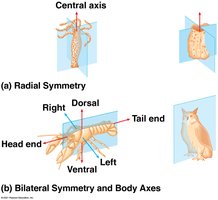
Bilateral Symmetry and Body Axes
Dorsal: Top side
Ventral: Bottom side
Anterior: Head end
Posterior: Tail end
Right and Left: Sides
Sensory Equipment: Often concentrated in the anterior end (e.g., brain)
Tissues
Embryonic Germ Layers and Tissue Organization
Animal tissues arise from embryonic germ layers. Sponges lack tissues, but most animals have two or three germ layers:
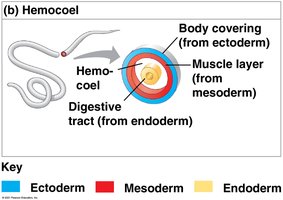
Ectoderm: Outermost layer; forms skin and nervous system
Endoderm: Innermost layer; forms digestive tract and organs
Mesoderm: Middle layer (in triploblastic animals); forms muscles and most organs
Diploblastic: Two layers (ectoderm and endoderm); e.g., cnidarians
Triploblastic: Three layers; includes all bilaterally symmetrical animals
Body Cavities
Types and Functions of Body Cavities
Most triploblastic animals possess a body cavity, which is a fluid- or air-filled space between the digestive tract and the body wall. Body cavities cushion organs, act as a hydrostatic skeleton, and allow organ movement independent of the body wall.
Coelom: Body cavity completely lined by mesoderm-derived tissue
Hemocoel: Body cavity formed between mesoderm and endoderm, filled with hemolymph for nutrient and waste transport
Example: Molluscs have both a hemocoel and a reduced coelom
Acoelomates: Triploblastic animals lacking a body cavity; typically flat-bodied
Protostome and Deuterostome Development
Developmental Modes
Animals are categorized by their developmental modes, which differ in cleavage, coelom formation, and blastopore fate.
Protostome Development:
Spiral and determinate cleavage
Coelom forms by splitting mesoderm
Blastopore becomes the mouth
Deuterostome Development:
Radial and indeterminate cleavage
Coelom forms from mesoderm budding off archenteron
Blastopore becomes the anus
Key Equations:
Cleavage:
Coelom Formation (Protostome):
Coelom Formation (Deuterostome):
Major Animal Clades
Ecdysozoa and Lophotrochozoa
All members of Ecdysozoa are invertebrates that secrete an exoskeleton, which is shed during growth (ecdysis). Nematodes and arthropods are examples. Lophotrochozoa includes animals with a lophophore (feeding structure) or trochophore larva (developmental stage), such as molluscs and annelids.
Ecdysozoa: Exoskeleton, ecdysis
Lophotrochozoa: Lophophore or trochophore larva
Future Directions in Animal Systematics
Current Research Questions
Animal systematics is a dynamic field. Two major questions are currently under investigation:
Are ctenophores basal metazoans?
Are acoelomate flatworms basal bilaterians?
