 Back
Overview of Brain Function and Structure: General Biology Study Notes
Study Guide - Smart Notes
 Tailored notes based on your materials, expanded with key definitions, examples, and context.
Overview of Brain Function and Structure
Introduction to Brain Function
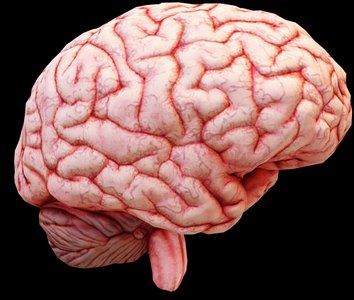
The brain is the central organ responsible for producing behavior by receiving, integrating, and responding to information from the environment. Different species have nervous systems adapted to their ecological niches, and the human brain is highly specialized for complex behaviors.
Receives information about the world through sensory systems.
Integrates sensory input to create a coherent sensory reality.
Produces motor commands to control muscles and behavior.
Neuroplasticity: The nervous system can adapt structurally and functionally in response to experience and injury.
Organization of the Nervous System
Anatomic and Functional Divisions
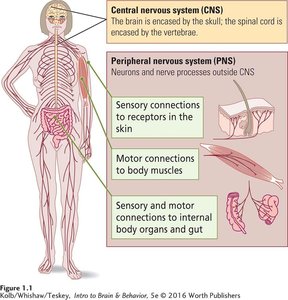
The nervous system is divided into the central nervous system (CNS) and peripheral nervous system (PNS), each with specialized roles in processing and transmitting information.
CNS: Consists of the brain and spinal cord; encased by bone for protection.
PNS: All neural tissue outside the CNS, including cranial and spinal nerves.
Somatic division: Controls voluntary movements and transmits sensory information.
Autonomic division: Regulates involuntary functions (e.g., heartbeat, digestion).
Enteric division: Network of neurons in the gut, largely autonomous but communicates with the CNS.


Direction of Neural Information Flow
Neural pathways are classified based on the direction of information flow relative to the CNS.
Afferent pathways: Carry sensory information toward the CNS ("arriving").
Efferent pathways: Carry motor commands away from the CNS ("exiting").

Anatomical Orientation and Brain Structure
Describing Brain Locations
Brain structures are described using anatomical terms that specify their location relative to the body or other brain regions.
Medial: Toward the midline of the brain.
Lateral: Toward the sides.
Dorsal: Atop the brain or toward the back.
Ventral: Toward the bottom or belly side.
Anterior (rostral): Toward the front.
Posterior (caudal): Toward the back.


Planes of Section
Brain anatomy is studied using different planes of section:
Coronal (frontal): Vertical cut from crown to base, yielding a front view.
Horizontal (axial): Cut parallel to the ground, yielding a top-down (dorsal) view.
Sagittal: Cut lengthwise from front to back, yielding a side (medial) view.

Surface Features of the Brain: The Cerebral Cortex
Lobes of the Cerebral Cortex
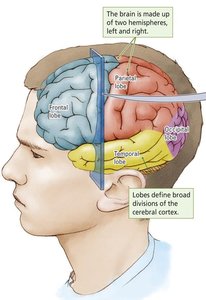
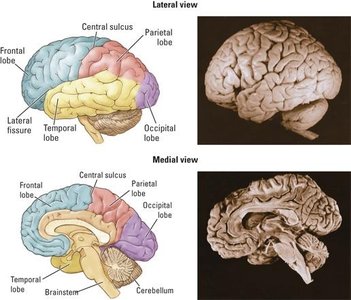
The cerebral cortex is divided into four main lobes, each associated with distinct functions:
Frontal lobe: Motor control, executive function, planning.
Parietal lobe: Sensory integration, touch perception.
Temporal lobe: Auditory processing, memory, taste, smell.
Occipital lobe: Visual processing.

Gyri, Sulci, and Fissures
The surface of the cerebral cortex is highly folded, increasing its surface area.
Gyrus (gyri): Raised bumps or ridges.
Sulcus (sulci): Shallow grooves between gyri.
Fissure: Deep groove, such as the longitudinal fissure separating hemispheres.

Meninges: Protective Coverings of the Brain
The brain is protected by three layers of connective tissue called meninges:
Dura mater: Tough, outermost layer.
Arachnoid membrane: Web-like, middle layer.
Pia mater: Thin, inner layer adhering to the brain's surface.

Internal Features of the Brain
Ventricles and Cerebrospinal Fluid (CSF)
The brain contains four ventricles filled with cerebrospinal fluid (CSF), which cushions and protects neural tissue.
Lateral ventricles (left and right)
Third ventricle
Fourth ventricle
CSF: Circulates in the ventricles and subarachnoid space, providing buoyancy and protection.
Gray Matter, White Matter, and Major Fiber Tracts
Gray matter: Regions rich in neuronal cell bodies and blood vessels.
White matter: Regions rich in myelinated axons (fatty sheaths).
Corpus callosum: Major fiber tract connecting the two cerebral hemispheres.
Microscopic Features: Neurons and Glia
Neurons: Primary cells for information processing (about 80 billion in the human brain).
Glial cells: Support, protect, and modulate neuronal activity (about 100 billion).
Functional Principles of Nervous System Organization
Ten Key Principles
The nervous system produces movement within a perceptual world the brain creates.
The details of nervous-system functioning are constantly changing (neuroplasticity).
Many of the brain’s circuits are crossed (contralateral control).
The CNS functions on multiple levels (hierarchical organization).
The brain is both symmetrical and asymmetrical (lateralization of function).
Brain systems are organized both hierarchically and in parallel.
Sensory and motor divisions exist throughout the nervous system.
Sensory input is divided for object recognition and motor control.
Functions in the brain are both localized and distributed.
The nervous system works by juxtaposing excitation and inhibition.
Summary Table: Divisions of the Nervous System
Division | Main Components | Primary Function |
|---|---|---|
Central Nervous System (CNS) | Brain, Spinal Cord | Mediates behavior |
Somatic Nervous System (SNS) | Cranial nerves, Spinal nerves | Transmits sensation, produces movement |
Autonomic Nervous System (ANS) | Sympathetic and Parasympathetic divisions | Balances internal functions |
Enteric Nervous System (ENS) | Neurons in the gut | Controls the gut |
Key Terms and Concepts
Neuroplasticity: The ability of neural tissue to change structurally and functionally in response to experience.
Gyri and Sulci: Surface features of the cerebral cortex that increase surface area for neural processing.
Meninges: Protective membranes surrounding the brain and spinal cord.
Ventricles: Cavities in the brain filled with cerebrospinal fluid.
Corpus Callosum: Major fiber tract connecting the two hemispheres of the brain.
