 Back
Paper Chromatography of Pigments in Spinach Leaves
Study Guide - Smart Notes
 Tailored notes based on your materials, expanded with key definitions, examples, and context.
Paper Chromatography of Pigments in Spinach Leaves
Introduction to Chromatography
Chromatography is an analytical technique used to separate mixtures into their individual components. In biological contexts, it is commonly used to separate plant pigments, such as those found in spinach leaves, which appear green but actually contain several different colored pigments. The process relies on the differential solubility and affinity of molecules for a stationary phase (paper) and a mobile phase (solvent).
Chromatography: A method for separating and identifying components in a mixture based on their movement through a stationary medium under the influence of a solvent.
Stationary phase: The medium that does not move (chromatography paper).
Mobile phase: The solvent that moves through the stationary phase (e.g., acetone).
Capillary action: The process by which the solvent moves up the paper, carrying dissolved pigments with it.
Principles of Separation
The separation of pigments depends on their solubility in the mobile phase and their affinity for the stationary phase. Pigments with similar polarity to the solvent travel further, while those with greater attraction to the paper move more slowly. The phrase "like dissolves like" summarizes this principle: polar solvents carry polar pigments further, and nonpolar solvents carry nonpolar pigments further.
Polarity: Polar solvents (e.g., water) move polar pigments further; nonpolar solvents (e.g., acetone, ethanol) move nonpolar pigments further.
Rf value (Retention factor): A ratio used to identify pigments, calculated as:
Each pigment has a characteristic Rf value for a given solvent and paper.
Common Plant Pigments
Spinach leaves contain several pigments, each with distinct colors and polarities:
Chlorophyll a: Bright green to blue-green
Chlorophyll b: Yellow-green to olive-green
Carotene: Yellow to yellow-orange
Xanthophyll: Yellow to gray
Materials and Setup
Chromatography paper (stationary phase)
Chromatography chamber (e.g., beaker with lid or foil)
Ruler and pencil (never use pen, as ink may interfere)
Mortar and pestle
Acetone (mobile phase)
Fresh spinach leaves
Anhydrous magnesium sulfate (removes water from leaves)
Experimental Procedure
Grind spinach leaves with magnesium sulfate and acetone to extract pigments.
Prepare chromatography paper, marking a "START" line 1 cm from the base.
Apply a concentrated spot of pigment extract to the paper.
Insert the paper into the chromatography chamber with acetone, ensuring the spot is above the solvent level.
Allow the solvent to rise by capillary action, separating the pigments.
Mark the solvent front and pigment bands immediately after removal.
Identify pigments by color and calculate Rf values.
Results and Data Analysis
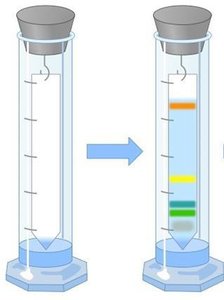
After development, the chromatogram will show separated bands of pigments. The distance each pigment travels is measured from the original spot to the center of each band. The Rf value for each pigment is calculated using the formula above.
Band Color | Plant Pigment | Distance (mm) | Rf Value |
|---|---|---|---|
Yellow to Yellow Orange | Carotene | [measured value] | [calculated value] |
Yellow | Xanthophyll | [measured value] | [calculated value] |
Bright Green to Blue Green | Chlorophyll a | [measured value] | [calculated value] |
Yellow Green to Olive Green | Chlorophyll b | [measured value] | [calculated value] |
Additional info: Actual distances and Rf values will depend on experimental results.
Discussion and Applications
Number of Pigments: The number of spots observed corresponds to the number of pigments separated.
Polarity: The most non-polar pigment (carotene) travels furthest; the most polar (chlorophyll b) travels least.
Use of Pencil: Pencil is used to mark the paper because ink may dissolve in the solvent and interfere with results.
Other Applications: Chromatography can be used to separate other pigment mixtures, such as those in black ink or other plant extracts.
Seasonal Pigment Changes: In maple leaves, green chlorophyll masks orange and red pigments in summer. In fall, chlorophyll degrades, revealing carotenoids and anthocyanins.
Summary Table: Pigment Properties
Pigment | Color | Polarity | Relative Position on Chromatogram |
|---|---|---|---|
Carotene | Yellow to Orange | Non-polar | Furthest from origin |
Xanthophyll | Yellow | Moderately non-polar | Intermediate |
Chlorophyll a | Bright Green | Moderately polar | Intermediate |
Chlorophyll b | Yellow Green | Polar | Closest to origin |
Additional info: Chromatography is widely used in biochemistry for analyzing mixtures, identifying compounds, and purifying substances. The Rf value is a reproducible characteristic for each pigment under fixed conditions, making it useful for identification.
