 Back
Passive Transport and Water Balance in Cells
Study Guide - Smart Notes
 Tailored notes based on your materials, expanded with key definitions, examples, and context.
Passive Transport Across Cell Membranes
Diffusion
Diffusion is a fundamental process by which molecules move from areas of higher concentration to areas of lower concentration, driven by their thermal energy. This movement occurs spontaneously and does not require cellular energy input.
Definition: Diffusion is the movement of particles so they spread out evenly in available space.
Concentration Gradient: Molecules diffuse down their concentration gradient, which is the difference in concentration across a space.
Dynamic Equilibrium: When concentrations are equal, molecules continue to move but there is no net change in concentration.
Example: Oxygen uptake by cells during cellular respiration is driven by diffusion.
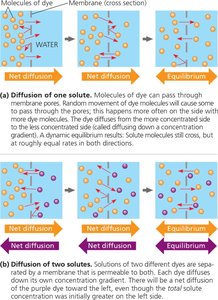
Diffusion of Multiple Solutes
Each solute diffuses independently down its own concentration gradient, unaffected by the gradients of other solutes.
Key Point: The net movement of each solute is determined by its own concentration difference across the membrane.
Osmosis: Diffusion of Water
Mechanism of Osmosis
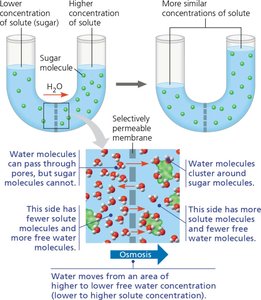
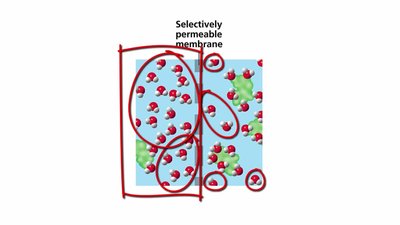
Osmosis is the diffusion of free water molecules across a selectively permeable membrane. Water moves from regions of higher free water concentration (lower solute concentration) to regions of lower free water concentration (higher solute concentration).
Selective Permeability: Membranes allow water to pass but restrict solute movement.
Free Water: Water molecules not bound to solutes are available for diffusion.
Example: In a U-shaped tube, water moves to equalize solute concentrations on both sides.
Water Balance and Tonicity in Cells
Tonicity and Its Effects
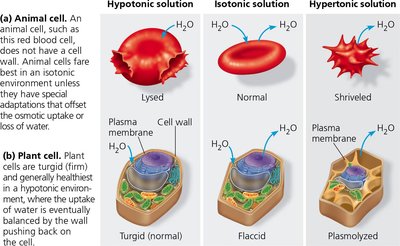
Tonicity describes the ability of a solution to cause a cell to gain or lose water, depending on the concentration of nonpenetrating solutes relative to the cell.
Isotonic Solution: No net movement of water; cell volume remains stable.
Hypertonic Solution: Cell loses water and shrivels.
Hypotonic Solution: Cell gains water, swells, and may burst (lyse).
Osmoregulation
Cells without rigid walls must regulate water balance to survive in non-isotonic environments. Adaptations include specialized structures and mechanisms.
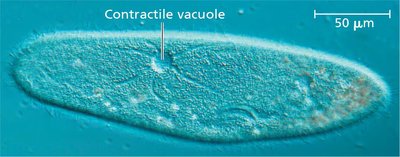
Example: Paramecium caudatum uses a contractile vacuole to expel excess water in hypotonic environments.
Water Balance in Cells with Cell Walls
Plant, Bacterial, and Fungal Cells
Cells with walls, such as plant cells, maintain water balance differently. The cell wall provides structural support and limits excessive swelling.
Turgor Pressure: Pressure exerted by the cell wall when the cell swells, keeping the cell turgid (firm).
Plasmolysis: In hypertonic environments, the plasma membrane pulls away from the cell wall, causing the cell to wilt.
Facilitated Diffusion: Passive Transport Aided by Proteins
Transport Proteins
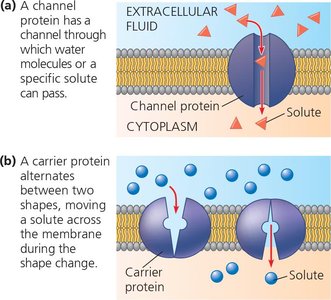
Many polar molecules and ions cross membranes via facilitated diffusion, which is aided by specific transport proteins. This process is still passive and does not require energy.
Channel Proteins: Provide corridors for specific molecules or ions to cross the membrane rapidly.
Carrier Proteins: Undergo shape changes to move molecules across the membrane.
Aquaporins: Specialized channel proteins for water, allowing rapid osmosis.
Ion Channels and Gated Channels
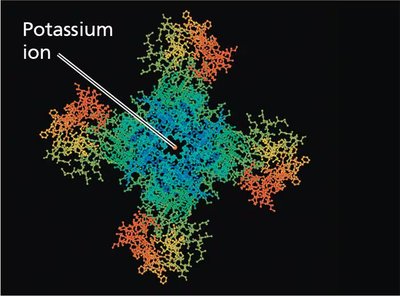
Ion channels are a type of channel protein that transport ions. Many are gated, opening or closing in response to electrical or chemical stimuli.
Example: Potassium ion channels in nerve cells open in response to electrical signals.
Carrier Proteins and Glucose Transport
Carrier proteins, such as glucose transporters, change shape to move molecules across the membrane. Facilitated diffusion via carrier proteins is specific and efficient.

Scientific Skills Exercise: Glucose Uptake in Red Blood Cells
Experimental Data
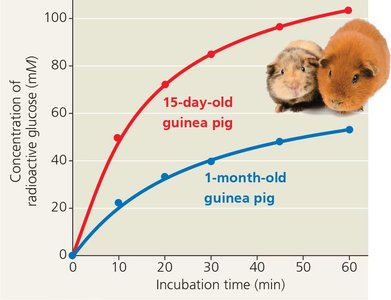
Researchers measured glucose uptake in red blood cells from guinea pigs of different ages, using radioactive glucose. The data show differences in uptake rates between younger and older cells.
Independent Variable: Incubation time (min).
Dependent Variable: Concentration of radioactive glucose inside cells (mM).
Observation: 15-day-old guinea pig cells uptake glucose faster than 1-month-old cells.
Incubation Time (min) | Glucose Uptake (15-day-old, mM) | Glucose Uptake (1-month-old, mM) |
|---|---|---|
0 | 0 | 0 |
10 | ~40 | ~20 |
30 | ~80 | ~40 |
60 | ~100 | ~60 |
Hypothesis and Experiment Design
Hypothesis: Younger red blood cells have more or more active glucose transporters, leading to higher uptake rates.
Experiment Design: Compare transporter protein expression or activity in cells from different ages using biochemical assays.
Summary Table: Types of Passive Transport
Type | Mechanism | Energy Required? | Example |
|---|---|---|---|
Simple Diffusion | Direct movement across membrane | No | O2 uptake |
Osmosis | Diffusion of water | No | Water balance in cells |
Facilitated Diffusion | Via channel/carrier proteins | No | Glucose transport |
Additional info: Passive transport is essential for maintaining cellular homeostasis and is regulated by membrane permeability and protein channels.
