 Back
BackPatterns of Blood Pressure and Flow: Structure and Function of Blood Vessels
Study Guide - Smart Notes
 Tailored notes based on your materials, expanded with key definitions, examples, and context.
Patterns of Blood Pressure and Flow Reflect the Structure and Arrangement of Blood Vessels
Blood Vessel Structure and Function
The vertebrate circulatory system relies on a network of blood vessels whose structure is closely matched to their function. All blood vessels contain a central lumen lined with an endothelium, a single layer of flattened epithelial cells that minimizes resistance to fluid flow. The tissue layers surrounding the endothelium differ among capillaries, arteries, and veins, reflecting their specialized roles.
Capillaries: The smallest blood vessels, with walls consisting only of endothelium and a basal lamina. Their thin walls allow for the exchange of substances between blood and interstitial fluid.
Arteries: Have thick, strong, and elastic walls composed of connective tissue (with elastic fibers and collagen) and smooth muscle. These adaptations allow arteries to withstand and regulate high-pressure blood flow from the heart.
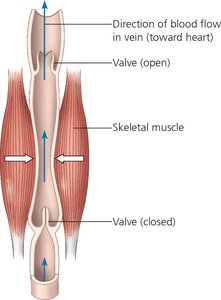
Veins: Convey blood back to the heart at lower pressure and have thinner walls than arteries. Veins contain valves to maintain unidirectional blood flow despite low pressure.
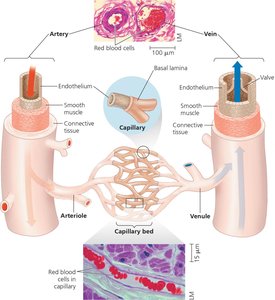
Example: The presence of valves in veins is crucial for returning blood to the heart, especially from the lower extremities, where gravity opposes upward flow.
Blood Flow Velocity
Blood flow velocity is influenced by the diameter and number of blood vessels. As blood moves from arteries to arterioles and then to the vast network of capillaries, the total cross-sectional area increases dramatically, causing a significant decrease in velocity. This slow flow in capillaries facilitates efficient exchange of materials with tissues.
Key Point: The velocity of blood flow is inversely related to the total cross-sectional area of the vessels.
Example: Water flows faster through a hose than through a wide, flat pan; similarly, blood slows in capillaries due to their collective large area.
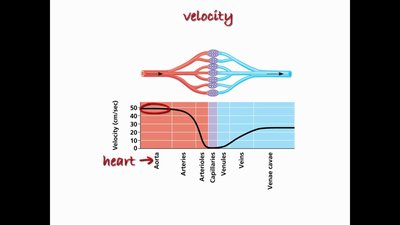
The Interrelationship of Cross-Sectional Area, Blood Flow Velocity, and Blood Pressure
As blood moves through the circulatory system, the cross-sectional area, velocity, and pressure change in predictable ways. The greatest cross-sectional area is found in the capillaries, where velocity is lowest and pressure drops significantly due to resistance.
Systolic Pressure: The highest arterial pressure during ventricular contraction.
Diastolic Pressure: The lower pressure during ventricular relaxation.
Elastic Recoil: The elastic walls of arteries help maintain blood pressure during diastole.
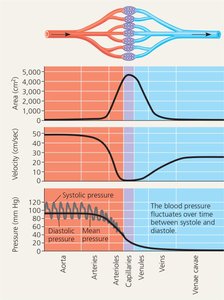
Additional info: Blood pressure is highest in the aorta and arteries, and lowest in the veins and venae cavae.
Regulation of Blood Pressure
Blood pressure is regulated by homeostatic mechanisms, including changes in arteriole diameter and cardiac output. Vasoconstriction (narrowing of arterioles) increases blood pressure, while vasodilation (widening of arterioles) decreases it. Nitric oxide is a major vasodilator, and endothelin is a potent vasoconstrictor.
Cardiac Output: The volume of blood the heart pumps per minute also affects blood pressure.
Example: During exercise, arterioles in muscles dilate, and cardiac output increases to maintain blood pressure and supply oxygen-rich blood.
Blood Pressure and Gravity
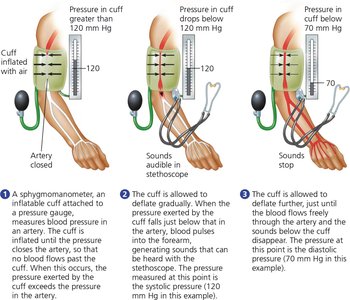
Gravity affects blood pressure, especially in upright animals. Blood pressure is typically measured in the arm at heart level using a sphygmomanometer. When standing, arterial pressure in the brain is lower than at the heart due to gravity. Fainting can occur if brain blood pressure drops too low, as the body collapses to restore blood flow to the brain.
Valves in Veins: Prevent backflow and assist in returning blood to the heart, especially from the legs.
Skeletal Muscle Contraction: Squeezes veins, aiding venous return during movement.
Capillary Function and Regulation of Blood Flow
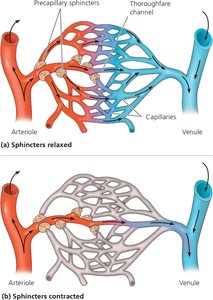
Not all capillaries are filled with blood at all times. Blood flow in capillary beds is regulated by constriction or dilation of arterioles and by precapillary sphincters, which are rings of smooth muscle at the entrance to capillary beds. These mechanisms direct blood flow according to tissue needs.
Example: After a meal, blood flow increases to the digestive tract; during exercise, it is redirected to skeletal muscles.
Local Regulation: Chemicals like histamine can cause vasodilation and increase blood flow to specific areas.
Fluid Exchange Between Capillaries and Interstitial Fluid
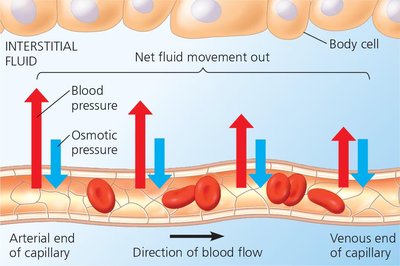
Exchange of substances between blood and tissues occurs across capillary walls. Two main forces control fluid movement:
Blood Pressure: Drives fluid out of capillaries into tissues.
Osmotic Pressure: Due to blood proteins, pulls fluid back into capillaries.
On average, blood pressure exceeds osmotic pressure, resulting in a net loss of fluid from capillaries.
Fluid Return by the Lymphatic System
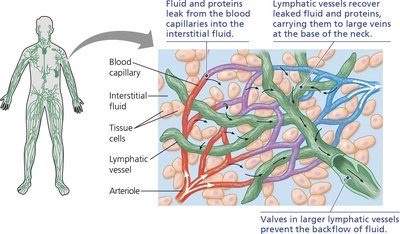
The lymphatic system recovers fluid and proteins lost from capillaries and returns them to the blood. Fluid enters lymphatic vessels, becoming lymph, which is filtered through lymph nodes before rejoining the circulatory system. Lymphatic vessels have valves and rely on skeletal muscle contractions for movement, similar to veins.
Lymph Nodes: Filter lymph and are sites of immune cell activity.
Edema: Disruption of lymph flow can cause fluid accumulation in tissues.
Clinical Note: Swollen lymph nodes may indicate infection or cancer metastasis.
Additional info: The lymphatic system also plays a role in immune responses and is a focus of biomedical research for conditions like asthma and lymphedema.
Concept Check
What is the primary cause of the low velocity of blood flow in capillaries? The enormous total cross-sectional area of capillaries causes blood flow velocity to decrease, allowing efficient exchange of materials.
What short-term changes in an animal’s cardiovascular function might facilitate using skeletal muscles to escape from a dangerous situation? Increased cardiac output and vasodilation of arterioles supplying skeletal muscles increase blood flow and oxygen delivery to muscles.
WHAT IF? If you had additional hearts distributed throughout your body, what would be one likely advantage and one likely disadvantage? Advantage: More efficient distribution of blood to distant tissues. Disadvantage: Potential for uncoordinated blood flow and increased risk of circulatory complications.
