 Back
BackPatterns of Inheritance and Genetic Principles
Study Guide - Smart Notes
 Tailored notes based on your materials, expanded with key definitions, examples, and context.
Genetics and Heredity
Introduction to Mendelian Genetics
Mendelian genetics forms the foundation of our understanding of heredity, describing how traits are passed from parents to offspring through genes. Gregor Mendel's experiments with pea plants established the basic laws of inheritance.
Gene: A unit of heredity that encodes information for a specific trait.
Allele: Alternate forms of a gene found at the same locus on homologous chromosomes.
Genotype: The genetic makeup of an organism (e.g., PP, Pp, pp).
Phenotype: The observable characteristics of an organism.
Mendel’s Law of Segregation
Mendel’s law of segregation states that pairs of alleles separate during gamete formation, and fertilization restores the paired condition in offspring.
Meiosis: The process by which diploid cells produce haploid gametes, separating allele pairs.
Fertilization: The union of gametes restores paired alleles in the zygote.
Example: In pea plants, the allele for purple flowers (P) and the allele for white flowers (p) segregate during gamete formation. 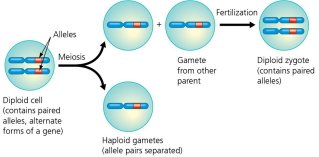
Mendel’s Law of Independent Assortment
This law states that alleles of different genes assort independently during gamete formation, leading to genetic variation.
Genes located on different chromosomes are inherited independently.
Independent assortment explains the diversity of traits observed in offspring.
Using a Testcross to Determine Genotype
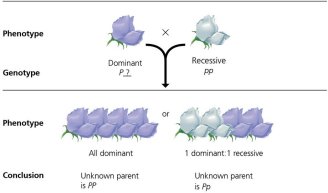
A testcross is used to determine the genotype of an individual with a dominant phenotype by crossing it with a homozygous recessive individual.
If all offspring display the dominant phenotype, the unknown parent is homozygous dominant.
If offspring display a 1:1 ratio of dominant to recessive phenotypes, the unknown parent is heterozygous.
The Rules of Probability in Inheritance
Inheritance follows the rules of probability, especially the rule of multiplication for independent events.
The probability of inheriting a recessive allele from one heterozygous parent is .
The probability of inheriting recessive alleles from both parents is .
Human Traits and Genetic Disorders
Single-Gene Traits and Disorders
Many human traits and disorders are controlled by a single gene with two alleles.
Wild type: The most common phenotype in a population.
Autosomal recessive disorders: Require two recessive alleles (e.g., cystic fibrosis).
Autosomal dominant disorders: Require only one dominant allele (e.g., Huntington’s disease).
Family Pedigrees
Pedigrees are diagrams used to trace inheritance patterns and determine genotypes within families.
Pedigrees help identify carriers and affected individuals for genetic disorders.
Variations on Mendel’s Laws
Incomplete Dominance
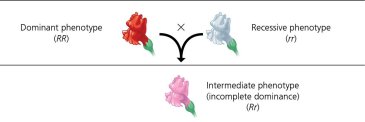
In incomplete dominance, the heterozygote displays an intermediate phenotype between the dominant and recessive forms.
Example: Crossing red (RR) and white (rr) flowers produces pink (Rr) flowers.
Multiple Alleles and Codominance
Some traits are controlled by more than two alleles, and in codominance, both alleles are fully expressed in the heterozygote.
Example: ABO blood groups in humans involve three alleles (IA, IB, i).
Pleiotropy
Pleiotropy occurs when one gene affects multiple traits.
Example: The sickle-cell gene affects red blood cell shape and multiple symptoms.
Polygenic Inheritance
Polygenic inheritance involves multiple genes contributing to a single trait, resulting in continuous variation.
Example: Human skin color and height.
Epigenetics and Environmental Influence
Epigenetic Inheritance
Epigenetics refers to heritable changes in gene expression caused by chemical modifications to DNA and proteins, often influenced by environmental factors.
Epigenetic changes can affect traits without altering the DNA sequence.
Chromosomal Basis of Inheritance
Genes and Chromosomes
Genes are located on chromosomes, and their behavior during meiosis and fertilization explains inheritance patterns.
Linked genes are inherited together because they are close on the same chromosome.
Sex Determination in Humans
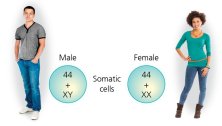
Sex is determined by the presence or absence of the Y chromosome.
Females have two X chromosomes (XX).
Males have one X and one Y chromosome (XY).
Sex-Linked Genes and Traits
Genes located on the X chromosome exhibit unique inheritance patterns.
Females have two X chromosomes, males have one X and one Y.
Most sex-linked disorders are due to recessive alleles and are more common in males.
Examples: Red-green colorblindness, hemophilia.
Sex-Linked Trait Table
Sex | Genotype | Phenotype |
|---|---|---|
Female | XNXN | Normal female |
Female | XNXn | Carrier female |
Female | XnXn | Affected female (rare) |
Male | XNY | Normal male |
Male | XnY | Affected male |
Example: A male receiving a single sex-linked recessive allele from his mother will have the disorder; a female must receive the allele from both parents to be affected.
Additional info: Academic context was added to clarify definitions, examples, and inheritance mechanisms for completeness.
