 Back
Patterns of Inheritance: Mendelian Genetics and Beyond
Study Guide - Smart Notes
 Tailored notes based on your materials, expanded with key definitions, examples, and context.
Patterns of Inheritance
Introduction to Genetics
Genetics is the scientific study of heredity, focusing on how traits are transmitted from one generation to the next. The field explains why offspring resemble their parents and how genetic disorders can become common through inbreeding. Both genes and the environment influence an organism's traits.
Heredity: Transmission of traits from parents to offspring.
Genetics: Study of heredity and variation in organisms.
Example: Purebred dogs inherit predictable traits from their parents.
Gregor Mendel and the Foundations of Genetics
Gregor Mendel, working in the 1860s, was the first to analyze patterns of inheritance and deduce the fundamental principles of genetics. He used garden peas for his experiments due to their ease of manipulation and distinct varieties.
Character: A heritable feature that varies among individuals (e.g., pea color).
Trait: A variant of a character (e.g., yellow or green peas).
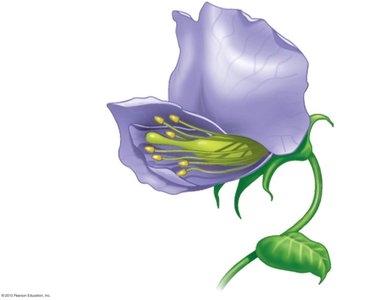
Image explanation: The diagram shows the structure of a pea flower, highlighting the carpel (produces eggs) and stamen (produces pollen), which are essential for Mendel's controlled breeding experiments.
Mendel's Experimental Approach
Mendel created true-breeding varieties and crossed them to produce hybrids. The parental generation (P) produces the first filial generation (F1), and crossing F1 individuals yields the second filial generation (F2).
True-breeding: Plants that produce offspring identical to themselves when self-pollinated.
Hybrid: Offspring of two different true-breeding varieties.
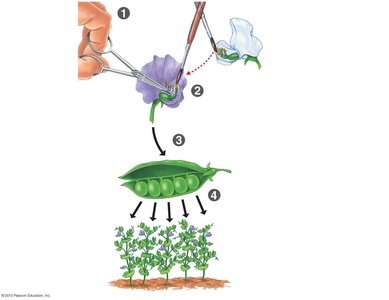
Image explanation: This image illustrates the steps of Mendel's cross-pollination experiment: removing stamens, transferring pollen, developing pods, and growing offspring.
Mendelian Laws of Inheritance
Law of Segregation
Mendel tracked inheritance of characters with two alternative traits and formulated the law of segregation, which states that allele pairs separate during gamete formation (meiosis), so each gamete carries only one allele for each gene.
Allele: Alternative versions of a gene.
Homozygous: Two identical alleles for a gene.
Heterozygous: Two different alleles for a gene.
Dominant allele: Expressed in the phenotype when present (capital letter).
Recessive allele: Masked by the dominant allele (lowercase letter).
Monohybrid Crosses
A monohybrid cross examines the inheritance of a single character. Mendel observed a 3:1 ratio of dominant to recessive phenotypes in the F2 generation.
Punnett Square: Diagram used to predict genotype and phenotype ratios of offspring.
Genotype: Genetic makeup (e.g., PP, Pp, pp).
Phenotype: Observable traits (e.g., purple or white flowers).

Image explanation: The Punnett square shows the segregation of alleles and the resulting genotypic and phenotypic ratios in the F2 generation.
Law of Independent Assortment
Mendel's dihybrid crosses (crosses involving two characters) led to the law of independent assortment, which states that each pair of alleles segregates independently during gamete formation. This explains the 9:3:3:1 phenotypic ratio in F2 generations for two traits.
Dihybrid cross: Cross between individuals differing in two characters.
Independent assortment: Inheritance of one character does not affect the inheritance of another.
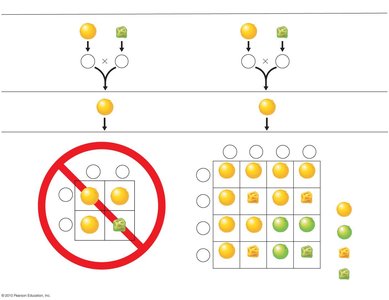
Image explanation: The diagram compares dependent and independent assortment, showing how alleles segregate to produce different combinations in offspring.
Genetics in Animals: Labrador Retrievers Example
Application of Mendelian Principles
Inheritance patterns in Labrador retrievers demonstrate Mendelian genetics, including independent assortment and the effects of multiple genes on traits such as coat color and vision.
Phenotype: Black or chocolate coat, normal vision or blindness (PRA).
Genotype: Combinations of alleles for coat color and vision.
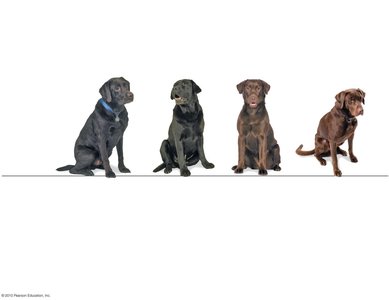
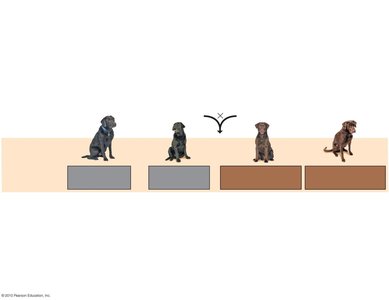
Image explanation: The images show the range of phenotypes and the expected ratios from a dihybrid cross in Labradors.
Genetic Testing and Human Inheritance
Pedigree Analysis
Pedigrees are diagrams that show the inheritance of traits in families, helping geneticists determine genotypes and predict inheritance patterns for dominant and recessive traits.
Dominant trait: Expressed if at least one dominant allele is present.
Recessive trait: Expressed only if both alleles are recessive.
Carrier: Heterozygous individual carrying a recessive allele without showing the trait.
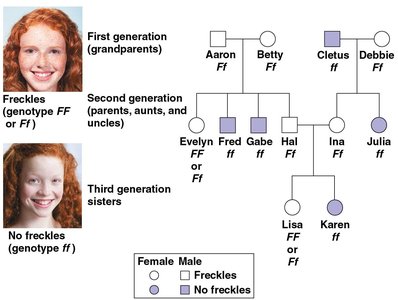
Image explanation: The pedigree chart traces the inheritance of freckles, a dominant trait, through three generations.
Human Genetic Disorders
Some human disorders are caused by single genes. Most are recessive (e.g., cystic fibrosis), but some are dominant (e.g., Huntington's disease, achondroplasia). Inbreeding increases the risk of recessive disorders.
Recessive disorder: Requires two copies of the mutant allele (e.g., cystic fibrosis).
Dominant disorder: Expressed with one copy of the mutant allele (e.g., Huntington's disease).
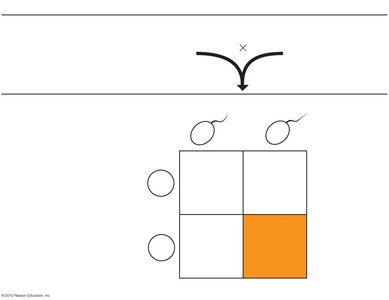
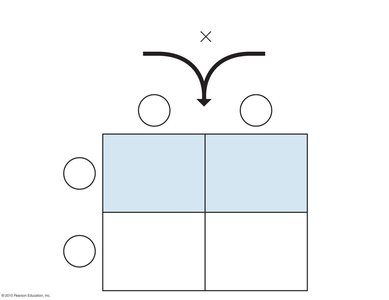
Image explanation: The diagrams show inheritance patterns for recessive and dominant genetic disorders.
Variations on Mendel's Laws
Incomplete Dominance
In incomplete dominance, heterozygotes have a phenotype intermediate between the two homozygotes. An example is the pink flower color in snapdragons from red and white parents.
Incomplete dominance: Neither allele is completely dominant; heterozygote shows intermediate phenotype.
Multiple Alleles and Codominance
Some genes have more than two alleles, and some alleles are codominant, meaning both are fully expressed in heterozygotes. The ABO blood group system in humans is a classic example.
Multiple alleles: More than two possible alleles for a gene (e.g., IA, IB, i for blood type).
Codominance: Both alleles are expressed equally (e.g., AB blood type).
Blood Group (Phenotype) | Genotypes | Red Blood Cell Antigens |
|---|---|---|
O | ii | None |
A | IAIA or IAi | A antigen |
B | IBIB or IBi | B antigen |
AB | IAIB | A and B antigens |
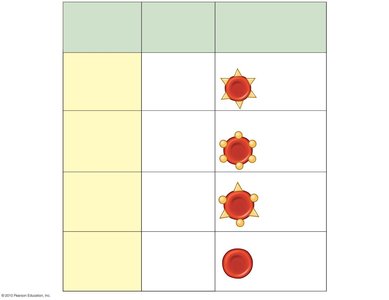
Image explanation: The table summarizes the genotypes and antigens for each human blood group.
Pleiotropy
Pleiotropy occurs when a single gene affects multiple traits. Sickle-cell disease is an example, where one gene mutation leads to various symptoms affecting different body systems.
Pleiotropy: One gene influences multiple phenotypic traits.
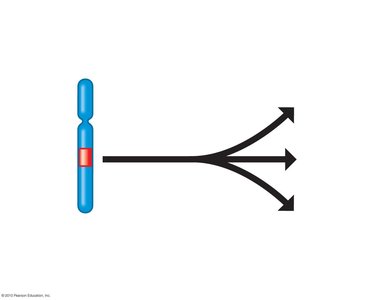
Image explanation: The diagram illustrates how a single gene can result in multiple phenotypic effects, as seen in sickle-cell disease.
Polygenic Inheritance
Polygenic inheritance involves multiple genes contributing to a single trait, resulting in continuous variation (e.g., human skin color).
Polygenic inheritance: Additive effects of two or more genes on a single phenotype.
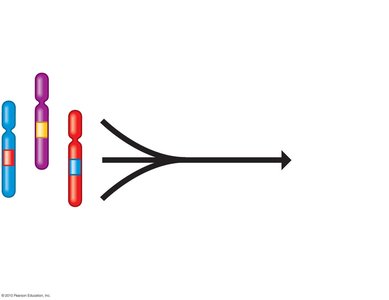
Image explanation: The diagram shows how multiple genes contribute to a single phenotype, such as skin color.
The Chromosomal Basis of Inheritance
Chromosome Theory of Inheritance
The chromosome theory of inheritance states that genes are located on chromosomes, and their behavior during meiosis and fertilization explains inheritance patterns. Chromosomes undergo segregation and independent assortment, accounting for Mendel's laws.
Linked Genes and Genetic Recombination
Linked genes are located close together on the same chromosome and tend to be inherited together. Crossing over during meiosis can separate linked alleles, producing recombinant chromosomes and phenotypes.
Linkage map: Diagram showing the relative positions of genes on a chromosome based on recombination frequencies.
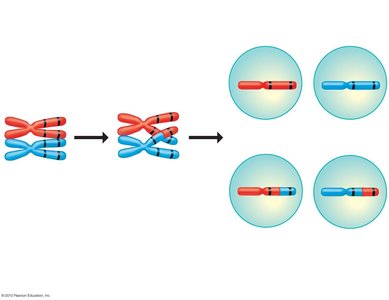
Image explanation: The image shows how crossing over between homologous chromosomes creates recombinant gametes.
Sex Chromosomes and Sex-Linked Genes
Sex Determination
In mammals, sex is determined by the presence of X and Y chromosomes. Males are XY, and females are XX. Sex-linked genes are located on sex chromosomes, with most found on the X chromosome.
Sex-linked gene: Gene located on a sex chromosome (usually X).
Example: Red-green color blindness and hemophilia are X-linked recessive traits.
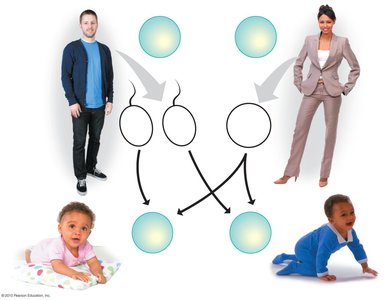
Image explanation: The diagram shows how sex chromosomes are inherited and determine the sex of offspring.
Major Themes in Genetics
Relationship of structure to function: Changes in protein structure (e.g., sickle-cell hemoglobin) affect function.
Information flow: Genes are transmitted from parents to offspring via chromosomes.
Interactions within biological systems: Traits like skin color result from multiple proteins and environmental factors.
Evolution: Genetic variation and inheritance drive evolutionary processes.
