 Back
Patterns of Inheritance: Mendelian Genetics and Beyond
Study Guide - Smart Notes
 Tailored notes based on your materials, expanded with key definitions, examples, and context.
Patterns of Inheritance
Introduction to Genetics and Heredity
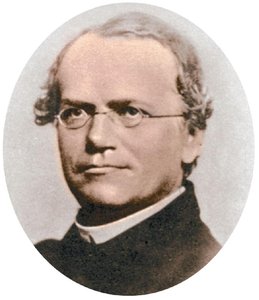
Genetics is the scientific study of heredity, the process by which traits are passed from parents to offspring. The foundational principles of genetics were established by Gregor Mendel in the 1860s through his experiments with garden peas. Mendel discovered that traits are inherited as discrete units, now known as genes, which retain their identity across generations.
Heredity: Transmission of traits from one generation to the next.
Genetics: The study of heredity and variation in organisms.
Gene: A unit of heredity that encodes information for a specific trait.
Mendel’s Experimental Model: The Garden Pea
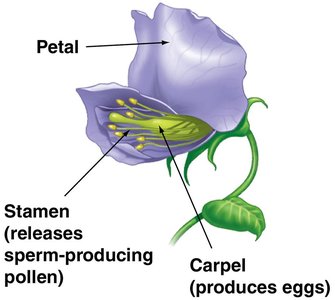
Mendel chose the garden pea (Pisum sativum) for his experiments due to its many distinct varieties and the ability to control its fertilization. He studied characters (heritable features) that occurred in two distinct forms, called traits.
Character: A heritable feature (e.g., flower color).
Trait: A variant of a character (e.g., purple or white flowers).
Mendel’s Experimental Techniques
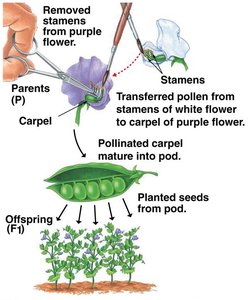
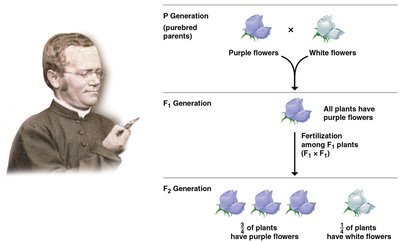
Mendel performed controlled crosses between purebred varieties, producing hybrids. The parental generation is called the P generation, their offspring the F1 generation, and the next generation the F2 generation.
Hybrid: Offspring of two different purebred varieties.
Genetic cross: The deliberate mating of two different individuals.
The Seven Characters Studied by Mendel
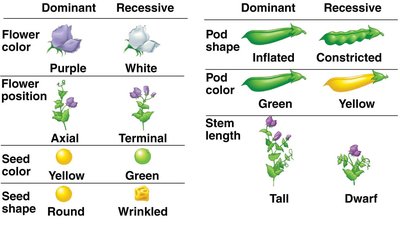
Mendel analyzed seven characters, each with two contrasting traits, such as flower color (purple/white), seed shape (round/wrinkled), and pod color (green/yellow).
Mendel’s Laws of Inheritance
Law of Segregation
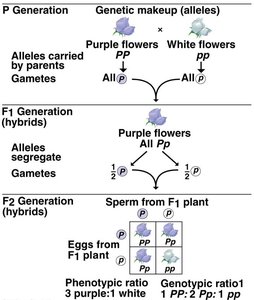
Mendel’s experiments led to the formulation of the law of segregation, which states that allele pairs separate during gamete formation and reunite at fertilization. This explains why traits can disappear in one generation and reappear in the next.
Allele: Alternative versions of a gene.
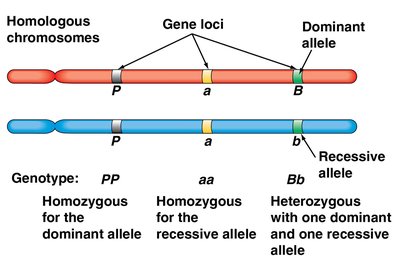
Homozygous: Having two identical alleles for a gene.
Heterozygous: Having two different alleles for a gene.
Dominant allele: Determines the organism’s appearance.
Recessive allele: Has no noticeable effect when the dominant allele is present.
Relationship Between Alleles and Chromosomes
Genes are located on chromosomes at specific loci. Homologous chromosomes carry alleles for the same genes, which may be identical or different.
Law of Independent Assortment
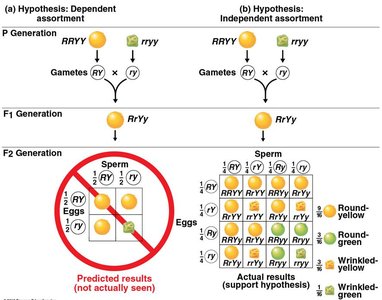
Mendel’s law of independent assortment states that each pair of alleles segregates independently of other pairs during gamete formation. This law is observed in dihybrid crosses, where two characters are followed simultaneously.
Monohybrid cross: Cross between individuals heterozygous for one character.
Dihybrid cross: Cross between individuals heterozygous for two characters.
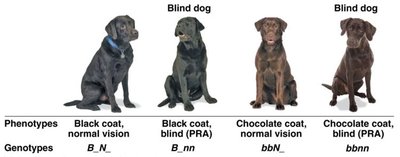
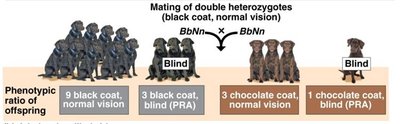
Testcrosses
A testcross is used to determine the genotype of an individual with a dominant phenotype by crossing it with a homozygous recessive individual.
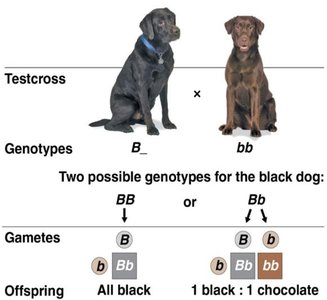
Probability in Genetics
Genetic crosses follow the rules of probability. The rule of multiplication states that the probability of a compound event is the product of the probabilities of its independent components.
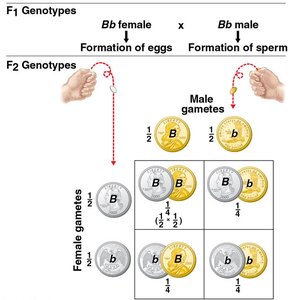
Human Genetics and Pedigrees
Family Pedigrees
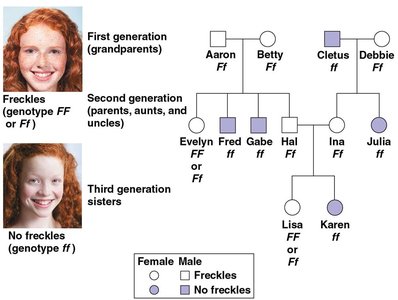
Pedigrees are family trees that show the inheritance of traits across generations. They help geneticists deduce genotypes and predict inheritance patterns.
Single-Gene Human Traits
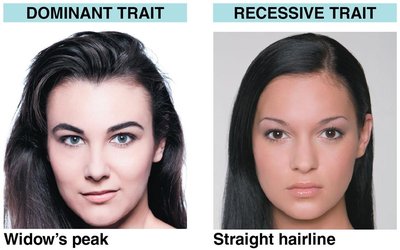
Some human traits, such as freckles and widow’s peak, are controlled by single genes and follow Mendelian inheritance patterns.
Autosomal Disorders
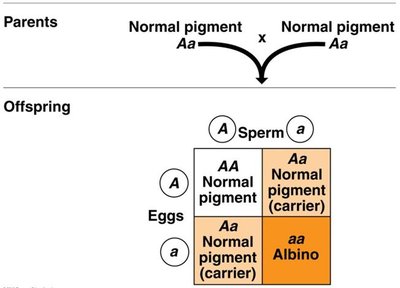
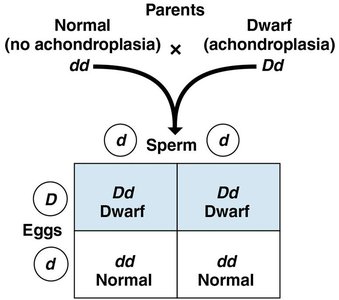
Genetic disorders can be caused by recessive or dominant alleles. Recessive disorders require two copies of the mutant allele, while dominant disorders require only one.
Disorder | Type | Major Symptoms |
|---|---|---|
Albinism | Recessive | Lack of pigment in skin, hair, and eyes |
Cystic fibrosis | Recessive | Excess mucus in lungs, digestive tract, liver; increased infections |
Phenylketonuria (PKU) | Recessive | Accumulation of phenylalanine; developmental disabilities |
Sickle-cell disease | Recessive | Misshapen red blood cells; tissue damage |
Tay-Sachs disease | Recessive | Lipid accumulation in brain cells; early death |
Achondroplasia | Dominant | Dwarfism |
Alzheimer's disease (one type) | Dominant | Mental deterioration |
Huntington's disease | Dominant | Uncontrollable movements; cognitive impairments |
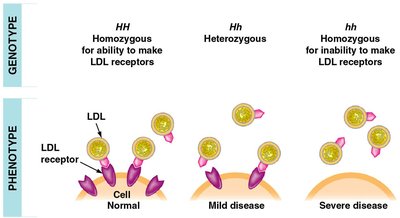
Hypercholesterolemia | Dominant | Excess cholesterol; heart disease |

Beyond Mendel: Complex Patterns of Inheritance
Incomplete Dominance
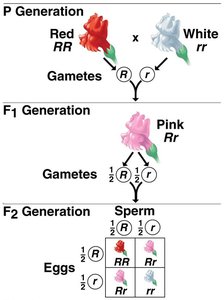
In incomplete dominance, heterozygotes have a phenotype intermediate between the two parental phenotypes. An example is hypercholesterolemia in humans.
Multiple Alleles and Codominance: ABO Blood Groups
The ABO blood group system in humans is determined by three alleles (IA, IB, i), resulting in four blood types (A, B, AB, O). IA and IB are codominant, while i is recessive.
Genotype | Phenotype (Blood Type) |
|---|---|
IAIA or IAi | A |
IBIB or IBi | B |
IAIB | AB |
ii | O |
Pleiotropy
Pleiotropy occurs when one gene influences multiple phenotypic traits. Sickle-cell disease is a classic example, affecting hemoglobin structure and causing multiple symptoms.
Polygenic Inheritance
Polygenic inheritance involves the additive effects of two or more genes on a single phenotypic character, such as human height or skin color. Many common diseases also show polygenic inheritance.
Epigenetics and Environmental Influence
Phenotypic expression can be influenced by both genetic and environmental factors. Epigenetic inheritance involves changes in gene activity not caused by changes in DNA sequence, such as chemical modifications to DNA or histones.
The Chromosomal Basis of Inheritance
Chromosome Theory of Inheritance
Genes are located on chromosomes, and the behavior of chromosomes during meiosis explains Mendel’s laws. Chromosomes undergo segregation and independent assortment, accounting for inheritance patterns.
Linked Genes
Linked genes are located close together on the same chromosome and tend to be inherited together, often violating Mendel’s law of independent assortment.
Sex Determination and Sex-Linked Genes
Sex in humans is determined by the presence of X and Y chromosomes. Genes located on sex chromosomes are called sex-linked genes. Many sex-linked traits, such as red-green colorblindness and hemophilia, are more common in males due to the presence of only one X chromosome.
Applications and Evolutionary Connections
Genetic Testing
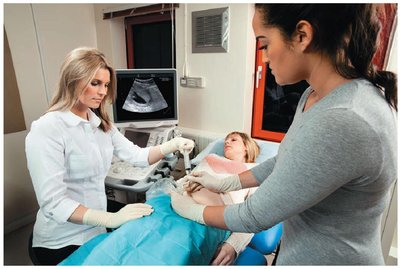
Modern genetic testing allows for the detection of genetic disorders before birth using techniques such as amniocentesis and chorionic villus sampling. Noninvasive methods are increasingly used for safer and earlier diagnosis.
Evolutionary Insights from Genetics
Genetic analysis and genome sequencing have provided insights into the evolution of species, such as the domestication and diversification of dog breeds.
Summary Table: Key Terms and Concepts
Term | Definition |
|---|---|
Gene | Unit of heredity encoding a trait |
Allele | Alternative form of a gene |
Homozygous | Two identical alleles for a gene |
Heterozygous | Two different alleles for a gene |
Dominant | Allele that determines phenotype in heterozygotes |
Recessive | Allele masked in heterozygotes |
Pleiotropy | One gene affects multiple traits |
Polygenic inheritance | Multiple genes affect one trait |
Epigenetics | Heritable changes not involving DNA sequence |
