 Back
BackPatterns of Inheritance: Mendelian Genetics, Probability, and Pedigree Analysis
Study Guide - Smart Notes
 Tailored notes based on your materials, expanded with key definitions, examples, and context.
Patterns of Inheritance
Introduction to Mendelian Genetics
Mendelian genetics forms the foundation of classical inheritance, describing how traits are passed from parents to offspring through discrete units called genes. Gregor Mendel's experiments with pea plants established the basic principles of heredity, including the concepts of dominant and recessive alleles, segregation, and independent assortment.
Mendel and Pea Plants
Unique Aspects of Mendel’s Studies
Controlled Crosses: Mendel used true-breeding pea plants and controlled pollination to study inheritance patterns.
Quantitative Analysis: He counted offspring and analyzed ratios, allowing him to deduce patterns of inheritance.
Example Character and Traits
Character: Flower color
Traits: Purple flowers, white flowers
Mendel’s Experiments and Conclusions
True-breeding: Plants that produce offspring of the same variety when self-pollinated.
P-generation: Parental generation, true-breeding for a trait (e.g., PP x pp).
F1 generation: First filial generation, all heterozygous (e.g., Pp), showing the dominant trait.
F2 generation: Second filial generation, produced by selfing F1 individuals.
Surprise in F2: Reappearance of the recessive trait in a 3:1 ratio (dominant:recessive).
Explanation: Traits are determined by pairs of alleles that segregate during gamete formation.
Law of Segregation: Each individual has two alleles for each gene, which segregate during meiosis so that each gamete carries only one allele for each gene.
Traits and Alleles
Definitions and Key Concepts
Alleles: Alternative forms of a gene found at the same locus on homologous chromosomes.
Purple allele: Produces purple pigment in flowers.
White allele: Nonfunctional enzyme, no pigment produced.
Locus: The specific location of a gene on a chromosome.
Diploids: Have two alleles per character (one from each parent).
Haploids: Have one allele per character (e.g., gametes).
Allele Segregation During Meiosis
During meiosis, homologous chromosomes (and thus alleles) separate, ensuring each gamete receives only one allele per gene.
Solving Heredity Problems: Monohybrid Crosses
Monohybrid Crosses
Monohybrid crosses involve a single character with two alleles. The following steps are used to solve genetics problems:
Write allele and genotype keys
Determine genotypes of the parents
Determine gametes produced by each parent
Show fertilization using a Punnett square
Key Terms
Genotype: The genetic makeup (e.g., PP, Pp, pp)
Phenotype: The observable trait (e.g., purple or white flowers)
Practice Problem 1: Parental Cross
Cross: White (pp) x Homozygous purple (PP)
Genotype ratio: 100% Pp
Phenotype ratio: 100% purple
Practice Problem 2: F1 Cross
Cross: Heterozygous (Pp) x Heterozygous (Pp)
Genotype ratio: 1 PP : 2 Pp : 1 pp
Phenotype ratio: 3 purple : 1 white
Practice Problem 3: Test Cross
Test cross: Crossing an individual with a dominant phenotype (unknown genotype) with a homozygous recessive individual to determine genotype.
Application: If all offspring are dominant, parent is homozygous; if 1:1 ratio, parent is heterozygous.
Dihybrid Crosses and Independent Assortment
Dihybrid Crosses
Dihybrid crosses track two characters simultaneously (e.g., seed color and shape). Each parent can produce multiple types of gametes due to independent assortment.
Genotype AABB: Represents two characters, both homozygous dominant.
Genotype AB: Represents a gamete (haploid).
Genotype AA: Not a gamete; gametes have one allele per gene.
FOIL technique: Used to determine all possible gametes from a parent with genotype AaBb (AB, Ab, aB, ab).
Practice Problem: Dihybrid Cross (YYRR x yyrr)
All offspring: YyRr (heterozygous for both traits)
Phenotype: All yellow and round
Practice Problem: F1 Dihybrid Cross (YyRr x YyRr)
Phenotype ratio: 9 yellow round : 3 yellow wrinkled : 3 green round : 1 green wrinkled
Independent Assortment
Meiosis phase: Metaphase I is associated with independent assortment.
Number of gamete types: For two heterozygous genes, four types of gametes are formed.
F2 phenotype ratio: 9:3:3:1 for two heterozygous parents.
Rules of Probability
Used to predict the likelihood of specific genotypes or phenotypes in offspring, especially in complex crosses.
Product rule: Probability of independent events occurring together is the product of their individual probabilities.
Pedigree Analysis
Understanding Pedigrees
Pedigrees: Diagrams that show inheritance patterns of traits across generations in families.
Generations: Top row is generation I, next is II, and so on.
Affected individuals: Usually shaded symbols.
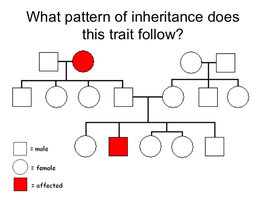
Pedigree Practice Problem 1: Tay Sachs Disease
Pattern: Recessive inheritance (affected individuals are often born to unaffected parents).
Genotype of affected individual in generation I: Homozygous recessive (e.g., tt).
Genotype of female in generation II with children: Likely heterozygous if she has both affected and unaffected offspring.
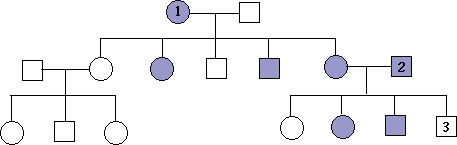
Pedigree Practice Problem 2: Achondroplasia Dwarfism
Pattern: Dominant inheritance (affected individuals appear in every generation).
Genotypes:
Individual 1: Heterozygous dominant (Dd)
Individual 2: Heterozygous dominant (Dd)
Individual 3: Homozygous recessive (dd)
Determining Inheritance Patterns from Pedigrees
Dominant traits: Appear in every generation; affected individuals have at least one affected parent.
Recessive traits: May skip generations; affected individuals can have unaffected parents.
Beyond Mendel: Non-Mendelian Inheritance
Vocabulary | Description | Example |
|---|---|---|
Multiple alleles | More than two alleles exist for a gene in a population | ABO blood groups |
Incomplete dominance | Heterozygote phenotype is intermediate between homozygotes | Red x white snapdragons produce pink flowers |
Codominance | Both alleles are fully expressed in heterozygotes | AB blood type |
Polygenic inheritance | Multiple genes affect a single trait | Human skin color |
Pleiotropy | One gene affects multiple traits | Sickle cell disease |
Nature vs Nurture | Both genetic and environmental factors influence traits | Height, intelligence |
Summary
Mendelian genetics explains basic inheritance patterns using laws of segregation and independent assortment.
Monohybrid and dihybrid crosses, Punnett squares, and probability rules are essential tools for predicting offspring genotypes and phenotypes.
Pedigree analysis helps determine inheritance patterns in families.
Non-Mendelian inheritance includes multiple alleles, incomplete dominance, codominance, polygenic traits, and pleiotropy.
