 Back
pH, Acids, Bases, and Buffer Systems in Biological Context
Study Guide - Smart Notes
 Tailored notes based on your materials, expanded with key definitions, examples, and context.
pH, Acids, Bases, and Buffers in Biology
Introduction to Water and Its Biological Importance
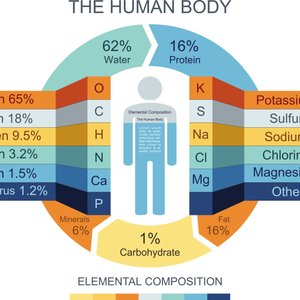
Water is the universal solvent in biological systems, making up about 70% of a cell's mass. Its ability to dissolve a wide range of substances enables biochemical reactions essential for life. Hydrophilic molecules, which are polar or charged, can form hydrogen bonds with water, facilitating their dissolution and reactivity.
Acids, Bases, and the pH Scale
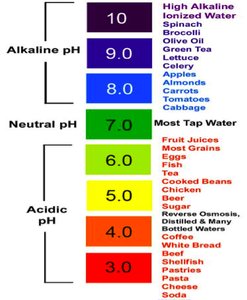
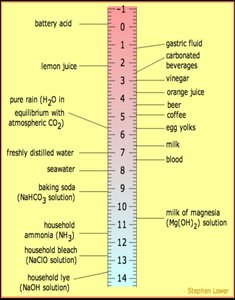
The concepts of acids, bases, and pH are fundamental to understanding biological chemistry. The pH scale is a logarithmic measure of hydrogen ion concentration in a solution, which directly affects cellular processes and enzyme activity.
Acid: A substance that releases protons (H+) when dissolved in water. The extent of dissociation determines acid strength. For example, hydrochloric acid (HCl) is a strong acid because it dissociates completely in water.
Base: A substance that accepts protons or releases hydroxide ions (OH-).
pH Scale: Ranges from 0 (most acidic) to 14 (most basic), with 7 being neutral. Each pH unit represents a tenfold difference in [H+].
Equation for pH:
Small changes in pH can have profound biological effects, as most living cells tolerate only a narrow pH range.
Water Dissociation and Chemical Equilibrium
Water can dissociate into hydrogen ions (H+) and hydroxide ions (OH-), but this occurs to a very small extent, making water a weak acid. The equilibrium can be represented as:
At equilibrium in pure water at 25°C:








Strong vs. Weak Acids
Strong acids, like HCl, dissociate completely in water, while weak acids, such as acetic acid (vinegar), only partially dissociate. The equilibrium for a weak acid (HA) is:
The equilibrium constant (Keq) for this reaction is:

Biological Relevance of pH
Cells and organisms tightly regulate pH because enzyme activity and molecular structure are highly sensitive to [H+]. For example, blood pH must remain between 6.8 and 8.0 for survival. Deviations can lead to coma or death.
Carbon Dioxide, Acids, and Blood Buffering
Carbon dioxide (CO2) dissolves in water to form carbonic acid (H2CO3), which partially dissociates to release protons and bicarbonate (HCO3-):
This equilibrium is central to the bicarbonate buffering system in blood, which helps maintain pH homeostasis.
Buffer Systems: Mechanism and Importance
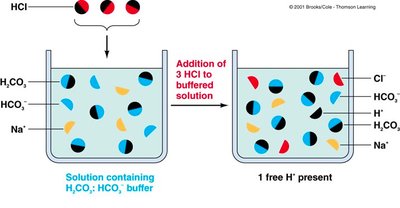
A buffer is a solution that resists changes in pH when acids or bases are added. Buffers typically consist of a weak acid and its conjugate base. They are crucial in biological systems to maintain stable pH for optimal enzyme function and metabolic processes.
How Buffers Work: When excess H+ is added, the conjugate base (A-) binds the protons to reform the weak acid (HA). When excess base is added, the weak acid donates protons to neutralize the base.
Bicarbonate Buffer System: The main buffer in blood, involving the equilibrium between carbonic acid and bicarbonate.
Major Body Buffer Systems
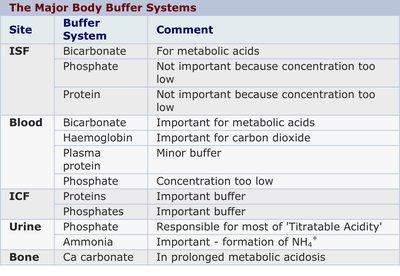
Different buffer systems operate in various body compartments to maintain pH balance. The table below summarizes the major buffer systems:
Site | Buffer System | Comment |
|---|---|---|
ISF | Bicarbonate | For metabolic acids |
ISF | Phosphate | Not important (concentration too low) |
ISF | Protein | Not important (concentration too low) |
Blood | Bicarbonate | Important for metabolic acids |
Blood | Hemoglobin | Important for carbon dioxide |
Blood | Plasma protein | Minor buffer |
Blood | Phosphate | Concentration too low |
ICF | Proteins | Important buffer |
ICF | Phosphate | Important buffer |
Urine | Phosphate | Responsible for most of 'Titratable Acidity' |
Urine | Ammonia | Important - formation of NH4+ |
Bone | Ca carbonate | In prolonged metabolic acidosis |
Enzyme Activity and pH
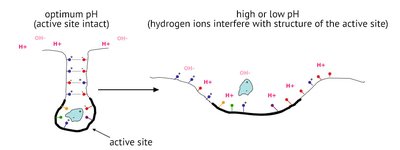
Enzymes have an optimal pH at which their active site is properly shaped for catalysis. Deviations from this pH can alter the structure of the active site, reducing or abolishing enzyme activity. Buffers help maintain the pH required for enzyme function.
Summary and Insights
pH control is vital for life, as many enzymes and biochemical processes function only within a narrow pH range.
Buffer systems, especially the bicarbonate buffer in blood, are essential for maintaining homeostasis and protecting organisms from harmful pH changes.
Proteins and other macromolecules can also act as buffers in biological systems.
Additional info: The regulation of pH is a classic example of homeostasis, and disruptions can lead to severe physiological consequences, as illustrated by the case study of aspirin overdose and its treatment with bicarbonate.
