 Back
Photosynthesis and Cellular Respiration: Core Concepts and Pathways
Study Guide - Smart Notes
 Tailored notes based on your materials, expanded with key definitions, examples, and context.
Photosynthesis
End Products of Photosynthesis: PGAL and Oxygen
Photosynthesis is the process by which plants, algae, and some bacteria convert light energy into chemical energy, producing organic molecules and oxygen. The main end products are PGAL (phosphoglyceraldehyde, also known as G3P) and oxygen.
PGAL (G3P): A three-carbon sugar produced during the Calvin cycle. It serves as a precursor for glucose and other carbohydrates, which are essential for plant growth and energy storage. These carbohydrates are the primary food source for plants and, indirectly, for all other organisms.
Oxygen: Released as a by-product during the light reactions. It is essential for cellular respiration in aerobic organisms, supporting life on Earth.
Note: The direct product of the Calvin cycle is G3P (PGAL), not glucose. G3P can be used to synthesize glucose and other organic compounds.
Light Dependent Reactions of Photosynthesis
Pigments and Photosystems
Photosystems are protein complexes located in the thylakoid membranes of chloroplasts. They play a central role in capturing light energy and converting it into chemical energy.
Photosystem II (PSII): Functions first, absorbs light, and initiates electron transport.
Photosystem I (PSI): Functions second, further energizes electrons for NADPH production.
Pigments: Molecules that absorb light. Main types include chlorophyll a (absorbs violet-blue and red), chlorophyll b (absorbs blue and orange), and carotenoids (absorb other wavelengths, responsible for fall colors).
Light energy is transferred from pigment molecules to the reaction center, exciting electrons that are passed to a primary electron acceptor, initiating the electron transport chain (ETC).
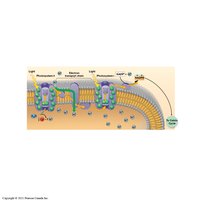
Electron Transport Chain and ATP/NADPH Production
Electrons from water are energized in PSII, passed through the ETC, and used to pump H+ ions into the thylakoid space, creating a proton gradient. PSI re-energizes electrons, which reduce NADP+ to NADPH. The proton gradient drives ATP synthesis via ATP synthase (photophosphorylation).
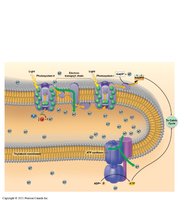
Photolysis and Chemiosmosis
Photolysis is the splitting of water molecules by light energy, releasing electrons, protons (H+), and oxygen. The electrons replenish those lost by chlorophyll in PSII, while the protons contribute to the electrochemical gradient used for ATP synthesis. Oxygen is released as a by-product.
Hydrogen ions (H+): Pumped into the thylakoid space, flow back through ATP synthase to generate ATP.
Electrons: Transferred through the ETC, ultimately reducing NADP+ to NADPH.
Oxygen: Released into the atmosphere, supporting aerobic life.
NADP+ as Final Electron Acceptor
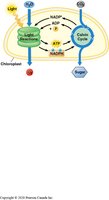
NADP+ acts as the final electron acceptor in the light-dependent reactions, forming NADPH in the thylakoid membrane. NADPH, along with ATP, is then used in the Calvin cycle for carbon fixation and sugar synthesis.
ATP Production (Photophosphorylation)
The chemiosmotic gradient of H+ ions across the thylakoid membrane powers ATP synthase, which synthesizes ATP from ADP and inorganic phosphate. This process is called photophosphorylation and is analogous to oxidative phosphorylation in mitochondria.
Calvin Cycle (Light Independent Reactions)
Overview of the Calvin Cycle
The Calvin cycle is a cyclical metabolic pathway in the stroma of chloroplasts that uses ATP and NADPH from the light reactions to fix carbon dioxide and synthesize G3P (PGAL), a precursor to glucose and other carbohydrates.
Carbon Fixation: CO2 is attached to RuBP by the enzyme rubisco, forming two 3-carbon molecules.
Reduction: ATP and NADPH reduce these molecules to G3P (PGAL).
Release of G3P: For every three CO2 fixed, one G3P exits the cycle.
Regeneration of RuBP: Remaining G3P is used to regenerate RuBP, allowing the cycle to continue.
Carbon Fixation
Carbon fixation is the process of incorporating inorganic CO2 into organic molecules. Rubisco catalyzes the attachment of CO2 to RuBP, forming an unstable six-carbon compound that splits into two three-carbon molecules. This is the entry point for carbon into the biosphere.
Roles of NADPH, ATP, CO2, and Rubisco
NADPH: Provides high-energy electrons for the reduction of 3-carbon molecules to G3P.
ATP: Supplies energy for both the reduction phase and the regeneration of RuBP.
CO2: The source of carbon for organic molecule synthesis.
Rubisco: The enzyme responsible for carbon fixation, catalyzing the first step of the Calvin cycle.
Fate of PGAL (G3P)
G3P (PGAL) produced in the Calvin cycle can be used to regenerate RuBP or to synthesize glucose, sucrose, and other carbohydrates. This integration with the light reactions ensures a continuous supply of energy-rich sugars for the plant.
Adaptations: C3, C4, and CAM Plants
Plants have evolved different mechanisms to optimize photosynthesis under various environmental conditions:
C3 Plants: Use the Calvin cycle directly. Stomata close on hot, dry days, leading to photorespiration (inefficient energy use).
C4 Plants: Use a specialized enzyme to fix CO2 into a 4-carbon compound, which is transported to bundle-sheath cells for the Calvin cycle. This adaptation minimizes photorespiration.
CAM Plants: Open stomata at night to fix CO2 into a 4-carbon compound, which releases CO2 during the day for the Calvin cycle. This conserves water in arid environments.
Cellular Respiration
Role of Cellular Respiration in Catabolic Metabolism
Cellular respiration is a catabolic process that breaks down glucose and other molecules to release energy, which is stored in ATP. It involves oxidation of substrates and reduction of energy carriers (NAD+, FAD).
Redox Reactions: Electrons are transferred from glucose to oxygen, releasing energy for ATP synthesis.
Metabolic Pathways: Cellular respiration includes glycolysis, the citric acid cycle, and oxidative phosphorylation.
Anaerobic Glycolysis
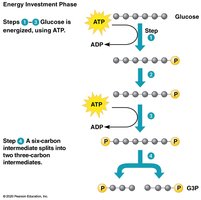
Glycolysis is the anaerobic breakdown of glucose into pyruvate, yielding a net gain of 2 ATP and 2 NADH. It occurs in the cytosol and is the first step in both aerobic and anaerobic respiration.
Starting Compound: Glucose
First 3-Carbon Intermediate: PGAL (G3P)
End Product: Pyruvate
Aerobic Respiration: Mitochondrial Structure and Function
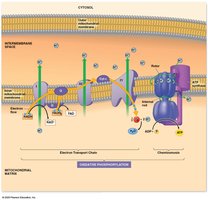
Mitochondria are the site of aerobic respiration. Their structure includes:
Outer Membrane: Separates mitochondrion from cytosol.
Inner Membrane: Contains cristae, increasing surface area for ATP production.
Intermembrane Space: Site of proton accumulation during ETC.
Matrix: Contains enzymes for the citric acid cycle and mitochondrial DNA.
Pyruvate Oxidation
Pyruvate from glycolysis is transported into the mitochondrion, where it is oxidized to acetyl CoA, producing NADH and CO2. Acetyl CoA enters the citric acid cycle.
The Citric Acid (Krebs) Cycle
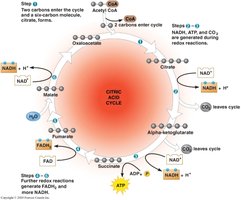
The citric acid cycle completes the oxidation of glucose derivatives, generating NADH, FADH2, ATP, and CO2. For each acetyl CoA:
3 NADH
1 FADH2
1 ATP
2 CO2
Electron Transport Chain (ETC) and Oxidative Phosphorylation
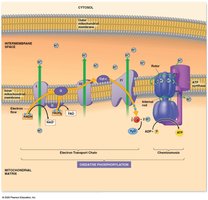
NADH and FADH2 donate electrons to the ETC in the inner mitochondrial membrane. The energy released pumps H+ ions into the intermembrane space, creating a gradient. Oxygen acts as the final electron acceptor, forming water. ATP synthase uses the proton gradient to generate ATP (chemiosmosis).
Anaerobic Fermentation
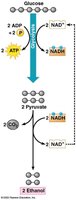
When oxygen is absent, cells regenerate NAD+ via fermentation, allowing glycolysis to continue:
Lactate Fermentation: Pyruvate is reduced to lactate, regenerating NAD+. Occurs in muscle cells and some bacteria.
Ethanol Fermentation: Pyruvate is converted to ethanol and CO2, regenerating NAD+. Occurs in yeast and some bacteria.
Summary Table: Major Steps of Cellular Respiration
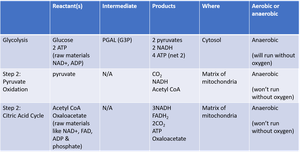
Step | Reactant(s) | Intermediate | Products | Where | Aerobic or Anaerobic |
|---|---|---|---|---|---|
Glycolysis | Glucose, 2 ATP, NAD+, ADP | PGAL (G3P) | 2 Pyruvate, 2 NADH, 4 ATP (net 2) | Cytosol | Anaerobic (will run without oxygen) |
Pyruvate Oxidation | Pyruvate | N/A | CO2, NADH, Acetyl CoA | Matrix of mitochondria | Anaerobic (won't run without oxygen) |
Citric Acid Cycle | Acetyl CoA, Oxaloacetate, NAD+, FAD, ADP, phosphate | N/A | 3 NADH, 1 FADH2, 1 ATP, 2 CO2, Oxaloacetate | Matrix of mitochondria | Anaerobic (won't run without oxygen) |
