Back
BackPhotosynthesis and Cellular Respiration: Interdependence and Mechanisms
Study Guide - Smart Notes
 Tailored notes based on your materials, expanded with key definitions, examples, and context.
Q1. Below is the equation for photosynthesis. Describe the role of each reactant and product in the equation. Which molecules are oxidized and reduced?
Background
Topic: Photosynthesis Equation and Redox Reactions
This question tests your understanding of the overall chemical equation for photosynthesis, the function of each reactant and product, and the redox (oxidation-reduction) changes that occur during the process.
Key Terms and Formulas
Photosynthesis equation:
Oxidation: Loss of electrons
Reduction: Gain of electrons
Step-by-Step Guidance
Identify the reactants (, , and light energy) and products ( and ) in the equation.
Describe the role of each reactant: provides carbon for glucose, supplies electrons and hydrogen, and light energy powers the reaction.
Describe the role of each product: is the sugar used for energy and building materials, is released as a byproduct.
Determine which molecules are oxidized (lose electrons) and which are reduced (gain electrons) during the process.
Try solving on your own before revealing the answer!
Q2. How does photosynthesis relate and depend on cellular respiration?
Background
Topic: Interdependence of Photosynthesis and Cellular Respiration
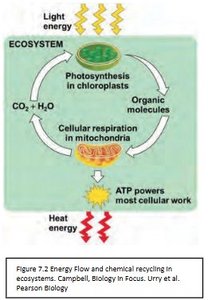
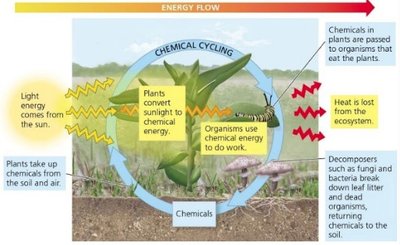
This question explores the relationship between the two processes, focusing on how the products of one serve as the reactants for the other, forming a cycle of energy and matter in living systems.
Key Terms and Concepts
Photosynthesis: Converts light energy to chemical energy (glucose), releases .
Cellular Respiration: Breaks down glucose to produce ATP, consumes and releases and .
Step-by-Step Guidance
Recall the overall equations for both photosynthesis and cellular respiration.
Identify how the products of photosynthesis (, glucose) are used in cellular respiration.
Explain how the products of cellular respiration (, ) are used in photosynthesis.
Discuss why this cyclical relationship is essential for life and energy flow in ecosystems.
Try solving on your own before revealing the answer!
Q3. Describe the general structure of a plant cell and chloroplast. Describe the role of the following structures: Stomata, Stroma, Thylakoid/membrane.
Background
Topic: Plant Cell and Chloroplast Structure
This question tests your knowledge of plant cell anatomy, focusing on the chloroplast and its specialized structures involved in photosynthesis.
Key Terms
Stomata: Pores on the leaf surface for gas exchange.
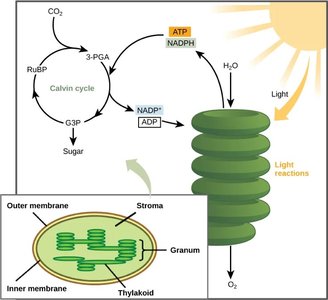
Stroma: Fluid-filled space inside the chloroplast where the Calvin cycle occurs.
Thylakoid/membrane: Flattened sacs where the light reactions take place.
Step-by-Step Guidance
Briefly describe the overall structure of a plant cell, highlighting the presence of chloroplasts.
Explain the structure and function of stomata in gas exchange.
Describe the stroma and its role in the Calvin cycle.
Describe the thylakoid membrane and its role in the light reactions of photosynthesis.
Try solving on your own before revealing the answer!