 Back
Photosynthesis and Cellular Respiration: Structure, Function, and Energy Flow
Study Guide - Smart Notes
 Tailored notes based on your materials, expanded with key definitions, examples, and context.
Photosynthesis
Introduction to Photosynthesis
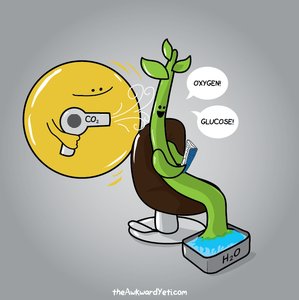
Photosynthesis is the process by which autotrophic organisms, such as plants, algae, and cyanobacteria, convert solar energy into chemical energy stored in the bonds of glucose. This process is fundamental for life on Earth, as it provides both food and oxygen for heterotrophic organisms.
Autotrophs: Organisms that produce their own food using light or chemical energy.
Photosynthesis Equation:
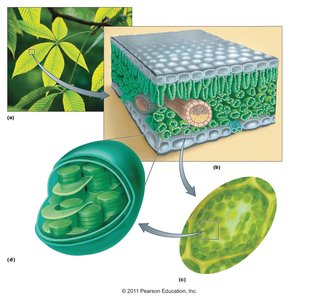
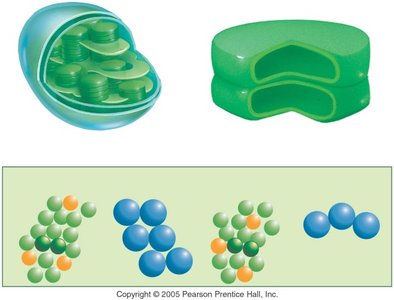
Photosynthesis occurs in chloroplasts, primarily within the leaf cells of plants.
Leaf and Chloroplast Structure
Leaves are specialized organs adapted for photosynthesis. Their structure maximizes light capture and gas exchange while minimizing water loss.
Epidermis: Transparent outer layer that protects the leaf and reduces water loss via the cuticle.
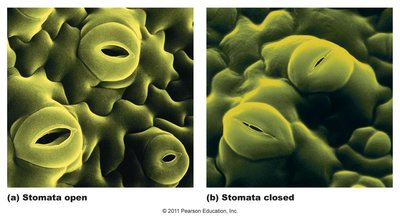
Stomata: Pores on the underside of the leaf that allow for gas exchange (CO2 in, O2 out).
Mesophyll: Internal leaf tissue where most chloroplasts are located and photosynthesis occurs.
Vascular Bundles (Veins): Transport water (xylem) and sugars (phloem) throughout the leaf.
Light and the Electromagnetic Spectrum
Light is a form of electromagnetic radiation. The sun emits energy across a broad spectrum, but only visible light (400–750 nm) is used in photosynthesis.
Photon: A particle of light with a discrete amount of energy.
Wavelength (λ): Distance between two peaks of a wave; shorter wavelengths have higher energy.
Visible Spectrum: The range of light wavelengths that human eyes can detect and that drive photosynthesis (ROYGBIV: Red, Orange, Yellow, Green, Blue, Indigo, Violet).
Fates of Light and Pigments
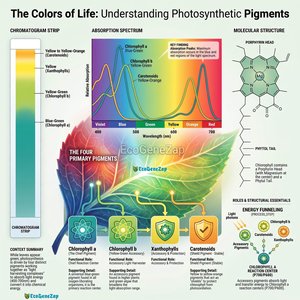
When light strikes an object, it can be reflected, transmitted, or absorbed. Pigments in chloroplasts absorb specific wavelengths of light, which is essential for photosynthesis.
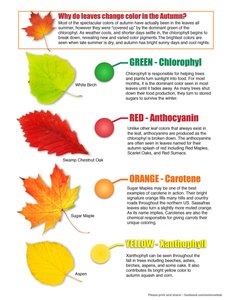
Chlorophyll a: Main pigment, absorbs violet, blue, and red light; reflects green.
Accessory Pigments: Chlorophyll b, carotenoids, and phycocyanin absorb additional wavelengths, broadening the spectrum of usable light.
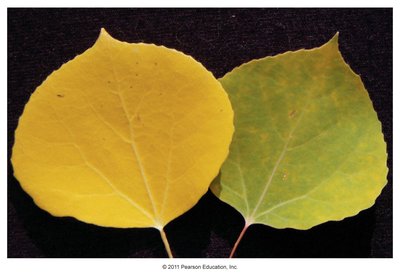
In autumn, chlorophyll breaks down, revealing carotenoids (yellow/orange) and other pigments.
The Light Reactions of Photosynthesis
Overview of Light Reactions
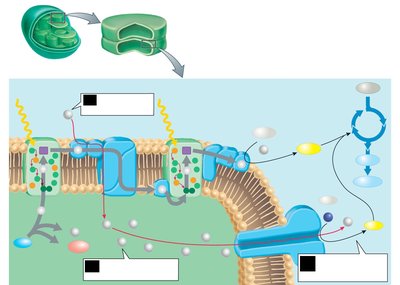
The light reactions occur in the thylakoid membranes of chloroplasts and convert solar energy into chemical energy in the form of ATP and NADPH.
Two main components: Photosystem II (PS II) and Photosystem I (PS I).
Light energy excites electrons, which are transferred through an electron transport chain (ETC).
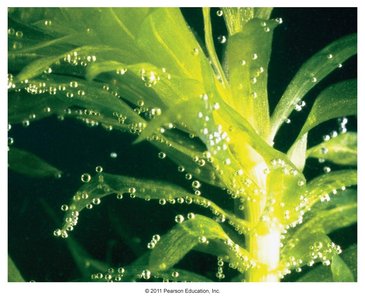
Water is split to provide electrons, releasing O2 as a by-product.
Steps of the Light Reactions
Photons are absorbed by pigment molecules in PS II, exciting electrons.
Excited electrons are transferred to a primary electron acceptor.
Electrons lost from PS II are replaced by splitting water (photolysis), producing O2 and H+.
Electrons move through ETC II, pumping H+ into the thylakoid space, generating a proton gradient.
Electrons reach PS I, are re-excited by light, and transferred to NADP+ to form NADPH.
ATP is synthesized as H+ flows back into the stroma through ATP synthase (chemiosmosis).


The Calvin Cycle (Dark Reactions)
Overview of the Calvin Cycle
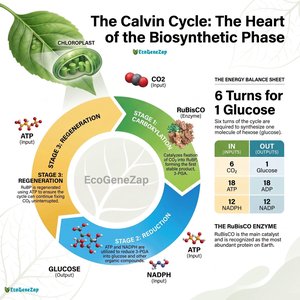
The Calvin cycle, also known as the C3 cycle or light-independent reactions, occurs in the stroma of the chloroplast. It uses ATP and NADPH from the light reactions to fix carbon dioxide and synthesize G3P, a three-carbon sugar.
Carbon Fixation: CO2 is attached to RuBP by the enzyme rubisco.
Reduction: ATP and NADPH are used to convert 3-phosphoglycerate (PGA) into G3P.
Regeneration: Most G3P is used to regenerate RuBP; some exits the cycle to form glucose and other carbohydrates.
Summary Table: Light Reactions vs. Calvin Cycle
Process | Location | Inputs | Outputs |
|---|---|---|---|
Light Reactions | Thylakoid Membrane | Light, H2O, ADP, NADP+ | ATP, NADPH, O2 |
Calvin Cycle | Stroma | CO2, ATP, NADPH | G3P (used to make glucose), ADP, NADP+ |
Cellular Respiration
Overview of Cellular Respiration
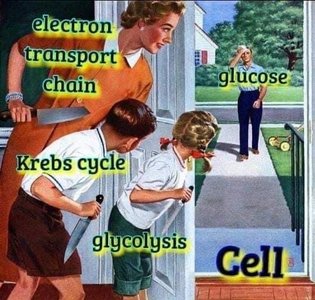
Cellular respiration is the process by which cells extract energy from glucose and other organic molecules. It is the reverse of photosynthesis and occurs in three main stages: glycolysis, the Krebs cycle, and the electron transport chain (ETC).
Overall Equation:
Occurs in the cytoplasm and mitochondria of eukaryotic cells.
Produces up to 38 ATP per glucose molecule under aerobic conditions.
ATP: The Energy Currency of the Cell
ATP (adenosine triphosphate) stores and releases energy for cellular processes. Energy is stored in the bonds between phosphate groups and released when ATP is hydrolyzed to ADP.
ATP is generated by substrate-level phosphorylation and oxidative phosphorylation.
Main goal of cellular respiration is to maximize ATP production.
Stages of Aerobic Respiration
Pathway | Location | Oxygen Requirement |
|---|---|---|
Glycolysis | Cytoplasm | Aerobic or Anaerobic |
Krebs Cycle | Mitochondrial Matrix | Aerobic Only |
Electron Transport Chain (ETC) | Inner Mitochondrial Membrane | Aerobic Only |
Glycolysis
Glycolysis is the breakdown of glucose into two molecules of pyruvate, producing a net gain of 2 ATP and 2 NADH. It occurs in the cytoplasm and does not require oxygen.
Two stages: Glucose activation (uses 2 ATP) and energy harvest (produces 4 ATP and 2 NADH).
Net gain: 2 ATP per glucose.
Fate of Pyruvate
Under aerobic conditions, pyruvate enters the mitochondria for further breakdown. Under anaerobic conditions, it undergoes fermentation to regenerate NAD+.
Alcoholic Fermentation: In yeast, produces ethanol and CO2.
Lactic Acid Fermentation: In animals, produces lactate; occurs in muscle cells during intense exercise.
Aerobic Respiration: Mitochondrial Processes
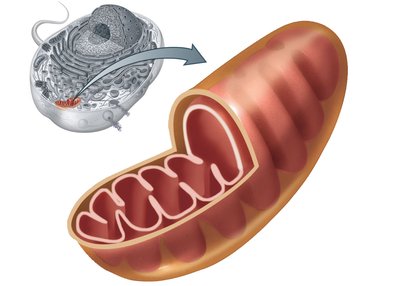
In eukaryotes, aerobic respiration occurs in the mitochondria and includes the pyruvate dehydrogenase complex (PDC), Krebs cycle, and electron transport chain (ETC).
PDC: Converts pyruvate to acetyl-CoA, producing NADH and CO2.
Krebs Cycle: Acetyl-CoA is oxidized, generating CO2, ATP, NADH, and FADH2.
ETC and Oxidative Phosphorylation: NADH and FADH2 donate electrons to the ETC, creating a proton gradient that drives ATP synthesis via ATP synthase. Oxygen is the final electron acceptor, forming water.
ATP Yield from Glucose
Stage | ATP Produced |
|---|---|
Glycolysis (direct) | 2 |
2 NADH (from glycolysis) | 6 |
PDC (2 NADH) | 6 |
Krebs Cycle (direct) | 2 |
6 NADH (Krebs) | 18 |
2 FADH2 (Krebs) | 4 |
Total | 38 |
Summary
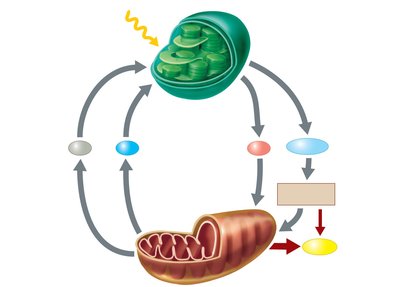
Photosynthesis and cellular respiration are complementary processes that cycle energy and matter through ecosystems.
Photosynthesis captures solar energy and stores it as chemical energy in glucose, while cellular respiration releases that energy for cellular work.
