 Back
BackPhotosynthesis and Cellular Respiration Study Guide
Study Guide - Smart Notes
 Tailored notes based on your materials, expanded with key definitions, examples, and context.
Q1. Below is the equation for photosynthesis. Describe the role of each reactant and product in the equation. Which molecules are oxidized and reduced?
Background
Topic: Photosynthesis Chemical Equation & Redox Reactions
This question tests your understanding of the photosynthesis equation, the function of each molecule involved, and the redox (oxidation-reduction) changes that occur during the process.
Key Terms and Formulas:
Photosynthesis equation:
Oxidation: Loss of electrons
Reduction: Gain of electrons
Step-by-Step Guidance
Identify the reactants: (carbon dioxide) and (water). These are the starting materials for photosynthesis.
Identify the products: (glucose) and (oxygen). These are the end products of the process.
Determine which molecules are oxidized and which are reduced. Consider the changes in electron distribution and the transfer of hydrogen atoms.
Think about the role of light energy in driving the transfer of electrons from water to carbon dioxide.
Try solving on your own before revealing the answer!
Final Answer:
In photosynthesis, water () is oxidized to oxygen (), and carbon dioxide () is reduced to glucose (). Light energy powers these transformations.
Water loses electrons (oxidation), and carbon dioxide gains electrons (reduction).
Q2. How does photosynthesis relate and depend on cellular respiration?
Background
Topic: Relationship Between Photosynthesis and Cellular Respiration
This question explores the interdependence of photosynthesis and cellular respiration in biological systems, focusing on energy flow and recycling of molecules.
Key Terms:
Photosynthesis: Converts light energy to chemical energy (glucose)
Cellular respiration: Breaks down glucose to release energy (ATP)
ATP: Adenosine triphosphate, the energy currency of the cell
Step-by-Step Guidance
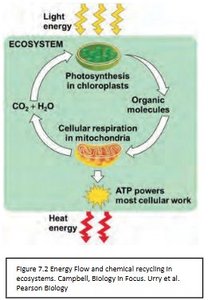
Recall that photosynthesis produces glucose and oxygen, which are used in cellular respiration.
Cellular respiration breaks down glucose, releasing energy (ATP) and producing carbon dioxide and water as byproducts.
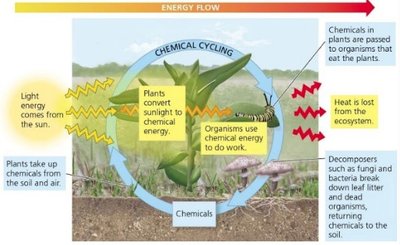
Consider how the products of one process serve as the reactants for the other, forming a cycle.
Think about how energy flows from sunlight to chemical energy and then to usable cellular energy.
Try solving on your own before revealing the answer!
Final Answer:
Photosynthesis and cellular respiration are interdependent: photosynthesis provides the glucose and oxygen needed for cellular respiration, while cellular respiration returns carbon dioxide and water to be used in photosynthesis. This cycle maintains energy flow and chemical recycling in ecosystems.
