 Back
Photosynthesis & Cellular Respiration Study Guide
Study Guide - Smart Notes
 Tailored notes based on your materials, expanded with key definitions, examples, and context.
Q1. Describe the role of each reactant and product in the equation for photosynthesis. Which molecules are oxidized and reduced?
Background
Topic: Photosynthesis Chemical Equation & Redox Reactions
This question tests your understanding of the photosynthesis equation, the function of each reactant and product, and the identification of oxidation and reduction processes.
Key Terms and Formulas:
Photosynthesis equation:
Oxidation: Loss of electrons
Reduction: Gain of electrons
Step-by-Step Guidance
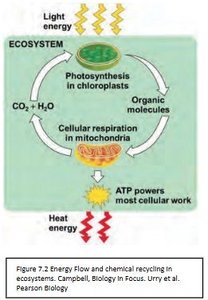
Identify the reactants: carbon dioxide (), water (), and light energy.
Identify the products: glucose () and oxygen ().
Explain the role of each reactant: provides carbon, provides hydrogen and electrons, light energy powers the reaction.
Explain the role of each product: Glucose stores energy, is released as a byproduct.
Determine which molecules are oxidized and which are reduced by analyzing electron transfer.
Try solving on your own before revealing the answer!
Final Answer:
In photosynthesis, is reduced to form glucose (), and is oxidized to form . $CO_2$ gains electrons (reduction), while $H_2O$ loses electrons (oxidation).
Each reactant and product plays a role in energy transformation and matter cycling within the ecosystem.
Q2. How does photosynthesis relate and depend on cellular respiration?
Background
Topic: Relationship Between Photosynthesis and Cellular Respiration
This question explores the interdependence of photosynthesis and cellular respiration in biological systems.
Key Terms:
Photosynthesis: Converts light energy to chemical energy (glucose)
Cellular respiration: Converts chemical energy (glucose) to ATP
ATP: Energy currency of the cell
Step-by-Step Guidance
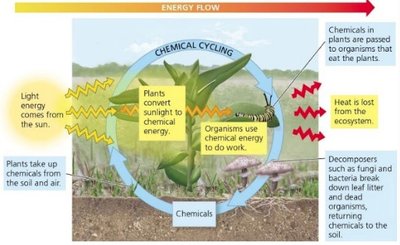
Recall the products of photosynthesis: glucose and oxygen.
Recall the reactants of cellular respiration: glucose and oxygen.
Explain how cellular respiration uses the products of photosynthesis to generate ATP.
Discuss how the cycle of matter and energy connects these two processes.
Try solving on your own before revealing the answer!
Final Answer:
Photosynthesis produces glucose and oxygen, which are used in cellular respiration to generate ATP. Cellular respiration releases and , which are then used in photosynthesis, creating a cycle of energy and matter in living systems.
Q3. Describe the general structure of a plant cell and chloroplast. What are the roles of stomata, stroma, and thylakoid/membrane?
Background
Topic: Plant Cell and Chloroplast Structure
This question tests your knowledge of plant cell anatomy and the specific structures involved in photosynthesis.
Key Terms:
Stomata: Pores for gas exchange
Stroma: Fluid inside chloroplast
Thylakoid/membrane: Site of light reactions
Step-by-Step Guidance
Describe the basic structure of a plant cell, including cell wall, membrane, and organelles.
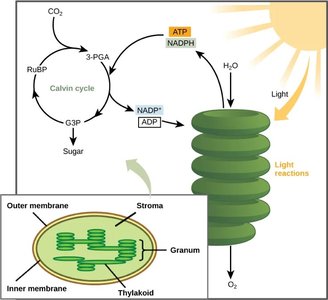
Explain the structure of the chloroplast: outer membrane, inner membrane, stroma, thylakoids.
Define the function of stomata in gas exchange.
Describe the role of stroma in the Calvin cycle.
Explain how thylakoid membranes are involved in the light reactions.
Try solving on your own before revealing the answer!
Final Answer:
Stomata allow gas exchange, stroma is the site of the Calvin cycle, and thylakoid membranes house the light reactions. The chloroplast's structure is specialized for efficient photosynthesis.
Q4. Compare and contrast the structures and function of the mitochondria and chloroplast. Why is it important that plant cells use both?
Background
Topic: Organelle Structure and Function
This question examines the similarities and differences between mitochondria and chloroplasts, and their roles in plant cells.
Key Terms:
Mitochondria: Site of cellular respiration
Chloroplast: Site of photosynthesis
ATP: Produced by both organelles
Step-by-Step Guidance
Describe the structure of mitochondria: double membrane, matrix, cristae.
Describe the structure of chloroplast: double membrane, stroma, thylakoids.
Compare their functions: mitochondria generate ATP from glucose, chloroplasts produce glucose from light energy.
Explain why both are necessary for plant cell energy metabolism.
Try solving on your own before revealing the answer!
Final Answer:
Chloroplasts capture light energy to make glucose, while mitochondria break down glucose to produce ATP. Both are essential for plant cells to maintain energy balance and support life processes.
Q5. Why do plants need both chloroplast and mitochondria? How do their roles differ in the cell?
Background
Topic: Organelle Function in Plant Cells
This question focuses on the distinct roles of chloroplasts and mitochondria in plant cells.
Key Terms:
Chloroplast: Photosynthesis
Mitochondria: Cellular respiration
Step-by-Step Guidance
Recall the function of chloroplasts: converting light energy to chemical energy (glucose).
Recall the function of mitochondria: converting chemical energy (glucose) to ATP.
Explain how these processes are complementary in plant cells.
Try solving on your own before revealing the answer!
Final Answer:
Plants need chloroplasts to produce glucose and mitochondria to convert glucose into ATP. Their roles differ: chloroplasts capture energy, mitochondria release energy for cellular work.
Q6. What is the primary purpose of the light reactions in photosynthesis? List the major steps of the light reactions in chronological order and the roles of the following components: Chlorophyll a, Photosystem II, Electron transport chain, ATP synthase, NADP⁺ reductase.
Background
Topic: Light Reactions of Photosynthesis
This question tests your understanding of the light-dependent reactions and the function of key components.
Key Terms:
Chlorophyll a: Primary pigment
Photosystem II: Initiates electron transport
Electron transport chain: Transfers electrons
ATP synthase: Produces ATP
NADP⁺ reductase: Produces NADPH
Step-by-Step Guidance
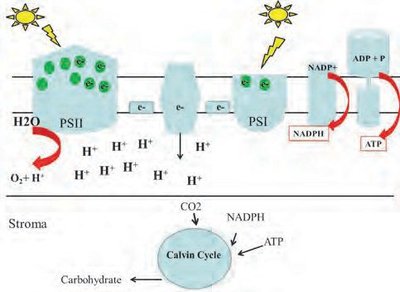
Identify the main goal: convert solar energy to chemical energy (ATP and NADPH).
Describe the absorption of light by chlorophyll a in Photosystem II.
Explain how excited electrons move through the electron transport chain.
Describe the role of ATP synthase in generating ATP from ADP and inorganic phosphate.
Explain how NADP⁺ reductase forms NADPH from NADP⁺ and electrons.
Try solving on your own before revealing the answer!
Final Answer:
The light reactions produce ATP and NADPH by transferring electrons from water through Photosystem II, the electron transport chain, and Photosystem I, ending with NADP⁺ reductase. These molecules power the Calvin cycle.
