 Back
BackPhotosynthesis and Related Cellular Processes Study Guide
Study Guide - Smart Notes
 Tailored notes based on your materials, expanded with key definitions, examples, and context.
Q1. What is the primary function of photosynthesis?
Background
Topic: Photosynthesis
This question tests your understanding of the main purpose of photosynthesis in plant cells, which is to convert energy from sunlight into a form that cells can use for their metabolic processes.
Key Terms:
Photosynthesis: The process by which plants, algae, and some bacteria convert light energy into chemical energy.
Chemical potential energy: Energy stored in molecules, such as glucose, that can be used by cells.
Step-by-Step Guidance
Recall that photosynthesis occurs in chloroplasts and involves capturing light energy.
Think about what the products of photosynthesis are (e.g., glucose, oxygen).
Consider how these products are used by the cell—especially the role of glucose as a source of energy.
Reflect on the difference between converting light energy and converting chemical energy from other molecules.
Try solving on your own before revealing the answer!
Q2. The cellular organelle pictured above is responsible for carrying out photosynthesis. Name the organelle and describe the location of the light reactions and Calvin cycle enzymes.
Background
Topic: Chloroplast Structure and Function
This question tests your knowledge of the structure of the chloroplast and the specific locations where photosynthetic processes occur.
Key Terms:
Chloroplast: The organelle in plant cells where photosynthesis takes place.
Thylakoid membrane: Site of the light reactions.
Stroma: Site of the Calvin cycle.
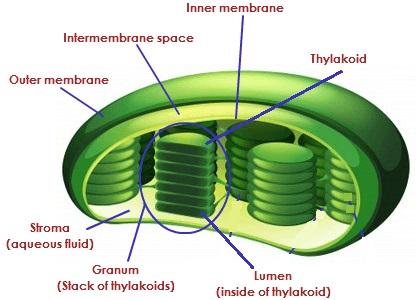
Step-by-Step Guidance
Identify the organelle shown in the diagram and recall its main function.
Locate the thylakoid membrane in the diagram and remember that this is where the light reactions occur.
Find the stroma in the diagram and note that this is where the Calvin cycle enzymes are found.
Think about how the structure of the chloroplast supports these processes.
Try solving on your own before revealing the answer!
Q3. Identify whether each of the following statements is true or false: Plants carry out photosynthesis but not cellular respiration; During photosynthesis, carbon dioxide reacts with water to produce sugar and oxygen.
Background
Topic: Plant Metabolism
This question tests your understanding of the relationship between photosynthesis and cellular respiration, and the chemical reactions involved in photosynthesis.
Key Terms:
Photosynthesis: Conversion of light energy to chemical energy.
Cellular respiration: Process by which cells extract energy from glucose.
Reactants and products: Substances involved in chemical reactions.
Step-by-Step Guidance
Recall whether plants perform both photosynthesis and cellular respiration.
Review the chemical equation for photosynthesis and identify the reactants and products.
Think about whether oxygen is a direct product of the reaction between CO2 and water.
Consider the role of each process in plant metabolism.
Try solving on your own before revealing the answer!
Q4. Connect carbohydrates and photosynthesis: Where does the carbon to make polysaccharides come from? What 3-carbon sugar is directly produced by photosynthesis? What 6-carbon sugar is synthesized from two of these? What structural and storage polysaccharides do plants synthesize?
Background
Topic: Carbohydrate Biosynthesis in Plants
This question tests your understanding of how photosynthesis provides the building blocks for carbohydrate synthesis in plants.
Key Terms:
Polysaccharides: Long chains of sugar molecules.
Glyceraldehyde-3-phosphate (G3P): 3-carbon sugar produced in the Calvin cycle.
Glucose: 6-carbon sugar synthesized from G3P.
Cellulose: Structural polysaccharide.
Starch: Storage polysaccharide.
Step-by-Step Guidance
Recall the source of carbon for plant carbohydrates (think about the reactants in photosynthesis).
Identify the 3-carbon sugar produced by the Calvin cycle.
Determine how two 3-carbon sugars combine to form a 6-carbon sugar.
Distinguish between structural and storage polysaccharides synthesized by plants.
Try solving on your own before revealing the answer!
Q5. If you tried to grow a plant in the dark, what would happen to it?
Background
Topic: Energy Requirements for Plant Growth
This question tests your understanding of the importance of light for photosynthesis and plant survival.
Key Terms:
Photosynthesis: Requires light energy.
Energy source: Needed for cellular work and growth.
Step-by-Step Guidance
Recall the role of light in photosynthesis and why it is essential for plants.
Think about what happens to a plant's energy supply if it cannot photosynthesize.
Consider whether plants can obtain energy or carbon from other sources in the absence of light.
Reflect on the consequences for plant survival and growth.
Try solving on your own before revealing the answer!
Q6. Many redox reactions are part of photosynthesis. Which statements correctly describe a reduction or oxidation step in photosynthesis?
Background
Topic: Redox Reactions in Photosynthesis
This question tests your understanding of electron transfer processes during photosynthesis, including the roles of NADP+, NADPH, and carbon fixation.
Key Terms:
Redox reaction: A chemical reaction involving the transfer of electrons.
Reduction: Gain of electrons.
Oxidation: Loss of electrons.
NADP+: Electron carrier reduced to NADPH.
G3P: Product of carbon reduction.
Step-by-Step Guidance
Recall the steps in the light reactions where NADP+ is reduced to NADPH.
Think about the fate of electrons in the reaction center chlorophyll.
Consider how carbon dioxide is reduced during the Calvin cycle to form G3P.
Review whether water is reduced or oxidized in the process.
Try solving on your own before revealing the answer!
Q7. Describe the structure and function of rubisco, referring to primary, secondary, tertiary, and quaternary protein structure.
Background
Topic: Protein Structure and Enzyme Function
This question tests your understanding of the levels of protein structure and how they relate to the function of rubisco, a key enzyme in photosynthesis.
Key Terms:
Primary structure: Sequence of amino acids.
Secondary structure: Alpha helices and beta sheets formed by hydrogen bonding.
Tertiary structure: 3D folding due to R group interactions.
Quaternary structure: Multiple polypeptides interacting.
Rubisco: Enzyme that catalyzes carbon fixation in the Calvin cycle.
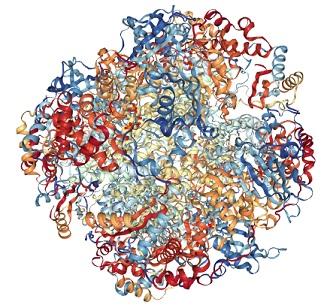
Step-by-Step Guidance
Recall the definition of primary structure and how amino acids are linked.
Identify the types of secondary structure present in rubisco and the role of hydrogen bonds.
Describe how tertiary structure forms through interactions between R groups.
Explain how quaternary structure involves multiple polypeptides.
Connect these structural features to rubisco's function in the Calvin cycle.
Try solving on your own before revealing the answer!
Q8. During the light reactions of photosynthesis, what happens when light of a usable wavelength strikes a chlorophyll molecule?
Background
Topic: Light Reactions of Photosynthesis
This question tests your understanding of the initial steps in the light reactions, specifically the excitation of electrons in chlorophyll.
Key Terms:
Chlorophyll: Pigment that absorbs light energy.
Photon: Particle of light.
Excited electron: Electron raised to a higher energy level.
Step-by-Step Guidance
Recall what happens when chlorophyll absorbs a photon of light.
Think about the fate of the excited electron and how it initiates the electron transport chain.
Consider the downstream effects of electron excitation in photosynthesis.
Review the role of other molecules (e.g., NADP+, water) in the light reactions.
Try solving on your own before revealing the answer!
Q9. How is H2O used in photosynthesis?
Background
Topic: Water's Role in Photosynthesis
This question tests your understanding of how water provides electrons for photosystem II and its importance in the light reactions.
Key Terms:
Photosystem II (PSII): Protein complex involved in the light reactions.
Electron donor: Substance that provides electrons.
Water splitting: Process that releases electrons, protons, and oxygen.
Step-by-Step Guidance
Recall the process by which water is split during the light reactions.
Identify the role of water as an electron donor to PSII.
Think about what happens to the electrons, protons, and oxygen produced.
Consider how this process supports the electron transport chain.
Try solving on your own before revealing the answer!
Q10. Which products of the light reaction are used in the Calvin cycle?
Background
Topic: Integration of Light Reactions and Calvin Cycle
This question tests your understanding of how the products of the light reactions (ATP and NADPH) are used in the Calvin cycle to drive sugar synthesis.
Key Terms:
ATP: Energy carrier produced in the light reactions.
NADPH: Electron carrier produced in the light reactions.
Calvin cycle: Series of reactions that synthesize sugars from CO2.
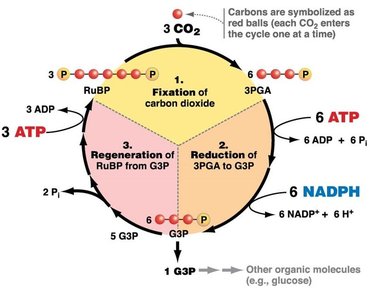
Step-by-Step Guidance
Recall the main products of the light reactions.
Identify which of these products are required for the Calvin cycle.
Think about the role of ATP and NADPH in the reduction and regeneration phases of the Calvin cycle.
Review the overall flow of energy and electrons from light reactions to sugar synthesis.
Try solving on your own before revealing the answer!
Q11. How many molecules of CO2 must be fixed by the Calvin cycle to produce one molecule of G3P that can exit the cycle?
Background
Topic: Calvin Cycle Stoichiometry
This question tests your understanding of the number of carbon atoms required to produce a 3-carbon sugar (G3P) in the Calvin cycle.
Key Terms:
G3P: 3-carbon sugar produced in the Calvin cycle.
CO2 fixation: Incorporation of carbon dioxide into organic molecules.
Step-by-Step Guidance
Recall the structure of G3P and how many carbon atoms it contains.
Think about how many CO2 molecules are needed to provide the required carbon atoms.
Review the steps of the Calvin cycle and the relationship between CO2 input and G3P output.
Consider the overall stoichiometry of the cycle.
Try solving on your own before revealing the answer!
Q12. Identify whether each event occurs during the light reactions, fixation, reduction, or regeneration phase of the Calvin cycle.
Background
Topic: Photosynthesis Phases
This question tests your ability to distinguish between the different phases of photosynthesis and the Calvin cycle.
Key Terms:
Light reactions: Produce ATP and NADPH, release O2.
Fixation: CO2 is incorporated into RuBP.
Reduction: Carbon is reduced to G3P.
Regeneration: RuBP is regenerated from G3P.
Step-by-Step Guidance
Recall the sequence of events in the light reactions and Calvin cycle.
Identify which phase each event belongs to (e.g., ATP production, O2 release, carbon fixation).
Think about the role of ATP and NADPH in the reduction phase.
Review how G3P is used in the regeneration phase to produce RuBP.
Try solving on your own before revealing the answer!
Q13. How are C4 and CAM photosynthesis different from C3 photosynthesis?
Background
Topic: Types of Photosynthesis
This question tests your understanding of the adaptations in C4 and CAM plants that allow them to efficiently fix carbon under different environmental conditions.
Key Terms:
C3 photosynthesis: Standard pathway using rubisco.
C4 photosynthesis: Uses PEP carboxylase and a 4-carbon compound to concentrate CO2.
CAM photosynthesis: Fixes carbon at night into organic acids, releases CO2 during the day.
Step-by-Step Guidance
Recall the basic steps of C3 photosynthesis and the role of rubisco.
Identify the adaptations in C4 plants that allow them to concentrate CO2.
Describe how CAM plants fix carbon at night and release it during the day.
Compare these adaptations to the standard C3 pathway.
Try solving on your own before revealing the answer!
Q14. Light energy captured by photosystem II (PSII) is used to __________.
Background
Topic: Photosystem II Function
This question tests your understanding of how PSII uses light energy to generate a proton gradient across the thylakoid membrane.
Key Terms:
Photosystem II (PSII): Protein complex that captures light energy.
H+ gradient: Difference in proton concentration across a membrane.
Thylakoid membrane: Site of light reactions.
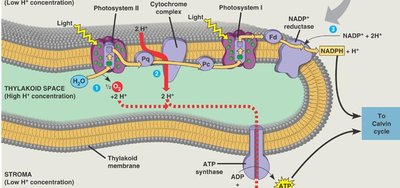
Step-by-Step Guidance
Recall the role of PSII in capturing light energy and splitting water.
Identify how the energy is used to pump protons across the thylakoid membrane.
Think about the importance of the H+ gradient for ATP synthesis.
Review the connection between the H+ gradient and the Calvin cycle.
Try solving on your own before revealing the answer!
Q15. PS I takes in light energy. This energy ends up being used to _______.
Background
Topic: Photosystem I Function
This question tests your understanding of how PSI uses light energy to produce NADPH, an important electron carrier for the Calvin cycle.
Key Terms:
Photosystem I (PSI): Protein complex that captures light energy.
NADPH: Electron carrier produced by PSI.
Step-by-Step Guidance
Recall the role of PSI in the light reactions.
Identify the product formed when PSI transfers electrons to NADP+.
Think about how NADPH is used in the Calvin cycle.
Review the flow of electrons from water to NADPH.
Try solving on your own before revealing the answer!
Q16. A group of students measure CO2 levels around a plant under different light treatments. How would you identify the white light and green light treatments on a graph?
Background
Topic: Photosynthesis and Light Wavelengths
This question tests your understanding of how different wavelengths of light affect photosynthesis and CO2 uptake.
Key Terms:
White light: Contains all wavelengths.
Green light: Least effective for photosynthesis.
CO2 uptake: Indicator of photosynthetic activity.
Step-by-Step Guidance
Recall which wavelengths of light are most effective for photosynthesis.
Identify which treatment would result in the highest CO2 uptake (white light).
Determine which treatment would result in the lowest CO2 uptake (green light).
Review how to interpret the graph based on these principles.
Try solving on your own before revealing the answer!
Q17. An herbicide makes thylakoid membranes permeable to hydrogen ions. What effect would this have on the light reactions and the Calvin cycle?
Background
Topic: Membrane Permeability and Photosynthesis
This question tests your understanding of how the integrity of the thylakoid membrane is essential for ATP production and sugar synthesis in photosynthesis.
Key Terms:
Thylakoid membrane: Site of proton gradient formation.
ATP synthase: Enzyme that uses the H+ gradient to produce ATP.
Calvin cycle: Dependent on ATP and NADPH from light reactions.
Step-by-Step Guidance
Recall how the thylakoid membrane maintains a proton gradient during the light reactions.
Think about what happens if the membrane becomes permeable to H+ ions (gradient is lost).
Consider the effect on ATP synthase and ATP production.
Review how decreased ATP production affects the Calvin cycle and sugar synthesis.
Try solving on your own before revealing the answer!
