 Back
Photosynthesis: Harnessing Sunlight to Power Life
Study Guide - Smart Notes
 Tailored notes based on your materials, expanded with key definitions, examples, and context.
Photosynthesis: Harnessing Sunlight to Power Life
Introduction to Photosynthesis
Photosynthesis is the process by which autotrophic organisms, such as plants, algae, and some bacteria, convert sunlight into chemical energy stored in carbohydrates. This process is fundamental to life on Earth, providing the oxygen we breathe and the organic molecules that fuel most ecosystems.
Autotrophs are "self-feeders" that produce their own food from inorganic substances.
Heterotrophs are organisms that must obtain sugars and organic molecules from other organisms.
The overall reaction for photosynthesis is essentially the reverse of cellular respiration:
10.1 Photosynthesis Harnesses Sunlight to Make Carbohydrates
Photosynthesis converts electromagnetic energy into chemical energy, requiring sunlight, carbon dioxide, and water, and producing oxygen as a by-product.
Light-capturing reactions use sunlight to excite electrons, producing ATP and NADPH.
Calvin cycle reactions use ATP and NADPH to reduce CO2 and synthesize sugars.
Photosynthetic Pigments and Light Absorption
Pigments in the thylakoid membranes of chloroplasts absorb specific wavelengths of light. The most important pigment is chlorophyll, which reflects green light and is responsible for the green color of plants.
Chlorophylls (a and b): Absorb red and blue light, reflect green.
Carotenoids: Absorb blue and green light, reflect yellow, orange, and red; act as accessory pigments and protect chlorophyll from damage.
Absorption spectrum: Shows how different wavelengths are absorbed by pigments.
Action spectrum: Indicates which wavelengths arpue most effective at driving photosynthesis.
Photosystems and Electron Excitation
Photosystems are complexes of chlorophyll and accessory pigments that capture light energy and transfer it to a reaction center, where electrons are excited and transferred through an electron transport chain (ETC).
Photosystem II (PSII): Splits water to replace lost electrons, releasing O2 (oxygenic photosynthesis).
Photosystem I (PSI): Transfers electrons to NADP+, forming NADPH.
The Z scheme: Describes the flow of electrons from water through PSII and PSI to NADP+.
Photophosphorylation: ATP synthesis driven by the proton gradient generated by the ETC.
Calvin Cycle: Carbon Fixation and Sugar Production
The Calvin cycle is the set of light-independent reactions that fix carbon dioxide into organic molecules. It occurs in the stroma of the chloroplast and consists of three main phases:
Fixation: CO2 reacts with ribulose-1,5-bisphosphate (RuBP) to form 3-phosphoglycerate (3PGA).
Reduction: 3PGA is phosphorylated by ATP and reduced by NADPH to form glyceraldehyde-3-phosphate (G3P).
Regeneration: Some G3P is used to regenerate RuBP, enabling the cycle to continue.
Rubisco and Photorespiration
Rubisco (ribulose-1,5-bisphosphate carboxylase/oxygenase) is the enzyme that catalyzes the fixation of CO2 in the Calvin cycle. It is the most abundant enzyme on Earth but is relatively slow and can also catalyze a reaction with O2, leading to photorespiration, which decreases photosynthetic efficiency.
Photorespiration: Consumes O2 and releases CO2, effectively undoing the work of photosynthesis.
Adaptations to Increase CO2 Concentration
Plants have evolved mechanisms to minimize photorespiration and increase the efficiency of carbon fixation, especially in hot and dry environments.
C4 pathway: Spatially separates initial CO2 fixation (in mesophyll cells) from the Calvin cycle (in bundle sheath cells).
CAM pathway: Temporally separates CO2 uptake (at night) from the Calvin cycle (during the day), common in succulents and cacti.
Regulation and Fate of Photosynthetic Products
Photosynthesis is regulated by light, sugar levels, and the availability of CO2. The products of the Calvin cycle, primarily G3P, are used to synthesize glucose, fructose, sucrose, and starch, which serve as energy sources and structural components for the plant.
Gluconeogenesis: Formation of glucose and fructose from G3P.
Sucrose: Transported throughout the plant; synthesized in the cytosol.
Starch: Storage form of glucose; synthesized in the chloroplast.
Summary Table: Comparison of Photosynthetic Pathways
Pathway | Initial CO2 Fixation | Main Enzyme | Adaptation | Example Plants |
|---|---|---|---|---|
C3 | Direct to Calvin cycle | Rubisco | Most efficient under cool, moist conditions | Wheat, rice |
C4 | PEP carboxylase in mesophyll cells | PEP carboxylase, Rubisco | Reduces photorespiration; spatial separation | Corn, sugarcane |
CAM | PEP carboxylase at night | PEP carboxylase, Rubisco | Reduces water loss; temporal separation | Cacti, succulents |
Chapter Roadmap
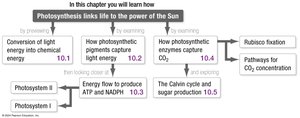
The following diagram summarizes the main topics covered in this chapter, linking the conversion of light energy to chemical energy, the role of photosynthetic pigments, the mechanisms of CO2 capture, and the Calvin cycle.
Human Angle: Artificial Photosynthesis
Research in artificial photosynthesis aims to mimic natural processes to produce food and fuel using solar energy. For example, Dr. Sean Overa developed a system coupling electricity from solar panels to catalyze the conversion of CO2 and water into organic molecules, replacing the high-energy molecules (ATP and NADPH) of natural photosynthesis with electricity.
Example Multiple Choice Question: During the Calvin cycle, CO2 is converted into sugars. The energy for this reaction originally comes from light energy, which is captured to create temporary energy storage molecules such as ATP and NADPH.
