 Back
Photosynthesis: Light Reactions, Calvin Cycle, and Adaptations
Study Guide - Smart Notes
 Tailored notes based on your materials, expanded with key definitions, examples, and context.
Photosynthesis: Overview
Introduction to Photosynthesis
Photosynthesis is the process by which plants, algae, and some bacteria convert light energy into chemical energy, producing oxygen and organic compounds. It occurs in chloroplasts and consists of two main stages: the light reactions and the Calvin cycle. - Light reactions: Convert solar energy to chemical energy (ATP and NADPH) and release O2 as a byproduct. - Calvin cycle: Uses ATP and NADPH to fix carbon dioxide and synthesize sugars. 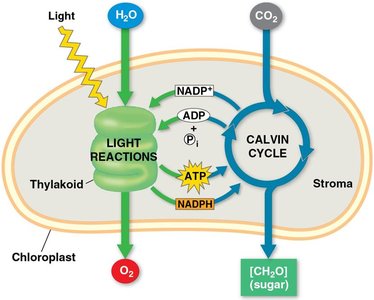
Light Reactions
Photosystems and Light Harvesting
Light reactions occur in the thylakoid membranes and involve two photosystems (PSII and PSI) that capture light energy and transfer electrons. - Photosystem: A complex of proteins and pigments that harvest light and initiate electron transfer. - Light-harvesting complexes: Contain pigment molecules that absorb photons and transfer energy to the reaction-center complex. - Primary electron acceptor: Receives excited electrons from the reaction center. 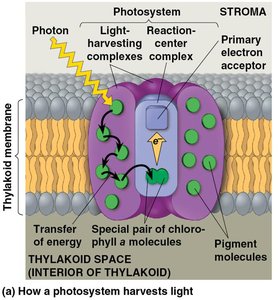
Linear Electron Flow
Linear electron flow is the primary pathway in light reactions, involving both photosystems and resulting in the production of ATP, NADPH, and O2. - Step 1: Photon excites pigment in PSII, transferring energy to the reaction center. - Step 2: Excited electrons are passed to the primary electron acceptor. - Step 3: Water is split, providing electrons, protons, and O2. - Step 4: Electrons move through the electron transport chain (ETC), releasing energy to pump protons and create a gradient. - Step 5: Proton gradient drives ATP synthesis via chemiosmosis. - Step 6: Electrons and light excite PSI, which donates electrons to its acceptor. - Step 7: Electrons are transferred to NADP+ by NADP+ reductase, forming NADPH. 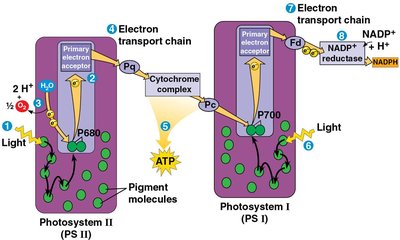
Summary of Light Reactions
The light reactions use solar energy to generate ATP and NADPH, which are essential for the Calvin cycle. Oxygen is released as a byproduct, supporting aerobic life on Earth. 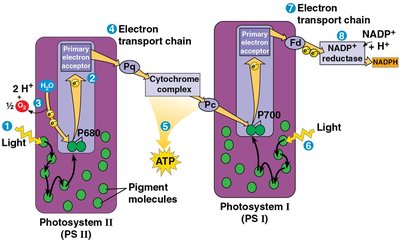
Cyclic Electron Flow
Cyclic electron flow involves only PSI and produces ATP without generating NADPH or O2. - Photoexcited electrons cycle back from ferredoxin to the cytochrome complex. - ATP is produced via chemiosmosis, but no NADPH or O2 is formed. - Evolutionary significance: Some organisms rely solely on cyclic electron flow for ATP production. 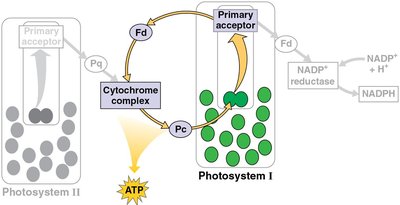
Chloroplasts and Mitochondria: Energy Conversion
Comparison of Chloroplasts and Mitochondria
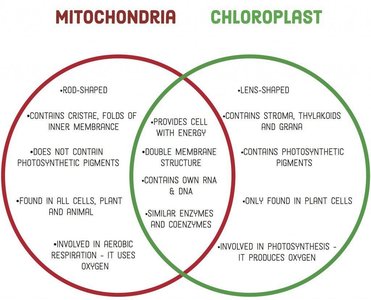
Both organelles generate ATP using electron transport chains and chemiosmosis, but differ in their energy sources and functions.
Mitochondria | Chloroplast |
|---|---|
Rod-shaped | Lens-shaped |
Contains cristae (folds of inner membrane) | Contains stroma, thylakoids, and grana |
Does not contain photosynthetic pigments | Contains photosynthetic pigments |
Found in all cells, plant and animal | Only found in plant cells |
Involved in aerobic respiration (uses O2) | Involved in photosynthesis (produces O2) |
Transfers chemical energy from food into ATP | Transfers light energy from sun into ATP |
Contains own RNA & DNA | Contains own RNA & DNA |
Similar enzymes and coenzymes | Similar enzymes and coenzymes |
ATP Synthesis: Chemiosmosis
- In mitochondria: Protons are pumped into the intermembrane space and diffuse back into the matrix, driving ATP synthesis. - In chloroplasts: Protons are pumped into the thylakoid space and diffuse back into the stroma, driving ATP synthesis. 
The Calvin Cycle
Overview of the Calvin Cycle
The Calvin cycle is an anabolic pathway that converts CO2 into glyceraldehyde 3-phosphate (G3P), a sugar. It consists of three phases: carbon fixation, reduction, and regeneration of the CO2 acceptor. 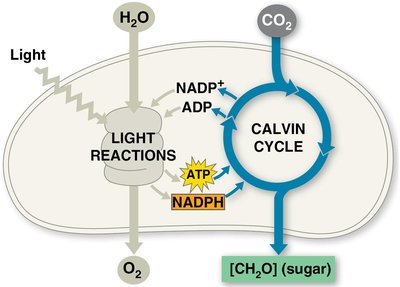
Step 1: Carbon Fixation
- CO2 binds to ribulose bisphosphate (RuBP), catalyzed by rubisco. - Forms a six-carbon intermediate, immediately split into two molecules of 3-phosphoglycerate.
Step 2: Reduction
- 3-phosphoglycerate is phosphorylated by ATP and reduced by NADPH to produce G3P. - For every 3 CO2 molecules, 6 G3P are produced, but only 1 is net gain; the rest are recycled.
Step 3: Regeneration of CO2 Acceptor
- Five G3P molecules are rearranged to regenerate three RuBP molecules, requiring additional ATP.
Logistics of the Calvin Cycle
- For one net G3P: 9 ATP and 6 NADPH are consumed. - G3P: Essential for carbohydrate production and other metabolic pathways.
Adaptations to Environmental Challenges
C3 Plants and Photorespiration
C3 plants use the Calvin cycle for carbon fixation, forming 3-phosphoglycerate. In hot, dry conditions, stomata close to conserve water, leading to photorespiration. - Photorespiration: Rubisco binds O2 instead of CO2, producing 2-phosphoglycolate, which is less efficient.
C4 Plants
C4 plants fix carbon dioxide into a four-carbon compound, allowing them to minimize photorespiration and thrive in hot, dry climates. - PEP carboxylase: Catalyzes initial fixation in mesophyll cells. - Bundle sheath cells: Calvin cycle occurs here, separated from O2 exposure.
CAM Plants
CAM plants open stomata at night, storing CO2 as organic acids, and release CO2 during the day for the Calvin cycle. - Temporal separation: Carbon fixation and Calvin cycle occur at different times.
Comparison of C3, C4, and CAM Pathways
Pathway | Carbon Fixation | Adaptation |
|---|---|---|
C3 | 3-phosphoglycerate | Most common, less efficient in hot/dry climates |
C4 | 4-carbon compound | Spatial separation, efficient in hot/dry climates |
CAM | Organic acids at night | Temporal separation, efficient in arid environments |
Importance of Photosynthesis
Photosynthesis stores solar energy as chemical energy in organic compounds, providing the foundation for life. - Sugar produced: Supplies energy and carbon skeletons for cellular processes. - Excess sugar: Stored as starch in various plant tissues.
Summary
Photosynthesis is essential for life, converting light energy into chemical energy, producing oxygen, and supporting metabolic pathways. Adaptations such as C4 and CAM pathways allow plants to survive in challenging environments. Key equations: ATP and NADPH: Produced in light reactions, consumed in Calvin cycle. G3P: Central product of Calvin cycle, precursor for glucose and other carbohydrates. Adaptations: C4 and CAM plants minimize water loss and photorespiration. Chloroplasts and mitochondria: Both use chemiosmosis for ATP synthesis, but differ in energy sources and functions.
