 Back
BackLEC 12: Photosynthesis: Light Reactions, Chemiosmosis, and the Calvin Cycle
Study Guide - Smart Notes
 Tailored notes based on your materials, expanded with key definitions, examples, and context.
Photosynthesis: Light Reactions and Chemiosmosis
Overview of Photosynthetic Electron Transport
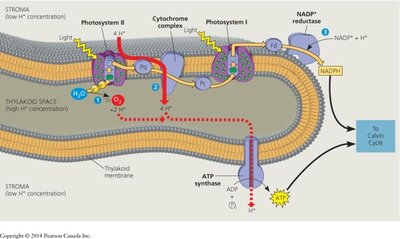
Photosynthesis in plants involves the conversion of light energy into chemical energy, primarily in the form of ATP and NADPH, which are then used to fix carbon dioxide into carbohydrates. The light reactions occur in the thylakoid membranes of chloroplasts and involve two main photosystems (PSII and PSI), an electron transport chain, and the generation of a proton gradient.
Photosystem II (PSII): Absorbs light, splits water molecules, and releases O2 while transferring electrons through a series of carriers.
Electron Transport Chain: Electrons move from PSII to PSI via plastoquinone (Pq), cytochrome b6f complex, and plastocyanin (Pc), pumping protons into the thylakoid space.
Photosystem I (PSI): Absorbs light, further energizes electrons, which are then used to reduce NADP+ to NADPH.
Proton Gradient: The movement of electrons is coupled to the translocation of protons (H+) into the thylakoid space, creating a proton motive force.

Chemiosmotic Coupling and ATP Synthesis
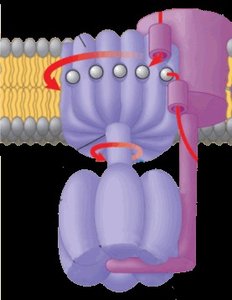
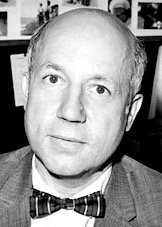
Chemiosmotic coupling, first proposed by Peter Mitchell, explains how the energy stored in a proton gradient across a membrane is used to synthesize ATP. In chloroplasts, this occurs across the thylakoid membrane, where ATP synthase harnesses the proton motive force to convert ADP and inorganic phosphate (Pi) into ATP.
ATP Synthase: A multi-subunit enzyme complex that allows protons to flow back into the stroma, driving the phosphorylation of ADP.
Proton Motive Force: The potential energy stored in the proton gradient is essential for ATP production.
Stoichiometry: Approximately 3-4 protons are required to generate one molecule of ATP.
Equation for ATP synthesis:
Additional info: Similar chemiosmotic mechanisms are found in bacterial plasma membranes and the inner mitochondrial membrane.
Linear and Cyclic Electron Flow
Linear Electron Flow
Linear electron flow is the primary pathway in the light reactions, producing both ATP and NADPH. However, the Calvin cycle requires more ATP than NADPH, necessitating an alternative mechanism to balance the ATP/NADPH ratio.
Products: ATP, NADPH, and O2 (from water splitting).
Imbalance: Carbon fixation reactions require about 1.5 times more ATP than NADPH.
Cyclic Electron Flow
Cyclic electron flow involves only PSI and results in the production of ATP without the formation of NADPH or O2. This pathway is engaged when the cell senses excess NADPH or a need for additional ATP.
Pathway: Electrons from ferredoxin (Fd) are cycled back to plastoquinone (Pq), then through the cytochrome b6f complex, contributing to the proton gradient.
Significance: Allows ATP production to continue without accumulating excess NADPH; protects plants from high light intensity.
Ancient Mechanism: Some photosynthetic bacteria use only cyclic electron flow.
Summary of Cyclic Electron Flow:
Electrons circle back to PSI reaction center.
Transfer from ferredoxin to plastoquinone instead of NADP+.
Proton pumping at cytochrome b6f increases the H+ gradient.
ATP is produced via cyclic photophosphorylation.
The Calvin Cycle: Carbon Fixation and Carbohydrate Synthesis
Overview of the Calvin Cycle
The Calvin cycle, also known as the C3 pathway, is the set of biochemical reactions that occur in the stroma of the chloroplast, using ATP and NADPH from the light reactions to fix CO2 into carbohydrates.
Location: Stroma of the chloroplast.
Phases: Carbon fixation, reduction, and regeneration of RuBP.
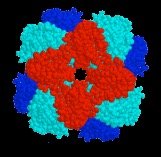
Key Enzyme: Ribulose 1,5-bisphosphate carboxylase/oxygenase (Rubisco).
Phase 1: Carbon Fixation
CO2 is fixed by Rubisco, which catalyzes the addition of CO2 to ribulose 1,5-bisphosphate (RuBP), forming an unstable 6-carbon intermediate that splits into two molecules of 3-phosphoglycerate (3-PGA).
Reaction:
Importance: This is the entry point for inorganic carbon into the biosphere.
Phase 2: Reduction
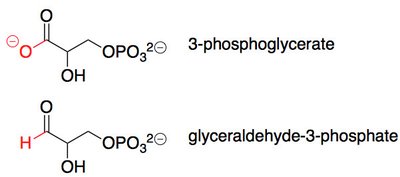
3-phosphoglycerate is phosphorylated by ATP and then reduced by NADPH to form glyceraldehyde-3-phosphate (G3P), a 3-carbon sugar.
Key Steps: 3-PGA + ATP → 1,3-bisphosphoglycerate; 1,3-bisphosphoglycerate + NADPH → G3P.
Products: For every 3 CO2 fixed, 6 G3P are produced, but only one is a net gain for the plant.
Phase 3: Regeneration of RuBP
Most G3P molecules are used to regenerate RuBP, allowing the cycle to continue. This phase requires additional ATP.
Stoichiometry: 5 G3P are rearranged to regenerate 3 RuBP.
Energy Requirement: 9 ATP and 6 NADPH are consumed per net G3P produced.
Summary Equation for the Calvin Cycle
Photorespiration and Adaptations
Photorespiration
Photorespiration is a process that competes with photosynthesis, occurring when Rubisco uses O2 instead of CO2 as a substrate. This leads to the formation of glycolate, which is metabolized at an energetic cost and results in the loss of fixed carbon as CO2.
Conditions Favoring Photorespiration: High O2/low CO2 ratio, often due to closed stomata on hot, dry days.
Impact: Can reduce photosynthetic yield by up to 50% in C3 plants.
Mechanism: Rubisco's oxygenase activity leads to the formation of a 2-carbon molecule (glycolate) and a 3-carbon molecule (3-PGA).
Adaptations to Minimize Photorespiration
Some plants have evolved mechanisms to reduce photorespiration and increase the efficiency of carbon fixation under stress conditions.
C4 Photosynthesis: Spatial separation of initial CO2 fixation (by PEP carboxylase) and the Calvin cycle. Occurs in two types of cells: mesophyll and bundle-sheath cells. PEP carboxylase is not inhibited by O2.
CAM Metabolism: Temporal separation of steps. CO2 is fixed at night into organic acids and released for the Calvin cycle during the day. Common in succulents and desert plants.
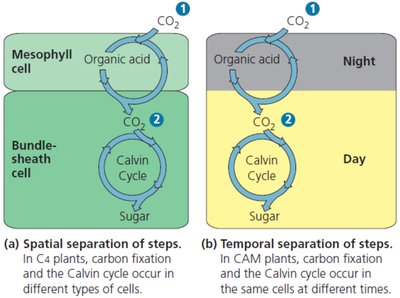
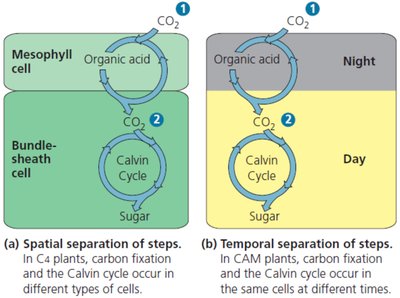
Additional info: These adaptations allow plants to thrive in hot, arid environments by minimizing water loss and maximizing carbon fixation efficiency.
