 Back
Photosynthesis: Mechanisms, Adaptations, and Importance
Study Guide - Smart Notes
 Tailored notes based on your materials, expanded with key definitions, examples, and context.
Photosynthesis
10.1 Photosynthesis Feeds the Biosphere
Photosynthesis is the fundamental process by which solar energy is converted into chemical energy, sustaining nearly all life on Earth. It nourishes the biosphere by providing food and oxygen.
Autotrophs: Organisms that produce their own food from inorganic sources (e.g., plants, algae).
Photoautotrophs: Autotrophs that use light as an energy source.
Heterotrophs: Organisms that obtain carbon from organic compounds (e.g., animals, fungi).
Producers: Autotrophs that form the base of food chains.
Consumers: Heterotrophs that rely on producers for energy.
10.2 Photosynthesis Converts Light Energy to Chemical Energy
Photosynthesis occurs primarily in leaves, within specialized cells and organelles. The process involves the conversion of light energy into chemical energy stored in glucose.
Leaves: Main organ of photosynthesis.
Mesophyll: Interior leaf tissue where most photosynthesis occurs.
Stomata: Pores for gas exchange (CO2 in, O2 out).
Chloroplast: Organelle containing chlorophyll, the pigment responsible for capturing light.
Thylakoids: Membranous sacs within chloroplasts; site of light reactions.
Grana: Stacks of thylakoids.
Stroma: Fluid surrounding thylakoids; site of the Calvin cycle.
Photosynthesis Equation:
Oxygen produced during photosynthesis comes from the splitting of water molecules.
Photosynthesis is a redox and endergonic process (requires energy input).
The Two Stages of Photosynthesis
Light Reactions: Occur in thylakoids; convert light and water into O2, ATP, and NADPH (via photophosphorylation).
Calvin Cycle: Occurs in stroma; uses ATP, NADPH, and CO2 to produce G3P (a sugar).
10.3 The Light Reactions: Conversion of Solar Energy
Light reactions transform solar energy into chemical energy (ATP and NADPH) using pigments and photosystems.
Sunlight: Electromagnetic energy traveling in waves; energy determined by wavelength.
Photons: Discrete particles of light.
Photosynthetic Pigments: Light Receptors
Pigments absorb specific wavelengths of light.
Chlorophyll a: Main photosynthetic pigment.
Chlorophyll b: Broadens absorption spectrum.
Carotenoids: Provide photoprotection by absorbing excess light.
Wavelengths not absorbed are reflected or transmitted; leaves appear green because chlorophyll reflects green light.
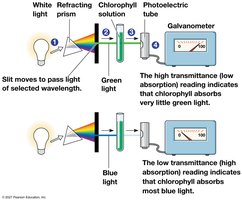
Absorption Spectrum
Chlorophyll a: Absorbs mainly blue and red light.
Chlorophyll b: Absorbs additional wavelengths.
Carotenoids: Absorb blue and green light, protecting chlorophyll from damage.
Excitation of Chlorophyll by Light
Absorption of light excites electrons in chlorophyll.
Excited electrons return to ground state, releasing energy as fluorescence and heat.
Isolated chlorophyll glows when exposed to light.
Photosystems: Reaction-Center Complexes
Photosystems: Complexes of pigments and proteins that capture light energy.
Reaction-center complex: Contains special chlorophyll a and a primary electron acceptor.
Light-harvesting complexes: Transfer photon energy to the reaction center.
Two Photosystems
Photosystem II (PSII): Functions first; best at 680 nm (P680).
Photosystem I (PSI): Functions second; best at 700 nm (P700).
Electron Flow in Light Reactions
Linear Electron Flow: Involves both photosystems; produces ATP and NADPH.
Cyclic Electron Flow: Involves only PSI; produces extra ATP, no NADPH or O2.
Comparison of Chemiosmosis: Mitochondria vs. Chloroplasts
Mitochondria: Use food energy for ATP production (oxidative phosphorylation).
Chloroplasts: Use light energy for ATP production (photophosphorylation).
Both rely on a proton gradient across membranes.
Organelle | Energy Source | ATP Production Site | Proton Gradient Location |
|---|---|---|---|
Mitochondria | Food | Matrix | Intermembrane space |
Chloroplasts | Light | Stroma | Thylakoid space |
10.4 The Calvin Cycle: Reducing CO2 to Sugar
The Calvin cycle uses ATP and NADPH from light reactions to build sugars from CO2. It is the main pathway for carbon fixation in plants.
RuBP: Ribulose bisphosphate, the CO2 acceptor.
Rubisco: Enzyme catalyzing carbon fixation.
G3P: Glyceraldehyde 3-phosphate, a sugar product (requires 3 turns of the cycle).
Steps: Carbon fixation, reduction, regeneration of RuBP.
Alternative Mechanisms of Carbon Fixation in Hot, Arid Climates
Plants have evolved adaptations to minimize water loss and photorespiration under hot, dry conditions.
Closing stomata conserves water but limits photosynthesis.
Photorespiration: Rubisco adds O2 instead of CO2, consuming energy and releasing CO2 without producing sugar.
Adaptation #1: C4 Plants
Store CO2 in 4-carbon compounds in one cell.
PEP carboxylase fixes CO2 efficiently.
CO2 released in a different cell for the Calvin cycle.
Examples: Sugarcane, corn, grasses.
Adaptation #2: CAM Plants
Open stomata at night to store CO2 as organic acids.
Stomata close during the day; CO2 is released for photosynthesis.
Examples: Succulents, cacti.
10.6 Photosynthesis is Essential for Life on Earth: A Review
Photosynthesis is vital for sustaining life, providing food, oxygen, and maintaining atmospheric balance. It is the foundation of energy flow in ecosystems.
