 Back
BackPhotosynthesis: Mechanisms, Adaptations, and Importance
Study Guide - Smart Notes
 Tailored notes based on your materials, expanded with key definitions, examples, and context.
Photosynthesis: Mechanisms, Adaptations, and Importance
Photosynthesis Feeds the Biosphere
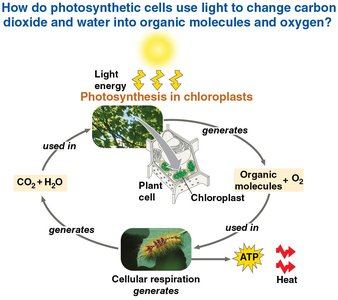
Photosynthesis is the process by which solar energy is converted into chemical energy within chloroplasts, nourishing almost all life on Earth either directly or indirectly.
Autotrophs are organisms that produce organic molecules from CO2 and other inorganic substances. They are the primary producers of the biosphere.
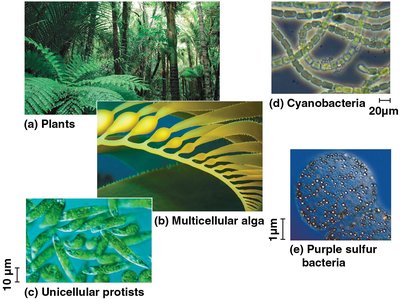
Photoautotrophs use sunlight to synthesize organic compounds. Examples include plants, algae, certain protists, and some prokaryotes.
Heterotrophs obtain organic material by consuming other organisms. They include consumers and decomposers.
Fossil fuels are ancient stores of solar energy, formed from the remains of organisms.
Chloroplasts: The Sites of Photosynthesis in Plants
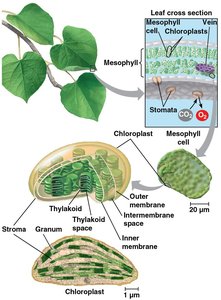
Photosynthesis primarily occurs in the leaves of plants, within organelles called chloroplasts. These organelles are structurally adapted to facilitate the chemical reactions of photosynthesis.
Chloroplasts are mainly found in mesophyll cells of leaves.
Stomata are microscopic pores that allow gas exchange (CO2 in, O2 out).
Veins transport water and nutrients to leaves and export sugars to other plant parts.
Chloroplasts have a double membrane and contain a dense fluid called the stroma.
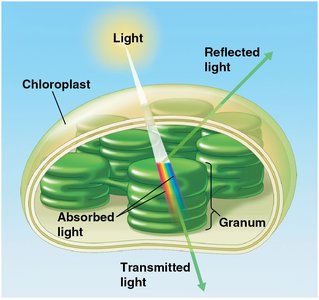
Thylakoids are membrane-bound sacs, often stacked into grana, containing chlorophyll.
The Overall Equation of Photosynthesis
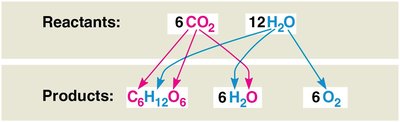
Photosynthesis is a complex series of reactions summarized by the following equation:
This process is the reverse of cellular respiration.
Chloroplasts split water, releasing O2 as a by-product and incorporating hydrogen into sugar molecules.

Photosynthesis as a Redox Process
Photosynthesis involves the transfer of electrons (redox reactions):
H2O is oxidized (loses electrons), and CO2 is reduced (gains electrons).
The process is endergonic (requires energy), with light providing the energy boost.
The Two Stages of Photosynthesis
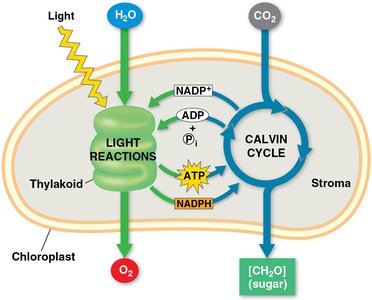
Photosynthesis consists of two main stages: the light reactions and the Calvin cycle.
Light reactions (in the thylakoids):
Split H2O, releasing O2
Reduce NADP+ to NADPH
Generate ATP by photophosphorylation
Calvin cycle (in the stroma):
Uses ATP and NADPH to convert CO2 into sugar (G3P)
Begins with carbon fixation
The Light Reactions: Converting Solar Energy to Chemical Energy
The Nature of Sunlight
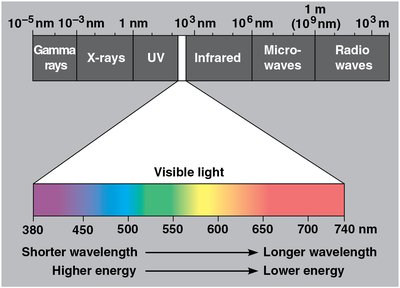
Light is a form of electromagnetic energy, traveling in waves. The electromagnetic spectrum encompasses all wavelengths of electromagnetic radiation, but only visible light (380–740 nm) drives photosynthesis.
Light also behaves as particles called photons.
Shorter wavelengths have higher energy per photon.
Photosynthetic Pigments: The Light Receptors
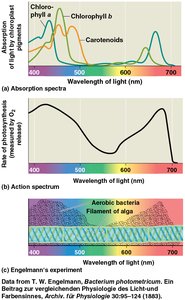
Pigments are substances that absorb visible light. Different pigments absorb different wavelengths, and the color observed is the wavelength reflected or transmitted.
Chlorophyll a: Main pigment in light reactions.
Chlorophyll b: Accessory pigment, broadens the spectrum.
Carotenoids: Accessory pigments, absorb violet and blue-green light, and provide photoprotection.
Measuring Pigment Absorption
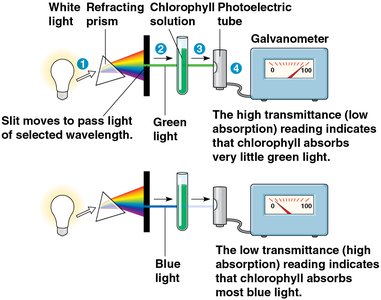
A spectrophotometer measures a pigment’s ability to absorb various wavelengths. The absorption spectrum plots absorption versus wavelength, while the action spectrum shows the effectiveness of different wavelengths for photosynthesis.
Structure and Function of Chlorophyll
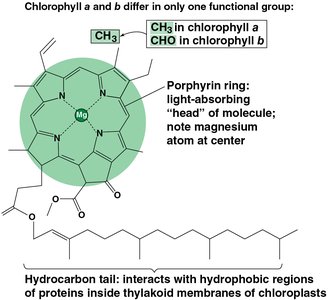
Chlorophyll a and b differ in a single functional group, affecting their absorption spectra. The porphyrin ring structure allows for light absorption, with a magnesium atom at the center.
Excitation of Chlorophyll by Light
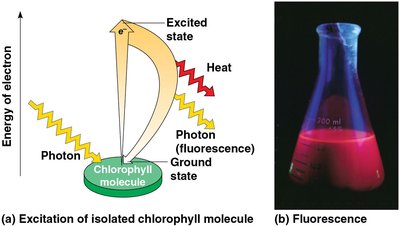
When chlorophyll absorbs light, electrons are excited to a higher energy state. In isolation, these electrons return to the ground state, releasing energy as heat or fluorescence.
Photosystems: Light-Harvesting Complexes
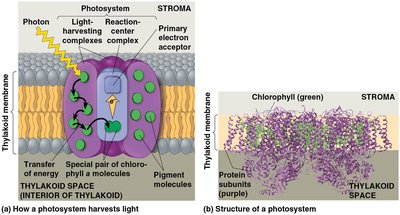
A photosystem consists of a reaction-center complex surrounded by light-harvesting complexes. The reaction center contains a special pair of chlorophyll a molecules and a primary electron acceptor.
Light-harvesting complexes transfer energy to the reaction center.
Solar-powered electron transfer to the primary acceptor is the first step of the light reactions.
Linear Electron Flow in the Light Reactions
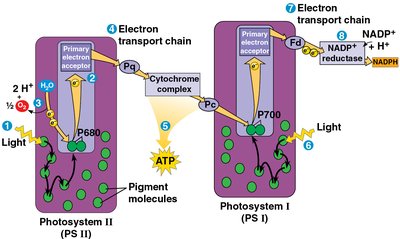
Linear electron flow is the primary pathway, involving both photosystems (PS II and PS I) and producing ATP and NADPH.
Photon excites pigment in PS II, energy transferred to P680.
Excited electron from P680 transferred to primary acceptor (P680+).
H2O is split, electrons reduce P680+, O2 released.
Electrons move down electron transport chain to PS I, creating a proton gradient for ATP synthesis.
Light excites P700 in PS I, electron transferred to acceptor.
Electrons passed to ferredoxin (Fd), then to NADP+ to form NADPH.
Cyclic Electron Flow
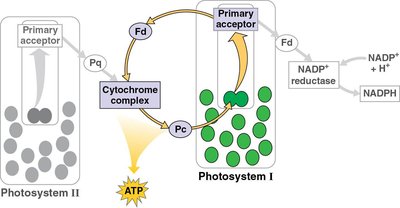
In cyclic electron flow, electrons cycle back from Fd to the cytochrome complex and then to P700. This process produces ATP but not NADPH or O2, and is used by some photosynthetic bacteria and as a photoprotective mechanism in plants.
Comparison of Chemiosmosis in Chloroplasts and Mitochondria
Both organelles use chemiosmosis to generate ATP, but differ in their energy sources and spatial organization:
Chloroplasts use light energy; mitochondria use chemical energy from food.
Proton gradients are established across different membranes, but both use ATP synthase for ATP production.
The Calvin Cycle: Reducing CO2 to Sugar
Overview of the Calvin Cycle
The Calvin cycle uses ATP and NADPH from the light reactions to convert CO2 into the three-carbon sugar glyceraldehyde 3-phosphate (G3P). The cycle must turn three times to fix three CO2 molecules and produce one net G3P.
Phase 1: Carbon fixation – CO2 is attached to ribulose bisphosphate (RuBP) by rubisco, forming 3-phosphoglycerate.
Phase 2: Reduction – 3-phosphoglycerate is phosphorylated and reduced to G3P using ATP and NADPH.
Phase 3: Regeneration – RuBP is regenerated from G3P, using additional ATP.
For one G3P, the cycle consumes 9 ATP and 6 NADPH.
Adaptations to Hot, Arid Climates: C4 and CAM Plants
Photorespiration and Its Consequences
Photorespiration occurs when rubisco binds O2 instead of CO2, leading to a wasteful process that consumes energy without producing sugar. It is considered an evolutionary relic from a time when atmospheric O2 was much lower.
C4 Plants
C4 plants minimize photorespiration by initially fixing CO2 into a four-carbon compound in mesophyll cells. This compound is transported to bundle-sheath cells, where CO2 is released for use in the Calvin cycle. Examples include sugarcane and corn.
CAM Plants
CAM (Crassulacean Acid Metabolism) plants open their stomata at night to fix CO2 into organic acids, which release CO2 during the day for the Calvin cycle. This adaptation is common in succulents and helps conserve water.
Photosynthesis: Essential for Life on Earth
Photosynthesis stores solar energy as chemical energy in organic compounds, providing the foundation for nearly all life. Plants store excess sugar as starch and supply energy and carbon skeletons for biosynthesis in all living organisms.
Process | Location | Inputs | Outputs |
|---|---|---|---|
Light Reactions | Thylakoid membrane | Light, H2O, NADP+, ADP + Pi | O2, ATP, NADPH |
Calvin Cycle | Stroma | CO2, ATP, NADPH | G3P (sugar), NADP+, ADP + Pi |
Key Terms: Photosynthesis, chloroplast, thylakoid, stroma, grana, chlorophyll, light reactions, Calvin cycle, photorespiration, C3 plants, C4 plants, CAM plants, chemiosmosis, ATP synthase, photophosphorylation, carbon fixation.
