 Back
Photosynthesis: Mechanisms, Adaptations, and Importance in the Biosphere
Study Guide - Smart Notes
 Tailored notes based on your materials, expanded with key definitions, examples, and context.
Photosynthesis: Feeding the Biosphere
Introduction to Photosynthesis
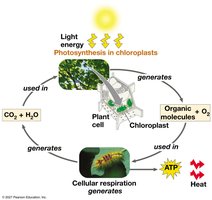
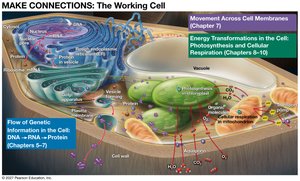
Photosynthesis is the fundamental process by which plants, algae, and certain bacteria convert solar energy into chemical energy, sustaining nearly all life on Earth. This process occurs within specialized organelles called chloroplasts and is essential for the production of organic molecules and oxygen.
Autotrophs: Organisms that produce their own food from inorganic substances. Most plants are photoautotrophs, using sunlight to synthesize organic compounds.
Heterotrophs: Organisms that obtain organic material by consuming other organisms. They rely on autotrophs for food and oxygen.
Fossil fuels: Ancient stores of solar energy, formed from the remains of organisms.
Photosynthesis equation:
Types of Photosynthetic Organisms
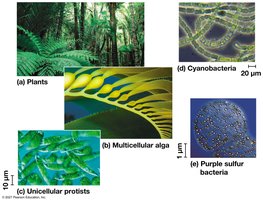
Photosynthesis is not limited to plants; it also occurs in multicellular algae, unicellular protists, cyanobacteria, and purple sulfur bacteria.
Photoautotrophs: Use sunlight to make organic molecules.
Examples: Ferns, algae, cyanobacteria, purple sulfur bacteria.
Chloroplasts: The Sites of Photosynthesis
Structure and Function of Chloroplasts
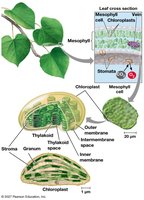
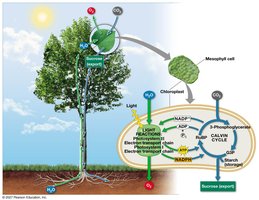
Chloroplasts are found mainly in the mesophyll cells of leaves. They have a double membrane and contain a dense fluid called stroma. Thylakoids, which may be stacked into grana, house the pigment chlorophyll.
Stomata: Microscopic pores for gas exchange.
Veins: Transport water and sugars.
Thylakoids: Membranous sacs where light reactions occur.
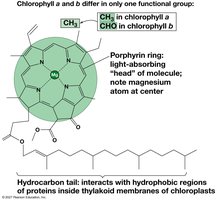
Chlorophyll: Green pigment responsible for capturing light energy.
Photosynthesis: Chemical Overview
Tracking Atoms Through Photosynthesis
Photosynthesis involves splitting water molecules and incorporating hydrogen into sugars, releasing oxygen as a by-product. The process is the reverse of cellular respiration.
Reactants: Carbon dioxide and water.
Products: Glucose, water, and oxygen.
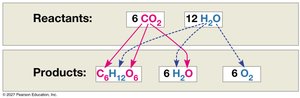
Photosynthesis as a Redox Process
Photosynthesis reverses the direction of electron flow compared to respiration. It is a redox process: carbon dioxide is reduced, and water is oxidized. The process is endergonic, requiring energy input from light.
Reduction: Gain of electrons (CO2 to C6H12O6).
Oxidation: Loss of electrons (H2O to O2).

The Two Stages of Photosynthesis
Light Reactions and Calvin Cycle
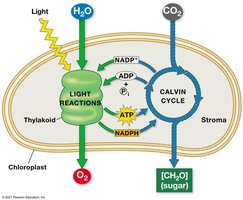
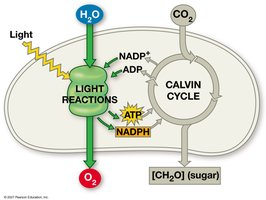
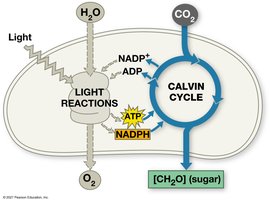
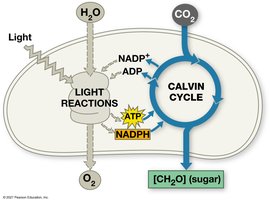
Photosynthesis consists of two main stages: the light reactions and the Calvin cycle. The light reactions occur in the thylakoids and generate ATP and NADPH, while the Calvin cycle occurs in the stroma and synthesizes sugars.
Light reactions: Split water, release O2, reduce NADP+ to NADPH, generate ATP by photophosphorylation.
Calvin cycle: Uses ATP and NADPH to fix carbon dioxide and produce carbohydrates.
The Nature of Sunlight
Electromagnetic Spectrum and Light Energy
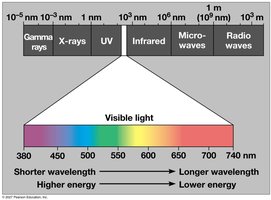
Light is electromagnetic energy, traveling in waves. The electromagnetic spectrum includes all wavelengths, but only visible light (380–740 nm) drives photosynthesis.
Photon: A discrete particle of light energy.
Energy per photon: Inversely related to wavelength; shorter wavelengths have higher energy.
Photosynthetic Pigments: Light Receptors
Types and Functions of Pigments
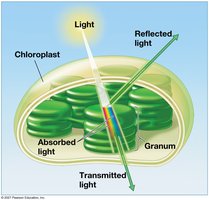
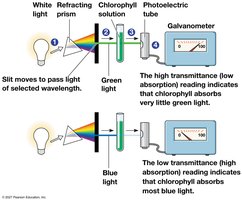
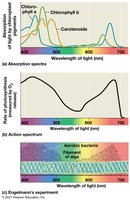
Pigments absorb specific wavelengths of light. Chlorophyll a is the primary pigment, while chlorophyll b and carotenoids are accessory pigments that broaden the spectrum and provide photoprotection.
Chlorophyll a: Absorbs violet-blue and red light; reflects green.
Chlorophyll b: Accessory pigment; slightly different absorption spectrum.
Carotenoids: Absorb violet and blue-green light; yellow/orange color.
Excitation of Chlorophyll by Light
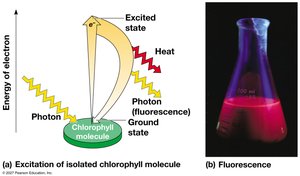
When chlorophyll absorbs light, electrons are excited to a higher energy state. In isolation, these electrons return to the ground state, releasing energy as heat or fluorescence.
Fluorescence: Afterglow from excited electrons returning to ground state.
Photosystems and Electron Flow
Structure and Function of Photosystems
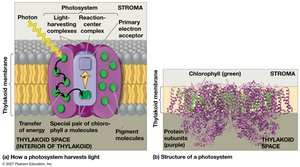
A photosystem consists of a reaction-center complex surrounded by light-harvesting complexes. There are two types: Photosystem II (P680) and Photosystem I (P700), each absorbing different wavelengths.
Reaction-center complex: Holds special chlorophyll a molecules and a primary electron acceptor.
Light-harvesting complex: Transfers energy to the reaction center.
Linear Electron Flow
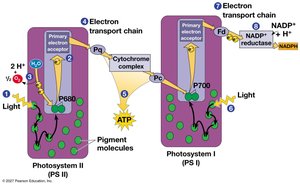
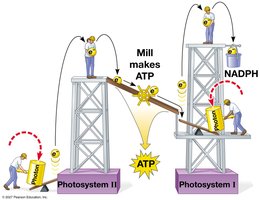
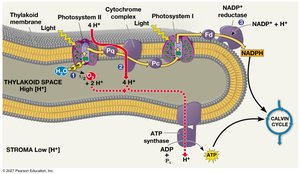
Linear electron flow is the primary pathway during light reactions, involving both photosystems and producing ATP and NADPH. It includes the splitting of water, electron transport chains, and chemiosmosis.
Photosystem II: Splits water, releases O2, transfers electrons.
Electron transport chain: Pumps protons, creates gradient.
Photosystem I: Excites electrons, reduces NADP+ to NADPH.
ATP synthase: Uses proton gradient to generate ATP.
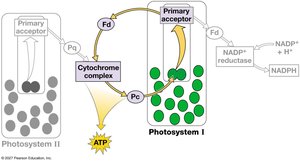
Cyclic Electron Flow
Cyclic electron flow involves only Photosystem I and produces ATP without generating NADPH or O2. It is an alternative pathway, especially in photosynthetic bacteria and under intense light conditions.
Photoprotective role: May protect plants from damage under high light intensity.
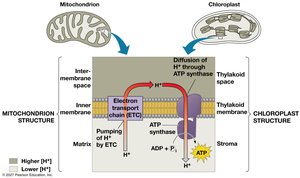
Comparison of Chemiosmosis in Chloroplasts and Mitochondria
Mechanisms and Differences
Both organelles generate ATP by chemiosmosis, but differ in electron sources and spatial organization. Chloroplasts use light energy, while mitochondria use chemical energy from food.
Electron transport chain: Pumps protons across membranes.
ATP synthase: Similar structure in both organelles.
Spatial differences: Protons pumped into thylakoid space (chloroplasts) vs. intermembrane space (mitochondria).
The Calvin Cycle: Synthesis of Sugar
Phases of the Calvin Cycle
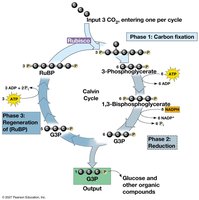
The Calvin cycle is an anabolic pathway that uses ATP and NADPH to fix carbon dioxide and produce glyceraldehyde 3-phosphate (G3P), a precursor to glucose and other carbohydrates. It consists of three phases: carbon fixation, reduction, and regeneration of RuBP.
Phase 1: Carbon fixation: CO2 binds to RuBP, catalyzed by rubisco.
Phase 2: Reduction: 3-phosphoglycerate is converted to G3P using ATP and NADPH.
Phase 3: Regeneration: RuBP is regenerated for the next cycle.
Net result: For one G3P, the cycle consumes 9 ATP and 6 NADPH.
Adaptations in Carbon Fixation
Photorespiration and Alternative Pathways
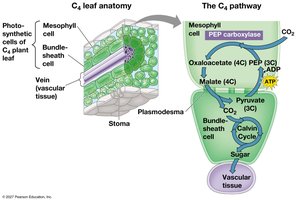
Photorespiration occurs when rubisco binds O2 instead of CO2, reducing efficiency. C4 and CAM plants have evolved mechanisms to minimize photorespiration and optimize carbon fixation in hot, arid climates.
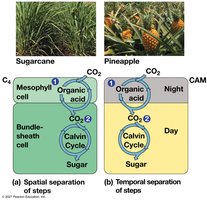
C4 plants: Spatially separate carbon fixation and Calvin cycle; use PEP carboxylase.
CAM plants: Temporally separate carbon fixation (night) and Calvin cycle (day).
Examples: Sugarcane (C4), pineapple (CAM).
Photosynthesis: Essential for Life
Importance and Review
Photosynthesis stores solar energy as chemical energy, providing the basis for nearly all food webs. Plants store excess sugar as starch and supply energy and carbon skeletons for cellular metabolism.
Energy flow: Sunlight → chemical energy → organic molecules.
Storage: Starch in roots, tubers, seeds, fruits.
Summary Table: Comparison of C3, C4, and CAM Photosynthesis
Type | Initial Carbon Fixation | Adaptation | Example |
|---|---|---|---|
C3 | CO2 fixed by rubisco (forms 3-phosphoglycerate) | Most common; susceptible to photorespiration | Rice, wheat |
C4 | CO2 fixed by PEP carboxylase (forms 4-carbon compound) | Spatial separation; minimizes photorespiration | Corn, sugarcane |
CAM | CO2 fixed at night (forms organic acids) | Temporal separation; conserves water | Pineapple, succulents |
