 Back
BackPhotosynthesis: Mechanisms, Adaptations, and Significance
Study Guide - Smart Notes
 Tailored notes based on your materials, expanded with key definitions, examples, and context.
Photosynthesis: Mechanisms, Adaptations, and Significance
Photosynthesis Feeds the Biosphere
Photosynthesis is the process by which solar energy is converted into chemical energy within chloroplasts, sustaining almost all life on Earth. Organisms that perform photosynthesis are called autotrophs, and they produce organic molecules from carbon dioxide and other inorganic substances. Heterotrophs, in contrast, obtain organic material by consuming other organisms and are thus dependent on autotrophs for food and oxygen.
Autotrophs: "Self-feeders" that produce their own food; includes plants, algae, and some prokaryotes.
Photoautotrophs: Use sunlight to synthesize organic compounds.
Heterotrophs: Obtain organic molecules by consuming other organisms; includes animals, fungi, and many bacteria.
Decomposers: Heterotrophs that break down dead organic material or feces.
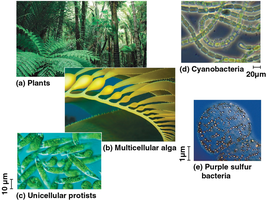
Example: Fossil fuels are ancient stores of solar energy, formed from the remains of organisms that died millions of years ago.
Chloroplasts: The Sites of Photosynthesis in Plants
Photosynthesis primarily occurs in the leaves of plants, within organelles called chloroplasts. These organelles are mainly found in the mesophyll cells of leaves. Chloroplasts have a double membrane and contain a dense fluid called the stroma. Inside, interconnected sacs called thylakoids are stacked into grana, and the green pigment chlorophyll is embedded in the thylakoid membranes.
Stomata: Microscopic pores that allow gas exchange (CO2 in, O2 out).
Veins: Transport water from roots and export sugars to non-photosynthetic tissues.
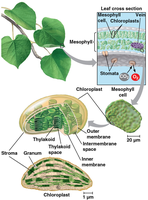
Tracking Atoms Through Photosynthesis
The overall process of photosynthesis can be summarized by the following equation, which is essentially the reverse of cellular respiration:
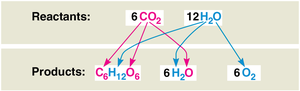
Chloroplasts split water into hydrogen and oxygen, incorporating the electrons of hydrogen into sugar molecules and releasing oxygen as a by-product.
Photosynthesis as a Redox Process
Photosynthesis is a redox (oxidation-reduction) process in which water is oxidized and carbon dioxide is reduced. The process is endergonic, requiring an input of energy from sunlight.

The Two Stages of Photosynthesis: Light Reactions and the Calvin Cycle
Photosynthesis consists of two main stages: the light reactions and the Calvin cycle. The light reactions occur in the thylakoid membranes and convert solar energy into chemical energy (ATP and NADPH), releasing oxygen as a by-product. The Calvin cycle occurs in the stroma and uses ATP and NADPH to convert CO2 into sugar.
Light Reactions: Split water, release O2, produce ATP and NADPH.
Calvin Cycle: Incorporates CO2 into organic molecules (carbon fixation), reduces fixed carbon to carbohydrate using ATP and NADPH.
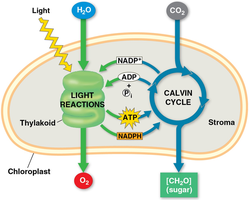
The Light Reactions: Converting Solar Energy to Chemical Energy
The Nature of Sunlight
Light is a form of electromagnetic energy, traveling in waves. The electromagnetic spectrum encompasses all wavelengths of electromagnetic radiation, but only visible light (380–740 nm) is used in photosynthesis. Light also behaves as discrete particles called photons, each with a fixed energy inversely related to its wavelength.
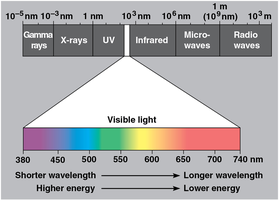
Photosynthetic Pigments: The Light Receptors
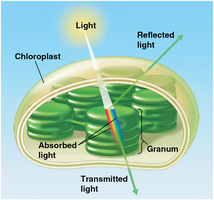
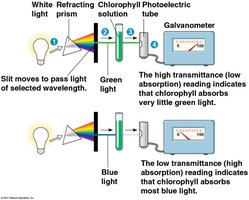
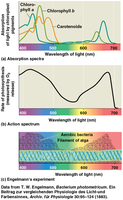
Pigments are substances that absorb visible light. Different pigments absorb different wavelengths; those not absorbed are reflected or transmitted, giving leaves their green color due to chlorophyll. The absorption spectrum shows which wavelengths are absorbed, while the action spectrum shows which wavelengths are most effective for photosynthesis.
A spectrophotometer measures a pigment’s ability to absorb various wavelengths, producing an absorption spectrum.
Chloroplasts contain three main types of pigments:
Chlorophyll a: The primary pigment in light reactions.
Chlorophyll b: An accessory pigment that broadens the spectrum of light used.
Carotenoids: Accessory pigments that absorb additional wavelengths and provide photoprotection.
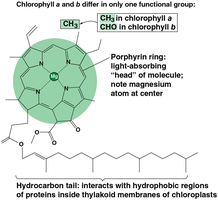
The difference between chlorophyll a and b is due to a slight structural variation, affecting their absorption properties.
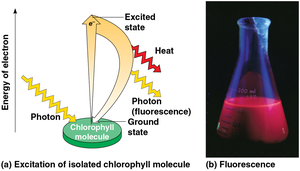
Excitation of Chlorophyll by Light
When a pigment absorbs a photon, an electron is elevated to an excited state. This state is unstable, and the electron quickly returns to the ground state, releasing energy as heat or fluorescence (emission of light).
A Photosystem: Reaction-Center Complex and Light-Harvesting Complexes
A photosystem consists of a reaction-center complex surrounded by light-harvesting complexes. The reaction center contains a special pair of chlorophyll a molecules and a primary electron acceptor. Light-harvesting complexes transfer photon energy to the reaction center, where an excited electron is transferred to the primary electron acceptor, initiating the light reactions.
Photosystem II (PSII): Contains P680 chlorophyll a, best at absorbing 680 nm light.
Photosystem I (PSI): Contains P700 chlorophyll a, best at absorbing 700 nm light.
Linear and Cyclic Electron Flow
During the light reactions, electrons can follow two paths:
Linear Electron Flow: The main pathway, involving both photosystems, produces ATP and NADPH, and releases O2.
Cyclic Electron Flow: Involves only PSI, produces ATP but not NADPH or O2; may provide photoprotection.
Comparison of Chemiosmosis in Chloroplasts and Mitochondria
Both organelles generate ATP by chemiosmosis, using electron transport chains to pump protons across membranes and drive ATP synthesis via ATP synthase. In chloroplasts, the energy source is light (photophosphorylation); in mitochondria, it is chemical energy from food (oxidative phosphorylation).
The Calvin Cycle: Reducing CO2 to Sugar
Overview of the Calvin Cycle
The Calvin cycle is an anabolic pathway that builds carbohydrates from smaller molecules using ATP and NADPH. It occurs in the stroma and regenerates its starting material, ribulose bisphosphate (RuBP), after molecules enter and leave the cycle. The cycle has three phases:
Carbon Fixation: CO2 is attached to RuBP by the enzyme rubisco, forming 3-phosphoglycerate.
Reduction: 3-phosphoglycerate is phosphorylated and reduced to glyceraldehyde 3-phosphate (G3P).
Regeneration: RuBP is regenerated from G3P, allowing the cycle to continue.
For each G3P produced, the cycle consumes 9 ATP and 6 NADPH, which are regenerated by the light reactions.
Alternative Mechanisms of Carbon Fixation
Photorespiration: An Evolutionary Relic?
Photorespiration occurs when rubisco binds O2 instead of CO2, leading to the consumption of energy without producing sugar. This process is considered wasteful but may protect plants from damage under certain conditions. It is thought to be a relic from an earlier atmosphere with less O2.
C4 and CAM Plants: Adaptations to Hot, Arid Climates
Some plants have evolved alternative carbon fixation pathways to minimize photorespiration and conserve water:
C4 Plants: Incorporate CO2 into four-carbon compounds in mesophyll cells, which are then transported to bundle-sheath cells for the Calvin cycle. This adaptation is found in species like corn and sugarcane.
CAM Plants: Open stomata at night to fix CO2 into organic acids, which release CO2 for the Calvin cycle during the day. This adaptation is common in succulents.
These mechanisms allow plants to balance photosynthesis with water conservation in challenging environments.
Plant Type | Initial CO2 Fixation | Adaptation | Examples |
|---|---|---|---|
C3 | 3-phosphoglycerate (via rubisco) | Standard Calvin cycle; susceptible to photorespiration | Wheat, rice, soybeans |
C4 | Four-carbon compound (via PEP carboxylase) | Spatial separation of steps; reduces photorespiration | Corn, sugarcane |
CAM | Organic acids (at night) | Temporal separation of steps; conserves water | Cacti, pineapples |
