 Back
Photosynthesis: Mechanisms and Importance (Chapter 10 Study Notes)
Study Guide - Smart Notes
 Tailored notes based on your materials, expanded with key definitions, examples, and context.
Photosynthesis: An Overview
Key Concepts of Photosynthesis
Photosynthesis is a fundamental biological process that converts solar energy into chemical energy, sustaining nearly all life on Earth. This process occurs primarily in plants, algae, and certain prokaryotes, and is essential for the biosphere's energy flow and carbon cycling.
Photosynthesis feeds the biosphere by producing organic molecules from inorganic carbon dioxide and water.
It converts light energy to the chemical energy of food, primarily in the form of glucose.
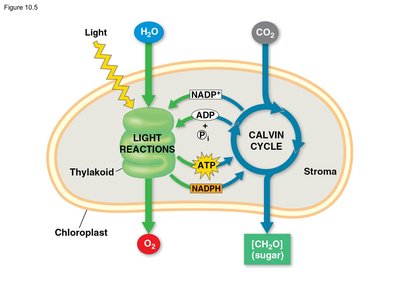
The light reactions convert solar energy to ATP and NADPH, while the Calvin cycle uses these molecules to reduce CO2 to sugar.
Alternative mechanisms of carbon fixation exist in hot, arid climates.
Photosynthesis is essential for life on Earth, providing both food and oxygen.
Photosynthesis Feeds the Biosphere
Autotrophs and the Role of Photosynthesis
Photosynthesis is the process by which solar energy is converted into chemical energy within chloroplasts. This process nourishes almost the entire living world, either directly or indirectly.
Autotrophs ("self-feeders") are organisms that sustain themselves without consuming other organisms. They are the primary producers of the biosphere, producing organic molecules from CO2 and other inorganic substances.
Most plants are photoautotrophs, using sunlight to make organic molecules.
Photosynthetic Organisms
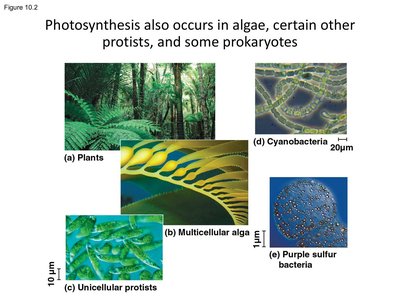
Photosynthesis is not limited to plants; it also occurs in algae, certain protists, and some prokaryotes.
Heterotrophs: The Consumers
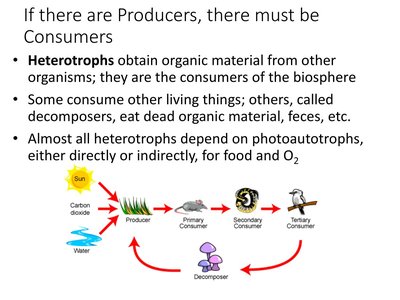
Heterotrophs obtain organic material by consuming other organisms and are considered the consumers of the biosphere. Some heterotrophs are decomposers, feeding on dead organic matter and waste.
Almost all heterotrophs depend on photoautotrophs for food and oxygen, either directly or indirectly.
Photosynthesis Converts Light Energy to Chemical Energy
Chloroplasts: The Site of Photosynthesis
Photosynthetic organisms contain specialized organelles called chloroplasts. These organelles are structurally similar to photosynthetic bacteria, supporting the endosymbiont theory of their origin. The organization of chloroplasts enables the chemical reactions of photosynthesis.
Leaf Structure and Chloroplast Location
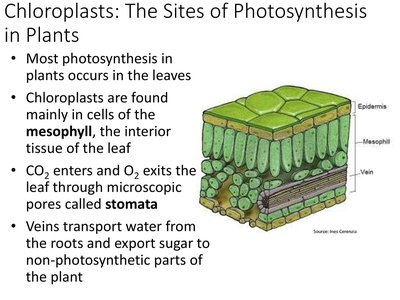
Most photosynthesis in plants occurs in the leaves, specifically in the mesophyll cells. CO2 enters and O2 exits the leaf through microscopic pores called stomata. Veins transport water from roots and export sugar to non-photosynthetic parts of the plant.
Chloroplast Anatomy
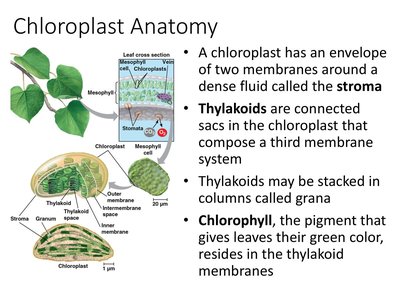
A chloroplast has an envelope of two membranes surrounding a dense fluid called the stroma. Inside, thylakoids are interconnected sacs that may be stacked in columns called grana. Chlorophyll, the pigment responsible for the green color of leaves, is located in the thylakoid membranes.
Tracking Atoms Through Photosynthesis
The Overall Chemical Equation
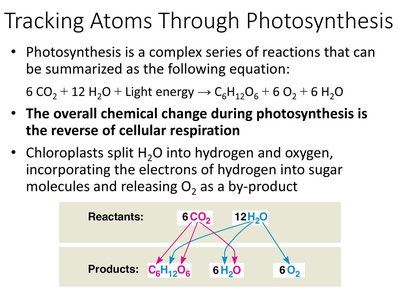
Photosynthesis is a complex series of reactions summarized by the following equation:
The overall chemical change during photosynthesis is the reverse of cellular respiration.
Chloroplasts split H2O, releasing O2 as a by-product and incorporating hydrogen electrons into sugar molecules.
Photosynthesis as a Redox Process
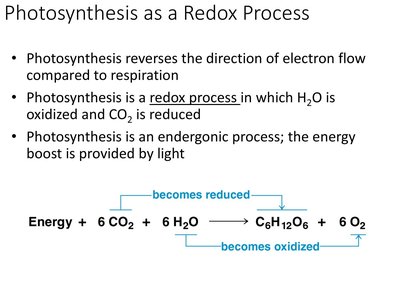
Photosynthesis reverses the direction of electron flow compared to respiration. It is a redox process in which H2O is oxidized and CO2 is reduced. The process is endergonic, requiring energy input from light.
The Two Stages of Photosynthesis
Light Reactions
The light reactions occur in the thylakoids and involve:
Splitting H2O to provide electrons and protons (H+), releasing O2 as a by-product.
Reducing NADP+ to NADPH.
Generating ATP from ADP by photophosphorylation.
The Calvin Cycle
The Calvin cycle occurs in the stroma and:
Makes sugar from CO2 using ATP and NADPH from the light reactions.
Begins with carbon fixation, incorporating CO2 into organic molecules.
Reduces fixed carbon to carbohydrate by transferring electrons from NADPH.
The Nature of Sunlight
Electromagnetic Energy and Wavelength
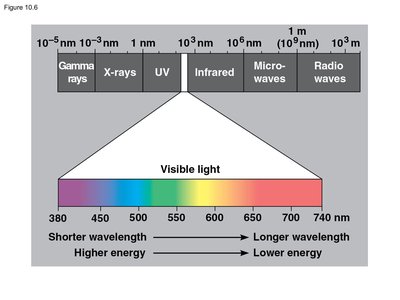
Light is a form of electromagnetic energy that travels as a wave. The wavelength is the distance between crests of electromagnetic waves, and the electromagnetic spectrum encompasses all types of electromagnetic radiation.
Visible light (380 nm to 740 nm) drives photosynthesis and produces the colors seen by the human eye.
Light also behaves as a particle called a photon.
Pigments: The Light Receptors
Role of Pigments in Photosynthesis
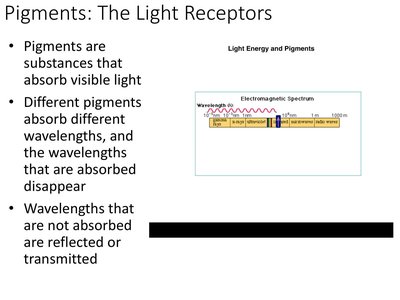
Pigments are substances that absorb visible light. Different pigments absorb different wavelengths, and the wavelengths that are not absorbed are reflected or transmitted.
Chlorophyll: The Pigment of Life
There are three main types of pigments in chloroplasts:
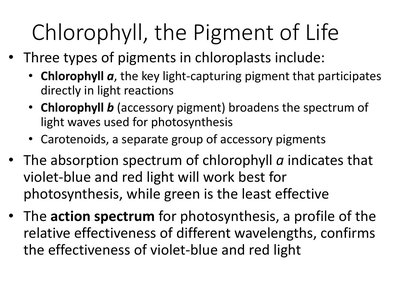
Chlorophyll a: The primary pigment that participates directly in light reactions.
Chlorophyll b: An accessory pigment that broadens the spectrum of light used for photosynthesis.
Carotenoids: Accessory pigments that absorb additional wavelengths.
The absorption spectrum of chlorophyll a shows that violet-blue and red light are most effective for photosynthesis, while green is least effective. The action spectrum confirms this by measuring the effectiveness of different wavelengths.
Structural Differences in Chlorophyll Molecules
The difference in absorption spectra between chlorophyll a and b is due to a slight structural difference in their functional groups. Chlorophyll a has a methyl group (CH3), while chlorophyll b has a formyl group (CHO).
Additional info: The structural differences between chlorophyll a and b allow plants to capture a broader range of the solar spectrum, increasing the efficiency of photosynthesis.
