 Back
Photosynthesis: Mechanisms and Importance in the Biosphere
Study Guide - Smart Notes
 Tailored notes based on your materials, expanded with key definitions, examples, and context.
Photosynthesis: Overview and Significance
Big Idea and Biological Importance
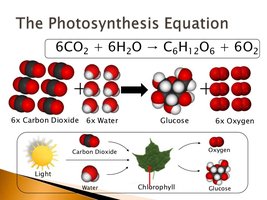
Photosynthesis is the process by which plants, algae, and certain bacteria convert sunlight into chemical energy, producing sugars and oxygen from carbon dioxide and water. This process sustains nearly all life on Earth, either directly or indirectly, by providing food and oxygen.
Photosynthesis Equation:
Key Products: Glucose (energy storage), Oxygen (by-product)
Energy Source: Sunlight
Photosynthesis Feeds the Biosphere
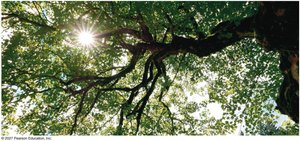
Photosynthesis nourishes almost the entire biosphere.
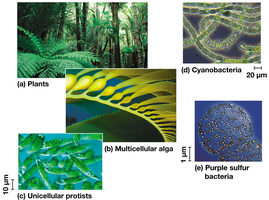
Autotrophs: Organisms that produce their own food from inorganic substances (e.g., plants, algae, cyanobacteria)
Photoautotrophs: Use sunlight to synthesize organic molecules
Heterotrophs: Obtain organic material by consuming other organisms
Photosynthesis: Cellular and Molecular Mechanisms
Chloroplasts: The Sites of Photosynthesis
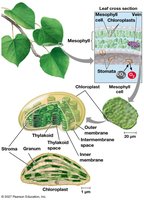
Photosynthesis occurs mainly in the leaves, specifically within chloroplasts located in mesophyll cells.
Chloroplast Structure: Double membrane, stroma (fluid), thylakoids (membranous sacs), grana (stacks of thylakoids)
Chlorophyll: Pigment responsible for capturing light energy
Stomata: Pores for gas exchange (CO2 in, O2 out)
Tracking Atoms Through Photosynthesis
The process involves splitting water and incorporating hydrogen into sugars, releasing oxygen as a by-product.
Reactants: CO2 and H2O
Products: Glucose, O2, and water
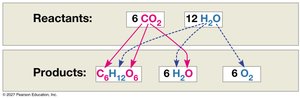
Photosynthesis as a Redox Process
Photosynthesis is a redox process, reversing the electron flow of cellular respiration.
CO2 is reduced to form glucose
H2O is oxidized to form O2
Endergonic Reaction: Requires energy input from light

Stages of Photosynthesis
Light Reactions and Calvin Cycle
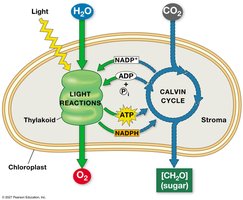
Photosynthesis consists of two main stages:
Light Reactions: Occur in thylakoids, convert solar energy to ATP and NADPH, split water, release O2
Calvin Cycle: Occurs in stroma, uses ATP and NADPH to fix carbon and produce sugars
The Nature of Sunlight
Electromagnetic Spectrum and Visible Light
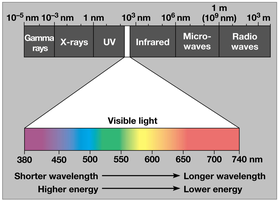
Light is electromagnetic energy, and only a small portion (visible light) drives photosynthesis.
Wavelength: Distance between wave crests; shorter wavelengths have higher energy
Visible Light: 380–740 nm; used by photosynthetic pigments
Photosynthetic Pigments
Light Absorption and Pigment Types
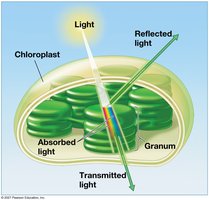
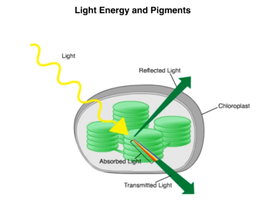
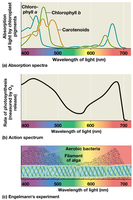
Pigments absorb specific wavelengths of light, determining the color of leaves and efficiency of photosynthesis.
Chlorophyll a: Main pigment, absorbs violet-blue and red
Chlorophyll b: Accessory pigment, broadens absorption spectrum
Carotenoids: Accessory pigments, absorb violet and blue-green, provide photoprotection
Mechanisms of Light Reactions
Photosystems and Electron Transport
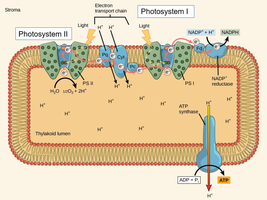
Light reactions involve two photosystems (PSII and PSI) embedded in the thylakoid membrane.
Photosystem II (P680): Absorbs 680 nm light, splits water, releases O2
Photosystem I (P700): Absorbs 700 nm light, produces NADPH
Electron Transport Chain: Transfers electrons, pumps protons, generates ATP via chemiosmosis
The Calvin Cycle
Carbon Fixation and Sugar Production
The Calvin cycle uses ATP and NADPH to fix CO2 and produce glyceraldehyde 3-phosphate (G3P), a precursor to glucose.
Phase 1: Carbon Fixation - CO2 binds to RuBP, catalyzed by rubisco
Phase 2: Reduction - 3-phosphoglycerate is converted to G3P
Phase 3: Regeneration - RuBP is regenerated for the next cycle
Energy Requirement: 9 ATP and 6 NADPH per G3P produced
Photosynthesis: Essential for Life
Ecological and Cellular Impact
Photosynthesis stores solar energy in organic compounds, providing energy and carbon skeletons for all living cells. Plants store excess sugar as starch in various organs.
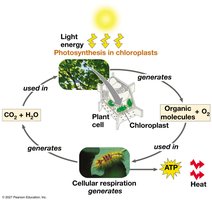
Energy Flow: Sunlight → Chemical Energy (Glucose) → Cellular Respiration → ATP
Oxygen Production: Supports aerobic life
Summary Table: Key Steps and Components of Photosynthesis
Stage | Location | Main Inputs | Main Outputs |
|---|---|---|---|
Light Reactions | Thylakoid Membrane | Light, H2O, NADP+, ADP | O2, ATP, NADPH |
Calvin Cycle | Stroma | CO2, ATP, NADPH | G3P (Sugar), ADP, NADP+ |
Example: Plants, algae, and cyanobacteria all perform photosynthesis, supporting ecosystems and global oxygen levels. Additional info: The Calvin cycle is analogous to the citric acid cycle in that it regenerates its starting material, but it is anabolic, building sugars from smaller molecules.
