 Back
Photosynthesis: Mechanisms and Significance in Biology
Study Guide - Smart Notes
 Tailored notes based on your materials, expanded with key definitions, examples, and context.
Photosynthesis: The Process That Feeds the Biosphere
Photoautotrophs and the Importance of Photosynthesis
Photosynthesis is the process by which photoautotrophs (such as plants, algae, and some bacteria) convert solar energy into chemical energy, sustaining themselves without consuming other organisms. This process nourishes almost the entire living world, either directly or indirectly.
Photoautotrophs: Organisms that use light energy to synthesize organic compounds from inorganic substances.
Photosynthesis: Converts solar energy into chemical energy stored in glucose and other organic molecules.
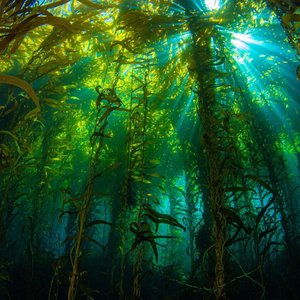
Marine plants contribute up to 70% of the oxygen in Earth's atmosphere.
Energy Transformations: Photosynthesis and Respiration
Anabolic and Catabolic Pathways
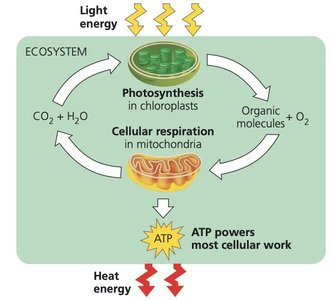
Photosynthesis and cellular respiration are complementary processes in the biosphere. Photosynthesis is an anabolic (building up) and endergonic (energy-requiring) process, while respiration is catabolic (breaking down) and exergonic (energy-releasing).
Photosynthesis: Reduces inorganic compounds (CO2 and H2O) to store energy in organic molecules.
Cellular Respiration: Oxidizes organic compounds to extract energy for cellular work.
ΔG for photosynthesis: (not spontaneous)
ΔG for respiration: (spontaneous)
Site of Photosynthesis: The Chloroplast
Chloroplast Structure and Function
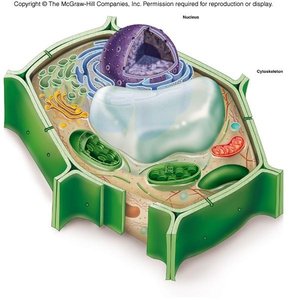
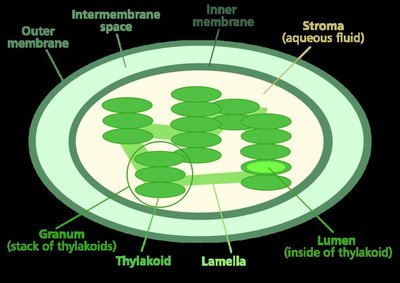
Photosynthesis occurs in the chloroplast, an organelle found in plant cells. Chloroplasts have a double membrane and internal structures called thylakoid membranes, which are organized into stacks called grana. The stroma is the fluid surrounding the thylakoids, and chlorophyll is the main pigment responsible for absorbing light.
Thylakoid membrane: Site of light-dependent reactions.
Stroma: Site of the Calvin Cycle (light-independent reactions).
Granum: Stack of thylakoids.
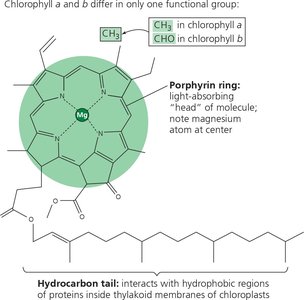
Chlorophyll: Pigment that absorbs light energy.
Photosynthesis as a Redox Process
Oxidation and Reduction in Photosynthesis
Photosynthesis is a redox process: water is oxidized and carbon dioxide is reduced. The overall equation is:
Water is split, and its electrons (and H+) are transferred to CO2, reducing it to sugar.
This process increases the potential energy of electrons, making it endergonic.
Photosynthesis equation:

Overview of Photosynthesis: Two Major Steps
Light-Dependent Reactions and the Calvin Cycle
Photosynthesis consists of two main stages:
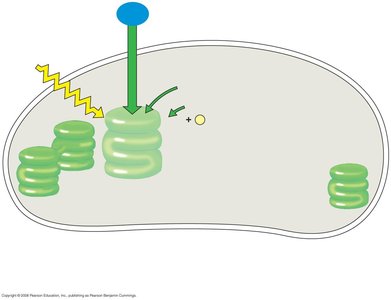
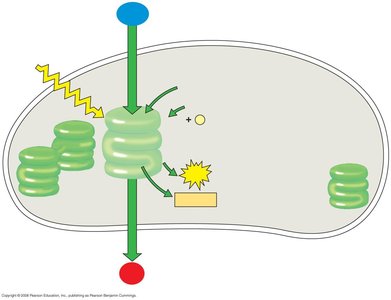
Light-dependent reactions: Occur in the thylakoid membrane; convert solar energy to chemical energy (ATP and NADPH).
Calvin Cycle: Occurs in the stroma; uses ATP and NADPH to synthesize glucose from CO2.
Light: The Energy Source for Photosynthesis
Properties of Light and the Electromagnetic Spectrum
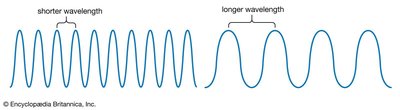
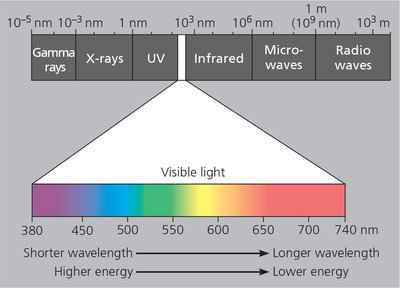
Light is a form of energy composed of photons, which travel in waves. The wavelength of light determines its energy: shorter wavelengths have higher energy. Only certain wavelengths (visible light) drive photosynthesis.
Photon: A particle of light, a discrete bundle of energy.
Electromagnetic spectrum: Range of wavelengths; visible light (400–700 nm) is used in photosynthesis.
Energy of a photon is inversely proportional to wavelength.
Absorption of Light: Pigments and Their Spectra
Chlorophyll and Accessory Pigments
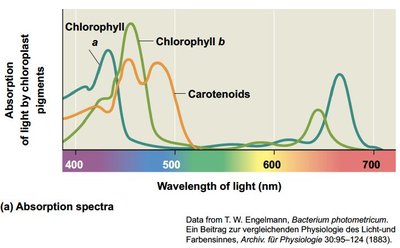
Pigments are molecules that absorb light energy. Chlorophyll a is the main photosynthetic pigment, absorbing blue and red light efficiently. Accessory pigments (such as chlorophyll b and carotenoids) broaden the spectrum of light that can be used for photosynthesis.
Absorption spectrum: Graph showing how different pigments absorb various wavelengths of light.
Chlorophyll a absorbs mainly blue and red light.
Accessory pigments help capture additional wavelengths.
Fate of Light Energy in Chlorophyll
Fluorescence and Powering Photosynthesis
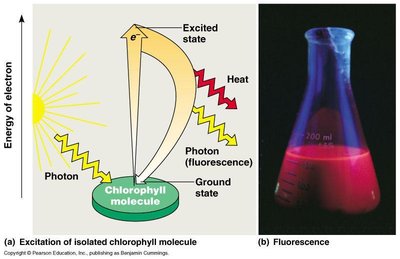
When chlorophyll absorbs light, electrons are excited to a higher energy state. This energy can be released as heat and fluorescence or used to power photosynthesis through resonance energy transfer and redox reactions.
Fluorescence: Afterglow emitted when excited electrons return to the ground state.
Resonance: Energy is transferred from one chlorophyll molecule to another.
Reduction/Oxidation: Excited electrons are transferred to electron acceptors, initiating chemical energy conversion.
Photosystems: Organization of Chlorophyll in Membranes
Structure and Function of Photosystems
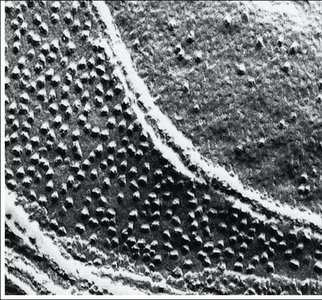
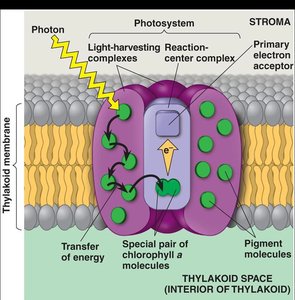
Photosystems are complexes of chlorophyll and proteins embedded in the thylakoid membrane. They capture light energy and transfer it to the reaction center, where electrons are excited and transferred to electron acceptors.
Photosystem: Group of chlorophyll molecules and associated proteins.
Reaction center: Site where excited electrons are transferred to electron acceptors.
Energy is transferred by resonance until it reaches the reaction center.
Light Reactions: Electron Transport and ATP/NADPH Formation
Photosystem II and Photosystem I
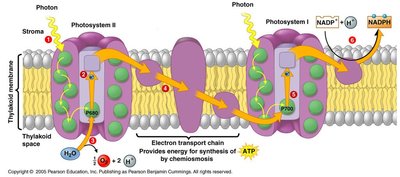
The light reactions involve two photosystems (II and I) and an electron transport chain. Water is split (oxidized) in Photosystem II, releasing O2 and providing electrons. These electrons move through the transport chain, generating a proton gradient for ATP synthesis and reducing NADP+ to NADPH in Photosystem I.
Photosystem II: Reaction center P680; splits water, releases O2, initiates electron transport.
Photosystem I: Reaction center P700; re-energizes electrons, reduces NADP+ to NADPH.
Electron transport chain: Transfers electrons, pumps protons, powers ATP synthesis.
NADPH: Electron carrier used in the Calvin Cycle.
Summary of Photosynthesis
Key Points and Takeaways
Photosynthesis is essential for life, providing energy and oxygen for most organisms. The process involves the absorption of light, excitation of electrons, and conversion of solar energy into chemical energy (ATP and NADPH), which is then used to synthesize organic molecules.
Light reactions occur in the thylakoid membrane and involve two photosystems.
Water is split, O2 is released, ATP and NADPH are produced.
NADPH is the main electron carrier in photosynthesis; NADH is not used.
Additional info: The Calvin Cycle, which uses ATP and NADPH to fix carbon dioxide into glucose, will be covered in subsequent lectures.
