 Back
Photosynthesis: Mechanisms, Pathways, and Comparative Bioenergetics
Study Guide - Smart Notes
 Tailored notes based on your materials, expanded with key definitions, examples, and context.
Photosynthesis: Overview and Significance
Introduction to Photosynthesis
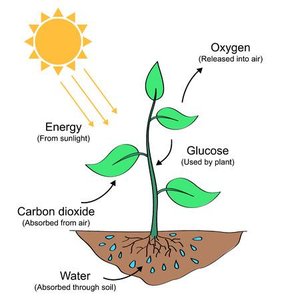
Photosynthesis is the process by which plants, algae, and some bacteria convert light energy into chemical energy, producing organic molecules and oxygen from carbon dioxide and water. This process is fundamental to life on Earth, providing the primary energy source for most ecosystems.
Reactants: Carbon dioxide (CO2) and water (H2O)
Products: Glucose (C6H12O6) and oxygen (O2)
General Equation:
The Two Stages of Photosynthesis
Light-Dependent Reactions
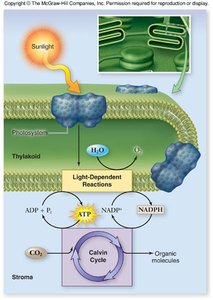
These reactions occur in the thylakoid membranes of the chloroplast and require light energy. Their main function is to capture solar energy and convert it into chemical energy in the form of ATP and NADPH, while releasing oxygen as a byproduct.
Location: Thylakoid membrane
Inputs: Light, H2O, NADP+, ADP + Pi
Outputs: O2, ATP, NADPH
Key Steps:
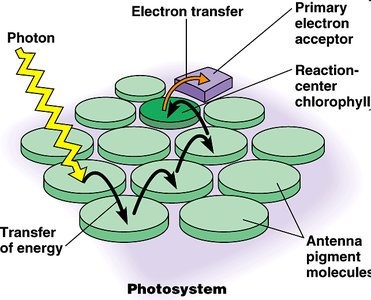
Light energy excites electrons in chlorophyll molecules within photosystems.
Water is split (photolysis), releasing O2 and providing electrons.
Electron transport chain generates a proton gradient, driving ATP synthesis (photophosphorylation).
NADP+ is reduced to NADPH.
Light-Independent Reactions (Calvin Cycle)
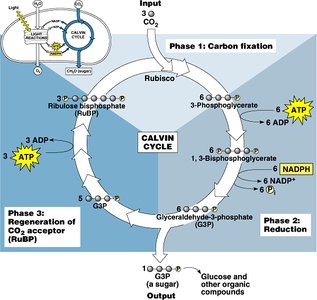
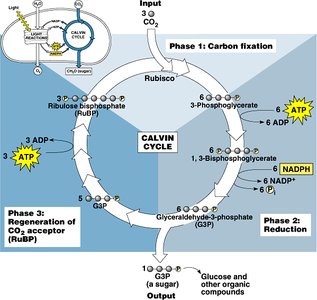
The Calvin cycle occurs in the stroma of the chloroplast and does not require light directly. It uses ATP and NADPH produced in the light-dependent reactions to fix carbon dioxide and synthesize glyceraldehyde-3-phosphate (G3P), a three-carbon sugar.
Location: Stroma
Inputs: CO2, ATP, NADPH
Outputs: G3P (which can be converted to glucose and other sugars)
Phases:
Carbon Fixation: CO2 is attached to ribulose-1,5-bisphosphate (RuBP) by the enzyme Rubisco, forming 3-phosphoglycerate (3-PGA).
Reduction: ATP and NADPH are used to convert 3-PGA into G3P.
Regeneration: Some G3P is used to regenerate RuBP, enabling the cycle to continue.

Calvin Cycle: Details and Stoichiometry
Key Steps and Enzymes
Carbon Fixation: Rubisco catalyzes the addition of CO2 to RuBP, forming an unstable 6-carbon intermediate that splits into two 3-PGA molecules.
Reduction: 3-PGA is phosphorylated by ATP and reduced by NADPH to form G3P.
Regeneration: Five molecules of G3P are rearranged to regenerate three molecules of RuBP, using additional ATP.
Stoichiometry: To produce one net G3P, the cycle must turn three times, consuming 3 CO2, 9 ATP, and 6 NADPH.
Fate of Sugars Produced in Photosynthesis
Utilization and Storage
G3P Export: G3P can be exported from the chloroplast to the cytosol, where it enters glycolysis or is used to synthesize glucose and fructose.
Storage: Glucose can be polymerized into starch for storage within the chloroplast. Starch is insoluble and can be broken down at night to provide energy.
Transport: Sucrose, synthesized from glucose and fructose, is transported throughout the plant for metabolic needs.
ATP Production: Mitochondria vs. Chloroplasts
Comparative Bioenergetics
Feature | Mitochondria | Chloroplasts |
|---|---|---|
Process | Oxidative phosphorylation | Photophosphorylation |
Energy Source | Food-derived electrons | Light-derived electrons |
ATP Synthesis Location | Matrix | Stroma |
Proton Gradient | Matrix to intermembrane space | Stroma to thylakoid space |
Key Point: Both organelles use chemiosmosis to generate ATP, but the source of energy and the direction of proton pumping differ.
Alternative Carbon Fixation Pathways: C3, C4, and CAM Plants
C3 Plants
Most plants use the C3 pathway, where the first stable product of carbon fixation is a three-carbon molecule (3-PGA). This pathway is efficient under moderate conditions but is susceptible to photorespiration under high temperatures and low CO2 concentrations.
C4 Plants
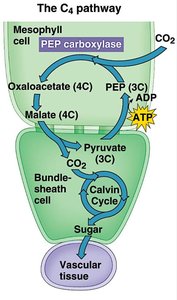
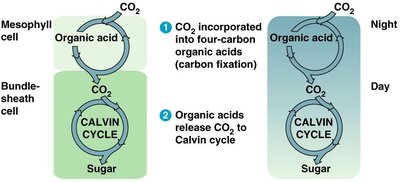
C4 plants minimize photorespiration by spatially separating initial CO2 fixation and the Calvin cycle. CO2 is first fixed into a four-carbon compound (oxaloacetate) in mesophyll cells by PEP carboxylase, which has a higher affinity for CO2 and no affinity for O2. The four-carbon compound is transported to bundle-sheath cells, where CO2 is released for use in the Calvin cycle.
CAM Plants
CAM (Crassulacean Acid Metabolism) plants temporally separate CO2 fixation and the Calvin cycle. CO2 is fixed at night into organic acids, which release CO2 during the day for the Calvin cycle. This adaptation reduces water loss in arid environments.
Plant Type | First Product of CO2 Fixation | Separation Mechanism | Example |
|---|---|---|---|
C3 | 3-PGA (3C) | None | Wheat, rice |
C4 | Oxaloacetate (4C) | Spatial (mesophyll vs. bundle-sheath cells) | Sugar cane, maize |
CAM | Organic acids (4C) | Temporal (night vs. day) | Pineapple, cacti |
Sample Questions for Review
Which molecule is directly produced by the Calvin cycle?
A. Glucose
B. Pyruvate
C. G3P
D. ATP
During the Calvin cycle, how many CO2 molecules are required to produce one net G3P?
A. 1
B. 2
C. 3
D. 6
Which statement correctly distinguishes C4 plants from C3 plants?
A. C4 plants use Rubisco only
B. C4 plants perform fixation in mitochondria
C. C4 plants separate CO2 fixation and Calvin cycle spatially
D. C4 plants do not use ATP
Why does the Calvin cycle require more ATP than NADPH?
A. ATP is used only in carbon fixation
B. NADPH is reused multiple times
C. Additional ATP is required for RuBP regeneration
D. NADPH is produced in excess
