 Back
BackPhotosynthesis: Mechanisms, Pigments, and Adaptations
Study Guide - Smart Notes
 Tailored notes based on your materials, expanded with key definitions, examples, and context.
Photosynthesis: Feeding the Biosphere
Introduction to Photosynthesis
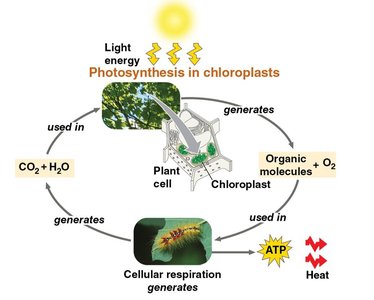
Photosynthesis is the fundamental process by which photoautotrophic organisms convert solar energy into chemical energy, sustaining nearly all life on Earth. This process occurs primarily in chloroplasts and is essential for the production of organic molecules and oxygen.
Photoautotrophs are organisms that use light energy to synthesize organic compounds from carbon dioxide and water.
Autotrophs are self-feeders
Heterotrophs obtain organic material by consuming other organisms, relying directly or indirectly on photoautotrophs for food and oxygen.
they depend on autotrophs , they eat other organisms
Decomposers consume dead organic material or waste products.
Photosynthesis nourishes the biosphere by providing energy and organic molecules.
Types of Photosynthetic Organisms
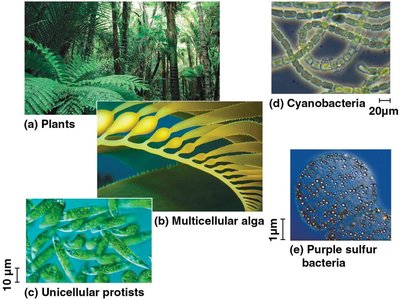
Photosynthetic organisms include plants, algae, and certain bacteria. These organisms are classified based on their cellular structure and evolutionary lineage.
Plants: Multicellular photoautotrophs.
Algae: Can be unicellular or multicellular.
Protists: Unicellular eukaryotes.
Cyanobacteria: Prokaryotic, photosynthetic bacteria.
Purple sulfur bacteria: Prokaryotes with unique photosynthetic pathways.
Chloroplasts: The Site of Photosynthesis
Structure and Function of Chloroplasts
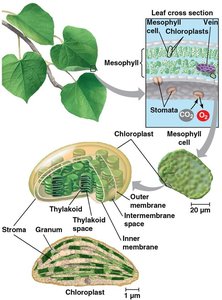
Chloroplasts are specialized organelles found mainly in the mesophyll cells of leaves. Their structural organization enables the complex reactions of photosynthesis.
Mesophyll: Interior leaf tissue containing most chloroplasts. upper part of leaf, have a lot of chloroplasts
Stomata: Microscopic pores for gas exchange (CO2 in, O2 out). bottom of the leaf, the leaf exchanges gases, they enter and exit
Veins: Transport water and sugars.
Chloroplast envelope: Double membrane surrounding the stroma.
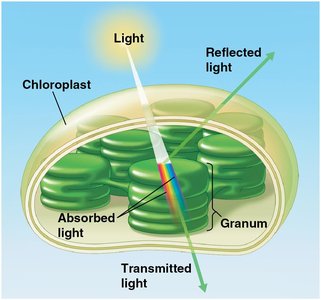
Thylakoids: Membranous sacs forming stacks called grana; site of light reactions.
may be stacked. that is where chlorophyll is.
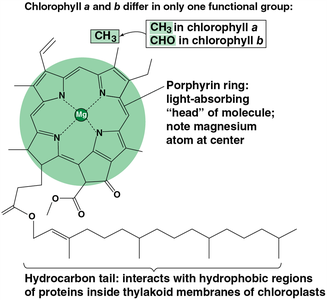
Chlorophyll: Green pigment in thylakoid membranes.
Photosynthesis: Overview and Chemical Equation
Photosynthesis Equation and Redox Process
Photosynthesis is a series of redox reactions, summarized by the following equation:
Reactants: 6 CO2 + 12 H2O + Light energy
Products: C6H12O6 + 6 O2 + 6 H2O
Redox Process: Water is oxidized, and carbon dioxide is reduced. The process is endergonic, requiring energy input from light.
the oxygen from water is oxidized. the electrons are taken from water and the oxygen is attached
Equation in LaTeX:

The Two Stages of Photosynthesis
Light Reactions and Calvin Cycle
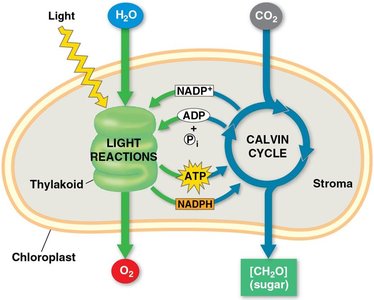
Photosynthesis consists of two main stages: the light reactions and the Calvin cycle.
Light Reactions (in thylakoids) the photo part: Split water, release O2, reduce NADP+ to NADPH, and generate ATP by photophosphorylation.
water is oxidized, and you get oxygen and ATP and NADH is generated.
Calvin Cycle the synthesis part (in stroma): Uses ATP and NADPH to fix carbon dioxide and synthesize sugars.
Carbon fixation is the initial incorporation of CO2 into organic molecules.
The Light Reactions: Converting Solar Energy
Nature of Sunlight and Electromagnetic Spectrum
Light is electromagnetic energy, traveling in waves. it is an electromagnetic wave
The electromagnetic spectrum includes all wavelengths, but only visible light (380–740 nm) drives photosynthesis.
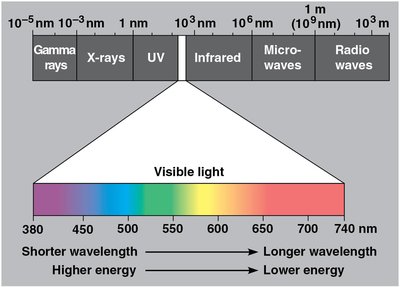
Wavelength: Distance between wave crests; determines energy.
Visible light: Drives photosynthesis and is perceived as color.
Gamma waves are radioactive and harmful
Photosynthetic Pigments: Light Receptors
Pigments absorb specific wavelengths of light. Chlorophyll absorbs violet-blue and red light, reflecting green. they don't absorb green that why we see green reflected
Chlorophyll a: Main pigment for light reactions.
Chlorophyll b: Accessory pigment, broadens absorption spectrum.
Carotenoids: Accessory pigments, absorb violet and blue-green light; some are photoprotective. they absorb excessive light, that's why they are protective.
Absorption and Action Spectra
The absorption spectrum shows which wavelengths are absorbed by pigments. The action spectrum indicates which wavelengths are most effective for photosynthesis.
Violet-blue and red light are most effective.
Accessory pigments broaden the action spectrum.
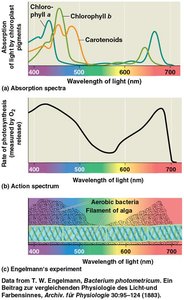
there is no absorption in the green.
Excitation of Chlorophyll by Light
When chlorophyll absorbs light, electrons are excited to a higher energy state. In isolation, these electrons return to the ground state, releasing energy as heat or fluorescence.
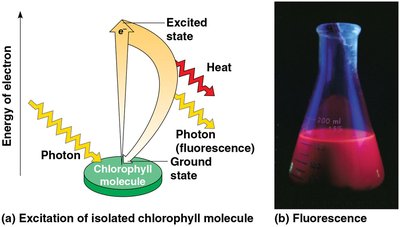
Photosystems and Electron Flow
Photosystems: Structure and Function
A photosystem consists of a reaction-center complex surrounded by light-harvesting complexes with chlorophyll a . There are two types:
Photosystem II (PS II): P680, absorbs 680 nm light. chlorophyll a is best absorbs at this wavelength
Photosystem I (PS I): P700, absorbs 700 nm light.
Linear Electron Flow
Linear electron flow is the primary pathway during light reactions, involving both photosystems and producing ATP and NADPH.
Photon excites pigment in PS II; energy transferred to P680. photon is a particle that comes as a wave depending on its wave, and energy levels. photons release heat and the light called flourescence.
light enters
Excited electron transferred to primary electron acceptor (P680+).
Water split; electrons reduce P680+, H+ released, O2 formed.
Electrons passed through electron transport chain; proton gradient created.
ATP produced by chemiosmosis.
PS I excited; P700 loses electron, accepts electron from PS II.
Electrons passed to ferredoxin (Fd); no ATP produced in this chain.
NADP+ reductase catalyzes reduction to NADPH.
Chemiosmosis: Chloroplasts vs. Mitochondria
Comparison of Chemiosmosis
Both chloroplasts and mitochondria generate ATP by chemiosmosis, but differ in electron sources and energy transformation.
Chloroplasts: Electrons from water,
transform light energy to chemical energy.
Mitochondria: Electrons from organic molecules,
transfer chemical energy from food.
ATP and NADPH produced on stroma side for Calvin cycle.
The Calvin Cycle: Sugar Synthesis
Phases of the Calvin Cycle
The Calvin cycle is anabolic, using ATP and NADPH to build sugars from CO2.
Carbon enters the sycle as CO2 and leaves a sugar named glyceraldehyde 3-phospate (G3P)
It regenerates its starting material and consists of three phases:
Carbon Fixation: CO2 binds to ribulose bisphosphate (RuBP), catalyzed by rubisco, forming 3-phosphoglycerate.
it is the most abundant protein
Reduction: 3-phosphoglycerate is phosphorylated and reduced to glyceraldehyde 3-phosphate (G3P).
Regeneration: Regeneration of the CO 2 acceptor (RuBP)
Five G3P molecules are rearranged to regenerate three RuBP, using ATP.
For net synthesis of one G3P, the cycle must occur three times, fixing three CO2 molecules.
Adaptations: Alternative Carbon Fixation Mechanisms
C4 and CAM Plants
Plants in hot, arid climates have evolved alternative carbon fixation mechanisms to minimize water loss and photorespiration.
C4 Plants: Incorporate CO2 into a four-carbon compound; spatial separation of steps reduces photorespiration.
Examples: sugarcane, corn.
CAM Plants: Use crassulacean acid metabolism; stomata open at night, CO2 fixed into organic acids, released during the day for Calvin cycle. Examples: succulents.
Summary of Key Concepts
Photosynthesis Review
Photosynthesis sustains the biosphere by converting light energy to chemical energy.
Chloroplasts are the site of photosynthesis, with thylakoids hosting light reactions and stroma hosting the Calvin cycle.
Light reactions produce ATP and NADPH; Calvin cycle uses them to fix carbon and synthesize sugars.
Adaptations such as C4 and CAM pathways allow plants to thrive in challenging environments.
