 Back
BackPhotosynthesis: Mechanisms, Pigments, and Adaptations
Study Guide - Smart Notes
 Tailored notes based on your materials, expanded with key definitions, examples, and context.
Photosynthesis: The Foundation of Energy Flow in Living Systems
Introduction to Photosynthesis
Photosynthesis is a fundamental biological process by which plants, algae, and some bacteria convert light energy into chemical energy, producing organic molecules and oxygen. It is the primary mechanism for energy input into the biosphere and is essential for life on Earth.
Light energy is captured and transformed into the stored chemical energy of carbohydrates.
Photosynthesis takes in CO2 from the atmosphere, incorporates it into organic molecules, and releases O2 and H2O.
Occurs in specialized organelles called chloroplasts found in plant cells.
Light Energy and the Electromagnetic Spectrum
Visible Light and Its Properties
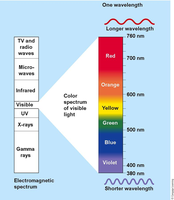
Visible light is a small segment of the electromagnetic (EM) spectrum, which includes a range of radiation types. Photosynthesis utilizes visible light, which has wavelengths between 380 and 760 nm, encompassing all colors from violet to red.
Electromagnetic spectrum: Includes radio waves, microwaves, infrared, visible light, ultraviolet, X-rays, and gamma rays.
Visible light: The only portion of the EM spectrum used in photosynthesis; violet has the shortest wavelength, red the longest.
Chloroplasts: The Site of Photosynthesis
Structure and Function of Chloroplasts
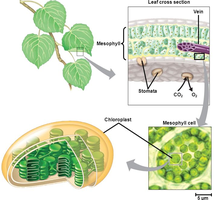
Chloroplasts are specialized organelles in plant cells, particularly in the mesophyll layer of leaves, where photosynthesis occurs. Each mesophyll cell contains numerous chloroplasts, and gas exchange takes place through stomata.
Chloroplasts contain the pigment chlorophyll and are found in mesophyll cells.
Stomata: Microscopic pores for gas exchange (CO2 in, O2 out).
Internal Structure of Chloroplasts
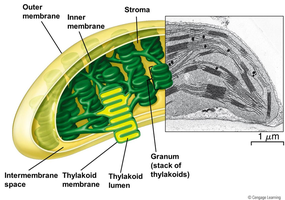
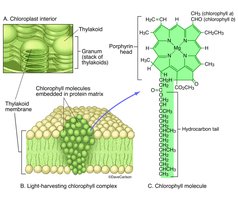
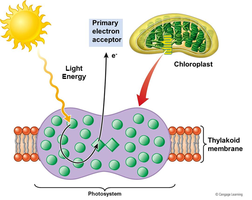
The chloroplast is enclosed by double membranes and contains a fluid-filled stroma. Suspended within the stroma are thylakoids, which are arranged in stacks called grana. The thylakoid membrane is the site of the light-dependent reactions.
Outer and inner membranes enclose the chloroplast.
Stroma: Contains enzymes for carbohydrate production.
Thylakoids: Membranous sacs arranged in stacks (grana); site of light reactions.
Photosynthetic Pigments
Types and Functions of Pigments
Thylakoid membranes contain several pigments that absorb light of different wavelengths. The main pigment is chlorophyll, which absorbs blue and red light and reflects green, giving leaves their characteristic color.
Chlorophyll a: Initiates light-dependent reactions.
Chlorophyll b: Accessory pigment, broadens the spectrum of light absorbed.
Carotenoids: Yellow and orange pigments, absorb wavelengths not absorbed by chlorophyll.
Absorption Spectra of Photosynthetic Pigments
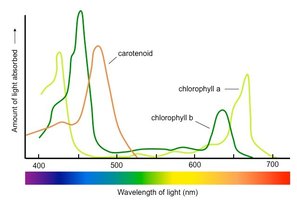
Different pigments absorb light at different wavelengths, maximizing the efficiency of photosynthesis. Chlorophyll a and b absorb primarily in the blue and red regions, while carotenoids absorb in the blue-green region.
Absorption spectra show the amount of light absorbed at each wavelength.
Reflectance of green light by chlorophyll explains why leaves appear green.
Experimental Evidence: Engelmann’s Experiment
Demonstrating the Action Spectrum of Photosynthesis
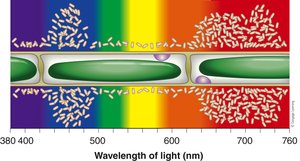
T. W. Engelmann’s experiment demonstrated that photosynthesis is most efficient at certain wavelengths of light. He used bacteria that move toward oxygen to show which wavelengths produced the most oxygen during photosynthesis.
Bacteria clustered where oxygen was produced, indicating the most effective wavelengths for photosynthesis.
Highest photosynthetic activity was observed in blue and red regions.
Overview of Photosynthesis: Two Phases
Light-Dependent and Light-Independent Reactions
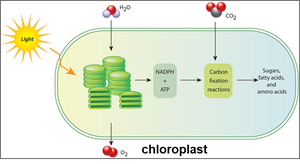
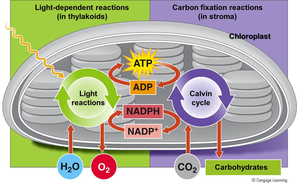
Photosynthesis consists of two main phases: light-dependent reactions (photo part) and carbon fixation reactions (synthesis part). Light-dependent reactions occur in the thylakoids, while carbon fixation occurs in the stroma.
Light-dependent reactions: Convert light energy to chemical energy (ATP and NADPH), release O2.
Carbon fixation reactions: Use ATP and NADPH to synthesize carbohydrates from CO2.
Light-Dependent Reactions
Mechanism and Products
Light-dependent reactions begin when chlorophyll absorbs light, exciting electrons that are transferred to NADP+. Water is split, releasing O2, and the electron transport chain generates ATP and NADPH.
Occurs in thylakoid membranes.
Produces ATP and NADPH for use in the Calvin cycle.
Releases O2 as a byproduct.
Light-Independent Reactions (Calvin Cycle and Alternatives)
Calvin Cycle (C3 Pathway)
The Calvin cycle is the primary pathway for carbon fixation in most plants. It occurs in the stroma and consists of three phases: CO2 uptake, reduction, and regeneration of RuBP. The initial product is a 3-carbon compound.
CO2 uptake and fixation: CO2 is incorporated into RuBP.
Reduction: ATP and NADPH are used to convert 3-phosphoglycerate to G3P.
Regeneration: RuBP is regenerated for the next cycle.
C4 and CAM Pathways: Adaptations to Hot, Dry Environments
Some plants have evolved alternative pathways to minimize water loss and avoid photorespiration. C4 plants fix CO2 into a 4-carbon compound in mesophyll cells, while CAM plants fix carbon at night and complete the Calvin cycle during the day.
C4 pathway: Efficient CO2 fixation at low concentrations, avoids photorespiration.
CAM pathway: Stomata open at night, carbon fixation occurs in two steps separated by time.
Pathway | Initial Carbon Fixation | Adaptation |
|---|---|---|
C3 (Calvin Cycle) | 3-carbon compound | Most plants, moderate climates |
C4 | 4-carbon compound (oxaloacetate) | Hot, dry environments; spatial separation |
CAM | Organic acids at night | Extremely hot, dry environments; temporal separation |
Summary Equation of Photosynthesis
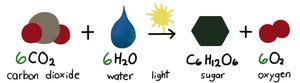
The overall chemical equation for photosynthesis is:
Review Questions
What part of the light spectrum does visible light fall under?
What are photons and how are they important in photosynthesis?
Which organelle carries out photosynthesis? Where are they found in plants and why?
What is the pigment molecule found in leaves? What’s their role?
Why do leaves appear green?
What did Engelmann’s experiment prove?
Describe the events in the light dependent and independent pathways.
What happens during Calvin (C3) Cycle?
What are C4 and CAM pathways?
Why do some plants adopt the C4 and CAM pathways?
