 Back
BackPhotosynthesis: Mechanisms, Pigments, and Carbon Fixation
Study Guide - Smart Notes
 Tailored notes based on your materials, expanded with key definitions, examples, and context.
Photosynthesis: The Foundation of Life
Overview of Photosynthesis
Photosynthesis is the process by which autotrophic organisms, such as plants and algae, convert sunlight into chemical energy, producing carbohydrates and oxygen. This process is essential for sustaining life on Earth, as it forms the basis of most food webs. - Autotrophs: Organisms that produce their own food from inorganic sources. - Heterotrophs: Organisms that obtain food by consuming other organisms. - Photosynthesis requires sunlight, carbon dioxide (CO2), and water (H2O), and produces oxygen (O2) as a by-product. 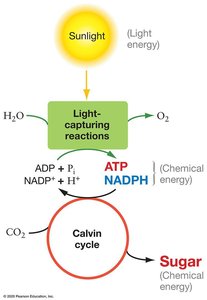
Photosynthesis Occurs in Chloroplasts
Chloroplasts are specialized organelles in plant cells where photosynthesis takes place. Their structure is optimized for capturing light and facilitating the biochemical reactions of photosynthesis. - Outer and inner membranes surround the chloroplast. - Thylakoids: Flattened, vesicle-like structures arranged in stacks called grana. - Stroma: Fluid-filled space between thylakoids and the inner membrane. - Lumen: Space inside the thylakoid. 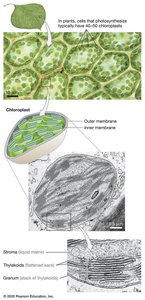
Light Capture and Pigments
Properties of Light and Pigments
Light is a form of electromagnetic radiation, exhibiting both wave-like and particle-like properties. Pigments in chloroplasts absorb specific wavelengths of light, enabling photosynthesis. - Wavelength: Distance between two wave crests; determines energy of light. - Photon: Discrete packet of light energy. - Energy of a photon is inversely proportional to its wavelength: 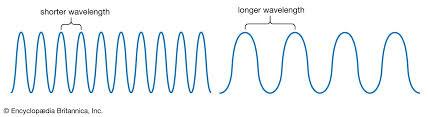

Types of Pigments in Plants
Plants contain two major classes of pigments: - Chlorophylls (a and b): Absorb red and blue light; reflect green light. - Carotenoids: Absorb blue and green light; reflect yellow, orange, and red light. 
Structure of Chlorophyll and Carotenoids
Chlorophyll molecules have a long isoprenoid tail and a head with a ring structure containing magnesium, which absorbs light. Carotenoids have a structure that allows them to absorb and transfer energy to chlorophyll. 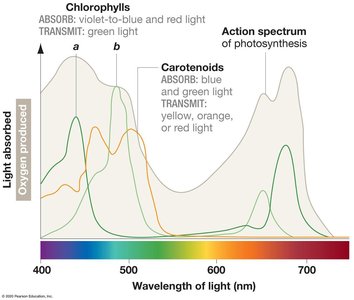

Role of Accessory Pigments
- Carotenoids and xanthophylls extend the range of light wavelengths that can drive photosynthesis and protect chlorophylls from damage by stabilizing free radicals.
Carbon Dioxide Capture and Fixation
Stomata and Gas Exchange
Plants are covered with a waxy cuticle that prevents water loss but also restricts gas exchange. Stomata, consisting of two guard cells, provide openings for CO2 to enter and O2 to exit. - Open stomata allow CO2 to diffuse into leaf tissues and O2 to diffuse out. - CO2 diffuses along a concentration gradient into chloroplasts. 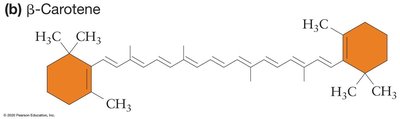
The Calvin Cycle: Carbon Fixation
The Calvin cycle is the process by which carbon atoms from CO2 are incorporated into organic molecules. - Ribulose bisphosphate (RuBP) is the initial reactant. - The enzyme Rubisco (ribulose-1,5-bisphosphate carboxylase/oxygenase) catalyzes the fixation of CO2. - The Calvin cycle is the most important chemical reaction for life on Earth. 
Rubisco: The Key Enzyme
Rubisco is abundant but slow and inefficient, as it can catalyze the addition of either CO2 or O2 to RuBP. - When O2 competes at Rubisco's active site, photorespiration occurs, reducing the efficiency of photosynthesis. 
Phases of the Calvin Cycle
The Calvin cycle consists of three phases: 1. Fixation: CO2 reacts with RuBP, producing two molecules of 3-phosphoglycerate (3PGA). 2. Reduction: 3PGA is phosphorylated by ATP and reduced by NADPH to produce glyceraldehyde-3-phosphate (G3P). 3. Regeneration: G3P is used to regenerate RuBP, allowing the cycle to continue. - All phases occur in the stroma of chloroplasts. 
Regulation and Fate of Photosynthetic Products
Regulation of Photosynthesis
Photosynthesis is regulated by environmental conditions and cellular signals: - Light triggers production of photosynthetic proteins. - High sugar levels inhibit photosynthetic protein production and stimulate storage protein production. - Rubisco is activated by regulatory molecules and inhibited when CO2 is low.
Fate of Sugar Produced by Photosynthesis
G3P produced by the Calvin cycle is used to synthesize glucose and fructose via gluconeogenesis, which can be combined to form sucrose. - When sucrose is abundant, glucose is polymerized to form starch. - Starch is produced in chloroplasts; sucrose is synthesized in the cytosol. - Virtually all organic carbon in living organisms originates from photosynthesis.
Summary Table: Key Components of Photosynthesis
Component | Function | Location |
|---|---|---|
Chloroplast | Site of photosynthesis | Plant cell |
Thylakoid | Light-capturing reactions | Chloroplast |
Stroma | Calvin cycle reactions | Chloroplast |
Chlorophyll | Absorbs light energy | Thylakoid membrane |
Rubisco | Fixes CO2 to RuBP | Stroma |
Stomata | Gas exchange | Leaf surface |
Additional info: Academic context was added to clarify the Calvin cycle, Rubisco's inefficiency, and the regulation of photosynthesis.
