 Back
Chapter 10: Photosynthesis: Mechanisms, Pigments, and Carbon Fixation
Study Guide - Smart Notes
 Tailored notes based on your materials, expanded with key definitions, examples, and context.
Overview of Photosynthesis
Photosynthesis is the process by which autotrophic organisms convert sunlight, carbon dioxide, and water into carbohydrates, releasing oxygen as a by-product. This process is fundamental to life on Earth, providing the primary source of organic matter and oxygen. - Autotrophs: Organisms that produce their own food from inorganic sources. - Heterotrophs: Organisms that must obtain organic molecules from other organisms. - Overall photosynthesis reaction: - Opposite of cellular respiration: 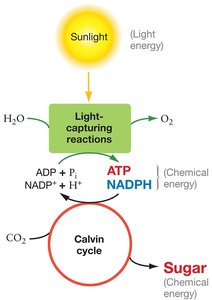
Two Linked Sets of Reactions
Photosynthesis consists of two major sets of reactions: 1. Light-capturing reactions: Occur in the thylakoid membranes, split water to produce O2, and generate ATP and NADPH. 2. Calvin cycle reactions: Occur in the stroma, use ATP and NADPH to reduce CO2 and produce sugars.
Photosynthesis Occurs in Chloroplasts
Structure of Chloroplasts
Chloroplasts are the site of photosynthesis in plants and algae. They are surrounded by double membranes and contain internal structures specialized for capturing light energy. - Thylakoids: Flattened, membrane-bound vesicles arranged in stacks called grana. - Stroma: Fluid-filled space surrounding the thylakoids. - Lumen: Interior space of the thylakoid. 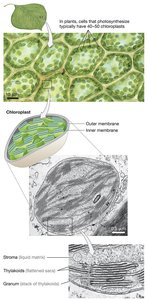
Pigments in Thylakoid Membranes
Thylakoid membranes contain pigments that absorb specific wavelengths of light. - Chlorophyll: The most common pigment, reflects green light, responsible for the green color of plants. - Pigments: Molecules that absorb certain wavelengths and reflect or transmit others.
Photosynthetic Pigments and Light Absorption
Chromatography: Separating Pigments
Thin layer chromatography is used to separate plant pigments based on their solubility and affinity for the matrix. - Carotene, pheophytin, chlorophyll a, chlorophyll b, and xanthophyll are common pigments. 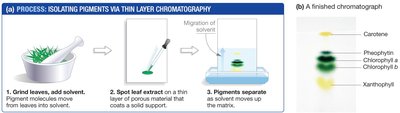
Classes of Pigments
- Chlorophylls (a and b): Absorb red and blue light, reflect green. - Carotenoids: Absorb blue and green light, reflect yellow, orange, and red.
Action and Absorption Spectra
- Action spectrum: Wavelengths that drive photosynthesis most effectively. - Absorption spectrum: Measures how much light is absorbed at each wavelength.
Role of Accessory Pigments
- Carotenoids and xanthophylls: Extend the range of light absorption, protect chlorophylls from damage by stabilizing free radicals.
Light Absorption and Electron Excitation
Excited States of Electrons
When chlorophyll absorbs photons, electrons are promoted to higher energy states. - Red photons: Excite electrons to a higher energy state. - Blue photons: Excite electrons to an even higher energy state. - Green photons: Not absorbed, intermediate energy. 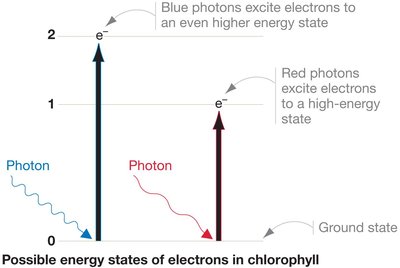
Fate of Excited Electrons
- If electrons fall back to ground state, energy is released as heat or light (fluorescence). - Most absorbed energy drives photosynthesis.
Photosystems and Conversion of Light Energy
Photosystems: Organization of Pigments
Chlorophyll molecules and accessory pigments form complexes called photosystems. - Antenna pigments: Gather light and transfer energy to the reaction center.
Light-Harvesting Complex and Electron Transport
- Light-harvesting complex: Transmits resonance energy to antenna pigments and then to the reaction center. - Pheophytin: Pigment molecule reduced by high-energy electrons. - Electron transport chain (ETC): Transfers electrons, creates proton gradient, drives ATP synthesis via ATP synthase. 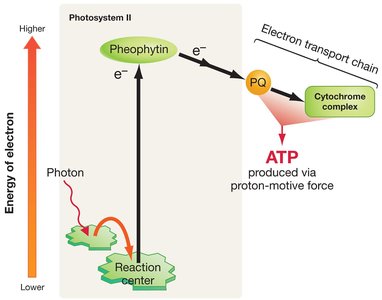
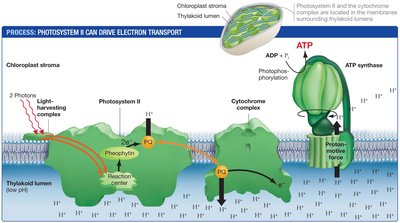
Photophosphorylation
- Photophosphorylation: ATP synthesis driven by light energy.
Photosystem II and Water Oxidation
Oxygenic Photosynthesis
Photosystem II is unique in its ability to oxidize water, producing oxygen. - Oxygenic photosynthesis: Produces O2 as a by-product. - Anoxygenic photosynthesis: Uses other electron donors (e.g., H2S), does not produce O2.
Photosystem I and NADPH Production
Mechanism of Photosystem I
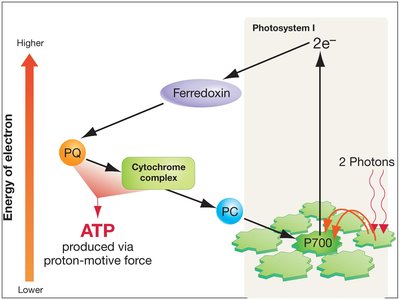
Photosystem I reduces NADP+ to NADPH using excited electrons. - Ferredoxin: Electron carrier. - NADP+ reductase: Enzyme that catalyzes reduction. 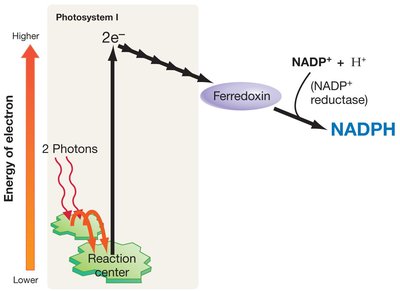
The Z Scheme: Integration of Photosystems II and I
Electron Flow and Energy Production
The Z scheme describes the linear flow of electrons from water through photosystem II, the electron transport chain, photosystem I, and finally to NADP+. - Plastocyanin (PC): Shuttles electrons between photosystems. - P700: Special pair chlorophyll in photosystem I, absorbs 700 nm light. 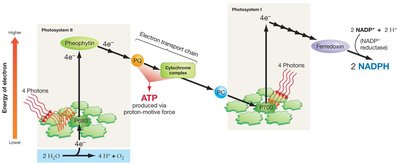
Noncyclic and Cyclic Electron Flow
- Noncyclic electron flow: Electrons move linearly from water to NADP+, producing both ATP and NADPH. 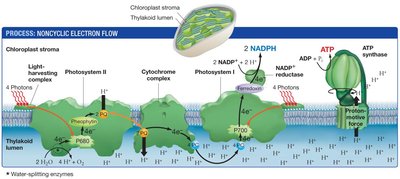 - Cyclic electron flow: Electrons cycle back to photosystem I, producing additional ATP but not NADPH.
Carbon Dioxide Capture and Fixation
Leaf Structure and Gas Exchange
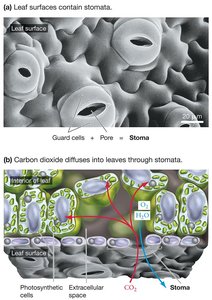
Plants are covered by a waxy cuticle that prevents water loss and restricts gas exchange. - Stomata: Pores formed by guard cells, allow CO2 in and O2 out. 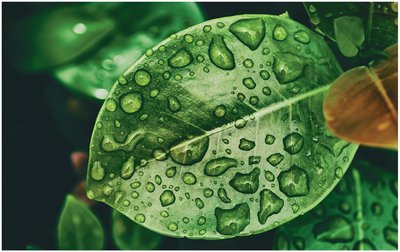
The Calvin Cycle: Carbon Fixation and Sugar Production
Mechanism of Carbon Fixation
The Calvin cycle converts inorganic CO2 into organic molecules. - RuBP (ribulose biphosphate): Five-carbon compound, initial reactant. - Rubisco: Enzyme catalyzing CO2 fixation, most abundant protein in leaves. 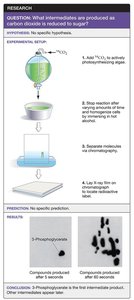
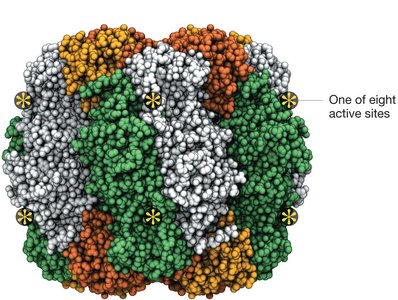
Rubisco and Photorespiration
Rubisco can catalyze reactions with either CO2 or O2. - Photorespiration: Reaction with O2 produces 2-phosphoglycolate, consumes ATP, releases CO2, and reduces photosynthetic efficiency. 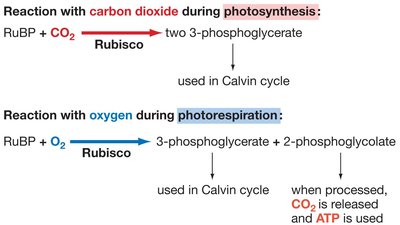
Mechanisms for Increasing CO2 Concentration
C4 Pathway
C4 plants use a spatial separation of carbon fixation and the Calvin cycle to minimize photorespiration. - PEP carboxylase: Enzyme in mesophyll cells, fixes CO2 to a three-carbon compound, forming a four-carbon organic acid. - Bundle sheath cells: Location of Calvin cycle and rubisco activity. 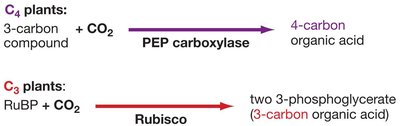
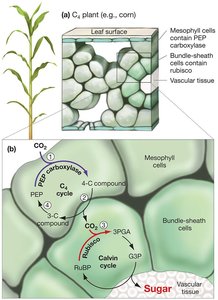
CAM Pathway
CAM plants temporally separate carbon fixation and the Calvin cycle, storing CO2 at night and using it during the day. - Crassulacean acid metabolism (CAM): Adaptation for hot, dry environments. 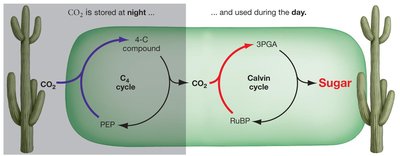
Calvin Cycle Steps and Regulation
Three Phases of the Calvin Cycle
1. Fixation: CO2 reacts with RuBP, forms 3-phosphoglycerate (3PGA). 2. Reduction: 3PGA is phosphorylated and reduced to glyceraldehyde-3-phosphate (G3P). 3. Regeneration: G3P is used to regenerate RuBP. 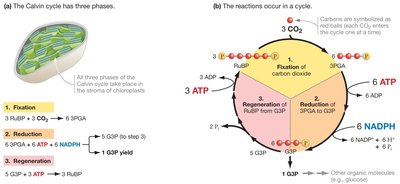
Regulation of Photosynthesis
- Light triggers production of photosynthetic proteins. - High sugar levels inhibit photosynthetic protein production and stimulate storage protein production. - Rubisco is regulated by light and CO2 concentration.
Fate of Sugar Produced by Photosynthesis
Utilization of G3P
- G3P is used to synthesize glucose and fructose via gluconeogenesis. - Sucrose is formed from glucose and fructose; when abundant, glucose is polymerized to form starch. - Starch is produced in chloroplasts; sucrose synthesis occurs in the cytosol.
Summary Table: Comparison of C3, C4, and CAM Pathways
Pathway | Initial Carbon Fixation | Location/Timing | Adaptation |
|---|---|---|---|
C3 | RuBP + CO2 (Rubisco) | Mesophyll cells | Most plants |
C4 | PEP carboxylase + CO2 (forms 4-C acid) | Mesophyll (fixation), Bundle sheath (Calvin cycle) | Hot, dry climates |
CAM | PEP carboxylase + CO2 (forms 4-C acid) | Night (fixation), Day (Calvin cycle) | Desert plants |
Virtually every carbon in organic molecules can be traced back to photosynthesis.
