 Back
Photosynthesis: Mechanisms, Pigments, and Ecological Significance
Study Guide - Smart Notes
 Tailored notes based on your materials, expanded with key definitions, examples, and context.
Photosynthesis: Overview and Significance
Introduction to Photosynthesis
Photosynthesis is the process by which plants, algae, certain protists, and some prokaryotes convert light energy into chemical energy, producing organic molecules from inorganic carbon dioxide and water. This process is fundamental for life on Earth, as it forms the basis of energy transfer in ecosystems and supports the global carbon-oxygen cycle.
Photosynthesis Location: Occurs primarily in the chloroplasts of plant cells, especially within the mesophyll tissue of leaves.
Organisms: Plants, algae, some protists, and certain prokaryotes (e.g., cyanobacteria).
Ecological Role: Provides food and oxygen for heterotrophic organisms, including animals and humans.
Leaf and Chloroplast Structure
Leaf Anatomy
The structure of a leaf is adapted to optimize photosynthesis and gas exchange.
Cuticle: Waxy layer that prevents water loss.
Epidermis: Protective outer layer of cells.
Mesophyll: Main photosynthetic tissue, divided into palisade (densely packed, high chloroplast content) and spongy (loosely packed, air spaces for gas exchange) layers.
Stomata: Pores on the leaf surface that regulate gas exchange (CO2 in, O2 out).
Chloroplast Structure
Chloroplasts are specialized organelles where photosynthesis takes place.
Double Membrane: Outer and inner membranes enclose the organelle.
Stroma: Fluid-filled space containing enzymes, DNA, and ribosomes.
Thylakoids: Flattened sacs where light-dependent reactions occur; stacked into grana.
Lamellae: Connect grana, facilitating distribution of energy and molecules.
Starch Grains: Storage form of glucose produced during photosynthesis.
Photosynthetic Pigments and Light Absorption
Types of Plant Pigments
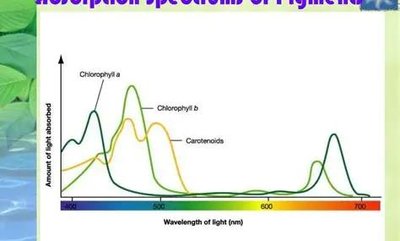
Photosynthetic pigments absorb light energy at specific wavelengths, driving the light reactions of photosynthesis.
Chlorophyll a: Main pigment, absorbs blue-violet and red light.
Chlorophyll b: Accessory pigment, broadens the range of absorbed light.
Carotenoids: Absorb blue and green light, protect against photo-damage.
Xanthophylls, Anthocyanins, Tannins, Betalains: Additional pigments with roles in light absorption and protection.
Absorption and Action Spectra
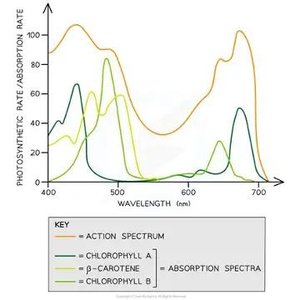
The absorption spectrum shows the wavelengths of light absorbed by each pigment, while the action spectrum indicates the effectiveness of different wavelengths in driving photosynthesis.
Chlorophyll a and b: Absorb mainly in the blue and red regions.
Carotenoids: Absorb in the blue-green region, reflecting yellow-orange.
Action Spectrum: Peaks correspond to the absorption maxima of chlorophylls and carotenoids.
Mechanisms of Photosynthesis
Light-Dependent Reactions
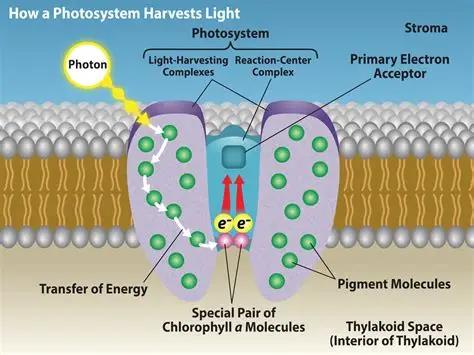
These reactions occur in the thylakoid membranes and require light energy to produce ATP and NADPH, which are used in the Calvin Cycle.
Inputs: Light, H2O, NADP+, ADP + Pi
Outputs: O2, ATP, NADPH
Photosystems: Clusters of pigment molecules (Photosystem I and II) that capture light and transfer energy to reaction centers.
Electron Transport Chain: Transfers electrons, generating a proton gradient for ATP synthesis.
Light-Independent Reactions (Calvin Cycle)
The Calvin Cycle occurs in the stroma and uses ATP and NADPH to fix carbon dioxide into organic molecules.
Stage 1: Carbon Fixation
CO2 enters through stomata and is fixed by the enzyme RuBisCO, forming 3-phosphoglyceric acid (3-PGA).
Stage 2: Reduction
ATP and NADPH reduce 3-PGA to glyceraldehyde-3-phosphate (G3P).
Stage 3: Regeneration of RuBP
Some G3P exits to form glucose; the rest regenerates RuBP using ATP.
Overall Calvin Cycle Equation: Inputs: CO2, ATP, NADPH, H2O Outputs: G3P (sugar), ADP + Pi, NADP+
Photosynthesis and Cellular Respiration: Interconnected Processes
Reciprocal Metabolic Pathways
Photosynthesis and cellular respiration are complementary processes. The products of one serve as the reactants for the other, forming a closed-loop cycle of energy and matter in ecosystems.
Photosynthesis: CO2 + H2O + light energy → glucose + O2
Cellular Respiration: glucose + O2 → CO2 + H2O + ATP
Ecological Impact: Drives the global carbon–oxygen cycle, supporting life and regulating atmospheric gases.
Alternative Mechanisms of Carbon Fixation
C3, C4, and CAM Pathways
Plants have evolved different mechanisms to fix carbon, especially in response to environmental conditions such as heat and aridity.
C3 Plants: Use the Calvin Cycle directly; most common in temperate climates.
C4 Plants: Spatial separation of carbon fixation and Calvin Cycle; adapted to high light and temperature (e.g., sugarcane).
CAM Plants: Temporal separation; fix CO2 at night to reduce water loss (e.g., pineapple).
Feature | C3 | C4 | CAM |
|---|---|---|---|
CO2 Fixation | Direct (mesophyll) | Mesophyll & bundle sheath | Night (stomata open) |
Adaptation | Temperate | Hot, sunny | Arid |
Examples | Wheat | Sugarcane | Pineapple |
Factors Affecting the Rate of Photosynthesis
Environmental Influences
The rate of photosynthesis is influenced by several key factors:
Light Intensity: Increases rate up to a saturation point.
CO2 Concentration: Increases rate up to a maximum threshold.
Temperature: Rate increases with temperature to an optimum, then declines due to enzyme denaturation.
Key Takeaways
Photosynthesis is essential for energy capture and carbon fixation in ecosystems.
Chloroplast structure and pigment diversity optimize light absorption and energy conversion.
Photosynthesis and cellular respiration form a closed-loop cycle, sustaining life and regulating Earth's atmosphere.
Plants have evolved alternative carbon fixation pathways (C3, C4, CAM) to adapt to diverse environments.
Environmental factors such as light, CO2, and temperature directly affect photosynthetic rates.
