 Back
BackPhotosynthesis: Mechanisms, Pigments, and Plant Adaptations
Study Guide - Smart Notes
 Tailored notes based on your materials, expanded with key definitions, examples, and context.
Photosynthesis: An Overview
Introduction to Photosynthesis
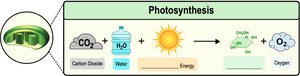
Photosynthesis is the fundamental process by which green plants, algae, and some bacteria convert light energy into chemical energy, producing glucose and oxygen from carbon dioxide and water. This process is essential for life on Earth, as it forms the basis of the food chain and regulates atmospheric gases.
Photosynthetic organisms are called autotrophs because they produce their own food.
The process occurs in specialized organelles called chloroplasts.
The overall chemical equation for photosynthesis is:
Photosynthesis as a Redox Reaction
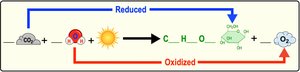
Photosynthesis is a redox (reduction-oxidation) reaction. In this process, carbon dioxide is reduced to form glucose, while water is oxidized to produce oxygen gas.
Reduction: Gain of electrons (CO2 to C6H12O6).
Oxidation: Loss of electrons (H2O to O2).
Photosynthesis vs. Cellular Respiration
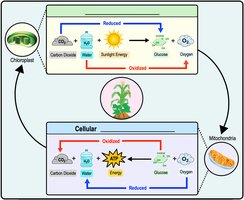
Photosynthesis and cellular respiration are interconnected metabolic pathways. Photosynthesis stores energy in glucose, while cellular respiration releases that energy for cellular work.
Photosynthesis: Converts light energy to chemical energy (glucose).
Cellular Respiration: Converts chemical energy (glucose) to ATP.
The products of one process serve as the reactants for the other.
Leaf and Chloroplast Anatomy
Leaf Structure and Gas Exchange
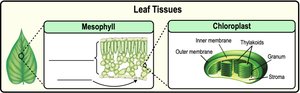
Photosynthesis primarily occurs in the mesophyll cells of leaves, which contain numerous chloroplasts. Gas exchange is facilitated by stomata, small pores on the leaf surface.
Mesophyll: Leaf tissue rich in chloroplasts; main site of photosynthesis.
Stomata: Pores that regulate the exchange of CO2, O2, and water vapor.
Chloroplast Structure
Thylakoids: Membranous sacs where light reactions occur.
Grana: Stacks of thylakoids.
Stroma: Fluid matrix containing enzymes, DNA, and ribosomes; site of the Calvin cycle.
The Electromagnetic Spectrum and Light Absorption
Electromagnetic Spectrum
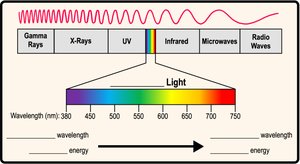
Sunlight consists of electromagnetic radiation of various wavelengths. Only a small portion, known as visible light, is used in photosynthesis.
Visible light: 380–750 nm; the range plants use for photosynthesis.
Shorter wavelengths (e.g., UV) have higher energy; longer wavelengths (e.g., infrared) have lower energy.
Pigments of Photosystems
Chloroplasts contain several pigments that absorb light energy for photosynthesis.
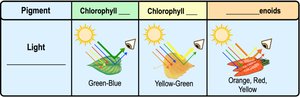
Chlorophyll a: Main photosynthetic pigment; absorbs blue-violet and red light.
Chlorophyll b and carotenoids: Accessory pigments; broaden the spectrum of light absorbed.
Pigments reflect the wavelengths they do not absorb, which is why plants appear green.
Absorption Spectrum and Action Spectrum
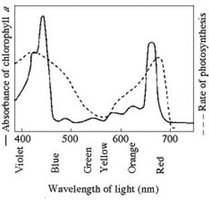
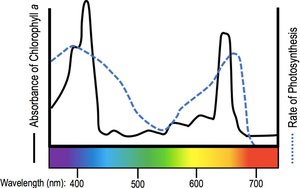
The absorption spectrum shows the wavelengths of light absorbed by each pigment, while the action spectrum shows the rate of photosynthesis at each wavelength.
Chlorophyll a absorbs most strongly in the blue and red regions.
Accessory pigments absorb additional wavelengths, increasing photosynthetic efficiency.
Stages of Photosynthesis
Overview of the Two Stages
Photosynthesis occurs in two main stages: the light reactions and the Calvin cycle (dark reactions).
Light Reactions: Convert light energy into chemical energy (ATP and NADPH); occur in the thylakoid membranes.
Calvin Cycle: Uses ATP and NADPH to fix CO2 and synthesize glucose; occurs in the stroma.
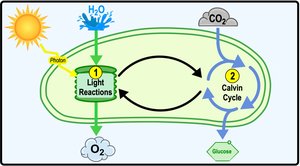
Light Reactions
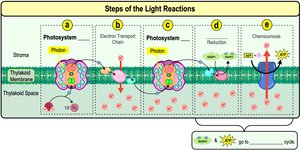
The light reactions use light energy to split water, release oxygen, and generate ATP and NADPH.
Photosystem II absorbs photons, energizing electrons from water (producing O2).
Electrons travel through the electron transport chain to Photosystem I, creating a proton gradient.
Photosystem I re-energizes electrons, which reduce NADP+ to NADPH.
ATP is produced by chemiosmosis via ATP synthase.
Calvin Cycle
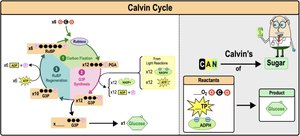
The Calvin cycle uses ATP and NADPH from the light reactions to fix carbon dioxide and produce glucose.
Carbon fixation: CO2 is attached to RuBP by the enzyme rubisco.
Reduction: ATP and NADPH are used to convert 3-phosphoglycerate to G3P.
Regeneration: Some G3P is used to regenerate RuBP, allowing the cycle to continue.
Photorespiration and Plant Adaptations
Photorespiration
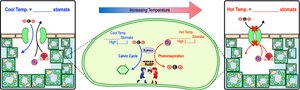
Photorespiration is a process that occurs when the enzyme rubisco fixes O2 instead of CO2, leading to the loss of fixed carbon and energy. This process is wasteful and is more likely under hot, dry conditions when stomata are closed to prevent water loss.
Photorespiration reduces the efficiency of photosynthesis in C3 plants.
Occurs when O2 concentration is high and CO2 is low inside the leaf.
C3, C4, and CAM Plant Adaptations
Plants have evolved different mechanisms to minimize photorespiration and maximize photosynthetic efficiency in various environments.
C3 Plants: Use the Calvin cycle directly; most common but susceptible to photorespiration.
C4 Plants: Spatially separate carbon fixation and the Calvin cycle; use a 4-carbon intermediate to efficiently fix CO2 even when stomata are partially closed.
CAM Plants: Temporally separate carbon fixation and the Calvin cycle; open stomata at night to fix CO2 and close them during the day to conserve water.
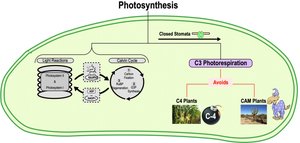
Summary Table: Comparison of Photosynthetic Pathways
Plant Type | Carbon Fixation | Adaptation | Example |
|---|---|---|---|
C3 | Direct Calvin cycle | Efficient in cool, moist environments; susceptible to photorespiration | Wheat, rice |
C4 | Spatial separation; 4-C intermediate | Reduces photorespiration; efficient in hot, sunny environments | Corn, sugarcane |
CAM | Temporal separation; 4-C intermediate at night | Conserves water; adapted to arid conditions | Cacti, succulents |
Key Terms and Concepts
Autotroph: Organism that produces its own food from inorganic substances.
Chloroplast: Organelle where photosynthesis occurs.
Stomata: Pores on leaf surfaces for gas exchange.
Thylakoid: Membranous sac in chloroplasts; site of light reactions.
Stroma: Fluid inside chloroplasts; site of Calvin cycle.
Photosystem: Complex of pigments and proteins that captures light energy.
Rubisco: Enzyme that catalyzes the first step of the Calvin cycle.
Photorespiration: Process that reduces photosynthetic efficiency by fixing O2 instead of CO2.
