 Back
BackLEC 11: Photosynthesis: Mechanisms, Redox Reactions, and Light Absorption
Study Guide - Smart Notes
 Tailored notes based on your materials, expanded with key definitions, examples, and context.
Photosynthesis: An Overview
Introduction to Photosynthesis
Photosynthesis is the process by which photoautotrophic organisms, such as plants, algae, and some prokaryotes, convert light energy into chemical energy. This process sustains most life on Earth by providing organic molecules and oxygen. Organisms are classified based on their metabolic properties as autotrophs or heterotrophs.
Autotrophs: Organisms that produce their own food from inorganic sources. Photoautotrophs use light energy to fix carbon dioxide into organic molecules.
Heterotrophs: Organisms that obtain energy by consuming other organisms. Most heterotrophs depend on photoautotrophs for food and oxygen.
Carbon Fixation: The process of converting inorganic CO2 into organic molecules.
The Site and Structure of Photosynthesis
Chloroplasts and Leaf Anatomy
Photosynthesis primarily occurs in the chloroplasts of mesophyll cells within plant leaves. Chloroplasts contain an outer membrane, an inner membrane, and a third membrane system called thylakoids, which are often stacked into grana. The stroma is the dense fluid inside the chloroplast, analogous to the cytosol.
Stomata: Pores on the leaf surface that allow CO2 to enter and O2 to exit.
Thylakoids: Membranous sacs containing chlorophyll, the main pigment for light absorption.
Grana: Stacks of thylakoids within the chloroplast.
Overview of Photosynthetic Reactions
Light Reactions and the Calvin Cycle
Photosynthesis consists of two main stages: the light reactions and the Calvin cycle. The light reactions convert solar energy into chemical energy (ATP and NADPH), while the Calvin cycle uses this energy to fix carbon dioxide into carbohydrates.
Light Reactions: Occur in the thylakoid membranes; produce ATP and NADPH.
Calvin Cycle: Occurs in the stroma; uses ATP and NADPH to convert CO2 into glucose.
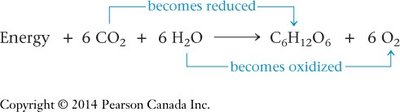
Overall equation for photosynthesis:
Redox Reactions in Photosynthesis
Oxidation-Reduction (Redox) Concepts
Photosynthesis is a redox process where water is oxidized and carbon dioxide is reduced. Redox reactions involve the transfer of electrons between molecules, with one molecule acting as the reducing agent (loses electrons) and the other as the oxidizing agent (gains electrons).
Oxidation: Loss of electrons by a molecule, atom, or ion.
Reduction: Gain of electrons by a molecule, atom, or ion.
Electron Carriers: Molecules such as NAD+ and NADP+ shuttle electrons during redox reactions.
Example: Methane combustion as a redox reaction:
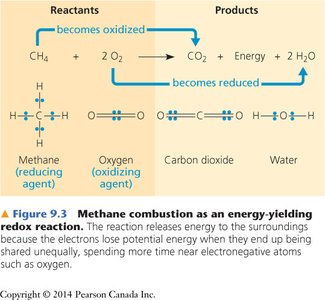
In this reaction, methane (CH4) is oxidized to CO2, and oxygen (O2) is reduced to water (H2O). The transfer of electrons releases energy as electrons move to more electronegative atoms.
Light and Pigments in Photosynthesis
Properties of Light
Light is a form of electromagnetic energy that travels in waves. The wavelength of light determines its energy and its role in photosynthesis. Visible light, which ranges from about 380 nm to 750 nm, is the portion of the spectrum used by plants.
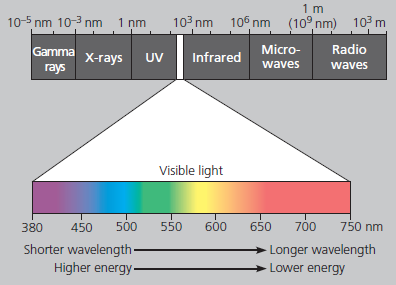
Shorter wavelengths: Higher energy (e.g., blue and violet light).
Longer wavelengths: Lower energy (e.g., red light).
Pigments and Light Absorption
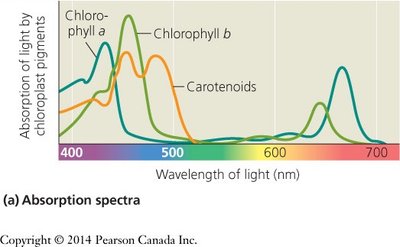
Pigments are substances that absorb visible light. Chlorophyll a is the main photosynthetic pigment, while chlorophyll b and carotenoids are accessory pigments that broaden the spectrum of light used for photosynthesis and protect against damage from excessive light.
Chlorophyll a: Absorbs violet-blue and red light; reflects green.
Chlorophyll b: Broadens the absorption spectrum.
Carotenoids: Absorb excessive light and protect chlorophyll.
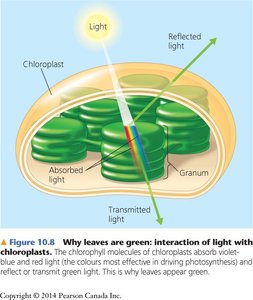
Leaves appear green because chlorophyll reflects and transmits green light while absorbing other wavelengths.
Absorption Spectra of Photosynthetic Pigments
The absorption spectra of chlorophyll a, chlorophyll b, and carotenoids show which wavelengths are most effectively absorbed for photosynthesis. Violet-blue and red light are most effective, while green light is least absorbed.
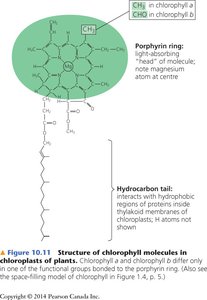
Structure of Chlorophyll
Chlorophyll molecules have a porphyrin ring with a central magnesium atom that absorbs light, and a hydrocarbon tail that anchors the molecule in the thylakoid membrane.
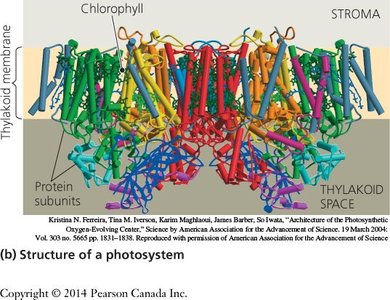
Photosystems and Light Harvesting
Photosystem Structure and Function
Photosystems are complexes in the thylakoid membrane that capture light energy and initiate electron transfer. Each photosystem consists of a reaction-center complex surrounded by light-harvesting complexes. Photosystem II (PSII) functions first, followed by Photosystem I (PSI).
Reaction Center: Contains a special pair of chlorophyll a molecules that transfer excited electrons to a primary electron acceptor.
Light-Harvesting Complexes: Contain accessory pigments that transfer energy to the reaction center via resonance energy transfer.
Linear Electron Flow in Photosynthesis
Electron Transport and ATP/NADPH Formation
During the light reactions, electrons flow from water through PSII and PSI to NADP+, forming NADPH. The electron transport chain also generates a proton gradient used to produce ATP. This process is called linear (non-cyclic) electron flow and is often depicted as the "Z scheme" due to the change in electron energy levels.
Water Splitting: PSII oxidizes water, releasing O2 and providing electrons.
Electron Carriers: Plastoquinone (Pq), cytochrome b6f, plastocyanin (Pc), and ferredoxin (Fd) shuttle electrons between complexes.
ATP Synthesis: The proton gradient across the thylakoid membrane drives ATP synthase.
NADPH Formation: Electrons reduce NADP+ to NADPH, which is used in the Calvin cycle.
Summary Table: Key Components of the Light Reactions
Component | Function |
|---|---|
Photosystem II (PSII) | Oxidizes water, initiates electron flow |
Electron Transport Chain | Transfers electrons, pumps protons |
Photosystem I (PSI) | Receives electrons, reduces NADP+ |
ATP Synthase | Uses proton gradient to synthesize ATP |
NADP+ Reductase | Reduces NADP+ to NADPH |
Example: The Z scheme illustrates the energy changes of electrons as they move through the photosynthetic electron transport chain, starting from water and ending with NADPH formation.
Additional info: The light reactions are tightly coupled to the Calvin cycle, as the ATP and NADPH produced are immediately used for carbon fixation. Disruptions in the electron transport chain can affect both energy production and carbon assimilation.
