 Back
4.3 Photosynthesis: Mechanisms, Structure, and Products
Study Guide - Smart Notes
 Tailored notes based on your materials, expanded with key definitions, examples, and context.
Photosynthesis
Overview of Photosynthesis
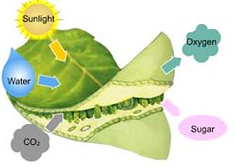
Photosynthesis is the process by which green plants, algae, and some bacteria convert light energy into chemical energy, producing sugars from carbon dioxide and water. This process is fundamental to life on Earth, as it provides the primary energy source for most organisms and releases oxygen as a by-product.
Photosynthesis Equation:
Energy Source: Sunlight
Type of Reaction: Endergonic (requires energy input)
Oxidized Reactant: Water (H2O)
Reduced Reactant: Carbon dioxide (CO2)
Electron Carriers: NADP+ (reduced to NADPH)
Structure of Chloroplasts
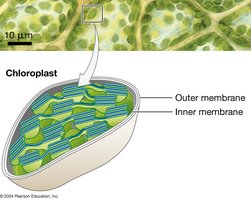
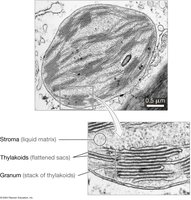
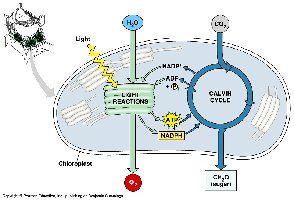
Chloroplasts are the organelles where photosynthesis occurs in plant cells. They contain specialized membranes called thylakoids, which are arranged in stacks known as grana. The fluid surrounding the thylakoids is called the stroma.
Thylakoids: Site of light-dependent reactions
Grana: Stacks of thylakoids
Stroma: Site of the Calvin cycle (light-independent reactions)
Light-Dependent and Light-Independent Reactions
Photosynthesis consists of two main sets of reactions:
Light-Dependent Reactions: Occur in thylakoid membranes; use light energy to produce ATP and NADPH
Light-Independent Reactions (Calvin Cycle): Occur in the stroma; use ATP and NADPH to convert CO2 into sugars
Photosynthetic Pigments and Light Absorption
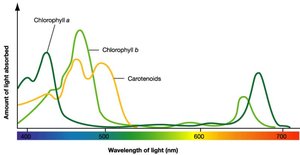
Thylakoid membranes contain pigments that absorb light energy. The most abundant pigment is chlorophyll, which absorbs mainly blue and red wavelengths. Carotenoids absorb in the blue/green region and provide additional protection and light absorption.
Chlorophyll a and b: Absorb blue and red light
Carotenoids: Absorb blue/green light; appear orange/yellow
Photosystems and Light Energy Capture
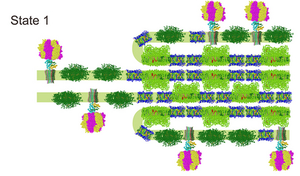
Pigments are organized into photosystems (PSII and PSI) in the thylakoid membrane. Each photosystem contains antenna pigments and a reaction center.
Photosystem II (PSII): Initiates electron transport chain, splits water to release O2
Photosystem I (PSI): Transfers electrons to NADP+ to form NADPH
Electron Transport Chain and ATP Synthesis
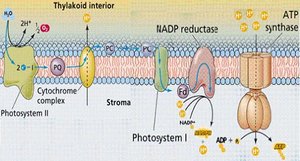
The electron transport chain creates a proton gradient across the thylakoid membrane, generating a proton motive force. ATP synthase uses this force to produce ATP from ADP and inorganic phosphate.
Water Splitting: Provides electrons to PSII and releases O2
ATP and NADPH: Produced by light reactions and used in the Calvin cycle
Calvin Cycle (Light-Independent Reactions)
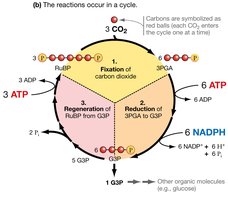
The Calvin cycle uses ATP and NADPH to convert CO2 into sugars. It occurs in the stroma and consists of three phases:
Carbon Fixation: CO2 is added to RuBP to form PGA
Reduction: PGA is reduced to G3P using ATP and NADPH
Regeneration: RuBP is regenerated to continue the cycle
Products and Uses of Photosynthesis
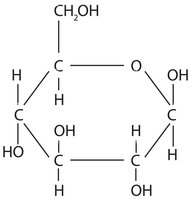
The primary products of photosynthesis are monosaccharides such as glucose and fructose. These can be joined to form disaccharides (e.g., sucrose) or polysaccharides (e.g., starch and cellulose).
Monosaccharides: Glucose, fructose
Disaccharides: Sucrose
Polysaccharides: Starch (storage in plants), cellulose (structure in plants), glycogen (storage in animals)
Formation of Disaccharides and Polysaccharides
Monosaccharides join via dehydration (condensation) reactions, which are endergonic and require energy input.
Glycosidic Bonds: Link monosaccharides in polysaccharides
Dehydration Reaction: Removes water to form bonds
Polysaccharides in Plants and Animals
Starch: Storage polysaccharide in plants; digestible by humans
Cellulose: Structural polysaccharide in plant cell walls; indigestible by humans (dietary fiber)
Glycogen: Storage polysaccharide in animals; highly branched
Comparison Table: Storage and Structural Polysaccharides
Type | Location | Structure | Digestibility |
|---|---|---|---|
Starch | Plants | Unbranched/slightly branched | Digestible |
Cellulose | Plants | Unbranched, hydrogen-bonded bundles | Indigestible (dietary fiber) |
Glycogen | Animals | Highly branched | Digestible |
Summary
Photosynthesis is a complex, multi-step process that transforms light energy into chemical energy, producing sugars and oxygen. The products of photosynthesis are essential for plant metabolism and provide energy for animals through cellular respiration. Additional info: Cows and horses can digest cellulose due to symbiotic microorganisms in their digestive systems, which produce enzymes capable of breaking cellulose bonds.
