 Back
BackPhotosynthesis: Mechanisms, Structures, and Adaptations
Study Guide - Smart Notes
 Tailored notes based on your materials, expanded with key definitions, examples, and context.
Photosynthesis Overview
Introduction to Photosynthesis
Photosynthesis is the fundamental process by which energy from sunlight is captured and converted into chemical energy by living organisms. This process sustains nearly all life on Earth by providing both energy and organic molecules necessary for growth and metabolism.
General Equation:
Oxygenic photosynthesis is performed by cyanobacteria, various algae, and all land plants.
Leaf and Chloroplast Structure
Organization of Photosynthetic Tissues
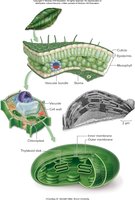
Photosynthesis primarily occurs in the leaves of plants, within specialized organelles called chloroplasts. The structure of leaves and chloroplasts is adapted to maximize light absorption and gas exchange.
Mesophyll cells contain numerous chloroplasts where photosynthesis takes place.
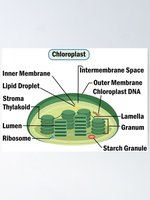
Chloroplasts have a double membrane, internal thylakoid membranes (forming grana), and stroma where the Calvin cycle occurs.
Stages of Photosynthesis
Light-Dependent and Light-Independent Reactions
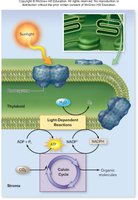
Photosynthesis consists of two main stages: the light-dependent reactions and the Calvin cycle (light-independent reactions).
Light-dependent reactions: Require light, occur in the thylakoid membranes, produce ATP and NADPH.
Calvin cycle (light-independent reactions): Occur in the stroma, use ATP and NADPH to fix carbon dioxide into organic molecules.
Pigments and Light Absorption
Nature and Role of Pigments
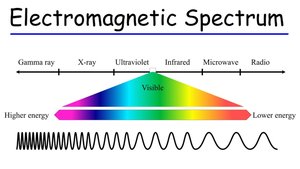
Pigments are molecules that absorb specific wavelengths of light, enabling the capture of solar energy for photosynthesis.
Photon: A particle of light, each with a discrete amount of energy inversely proportional to its wavelength.
Photoelectric effect: The removal of an electron from a molecule by light energy.
Types of Pigments in Photosynthesis
Chlorophylls: Main pigments in green plants; chlorophyll a is the primary pigment, while chlorophyll b is an accessory pigment.
Carotenoids: Accessory pigments that also function as antioxidants, protecting cells from damage by free radicals.
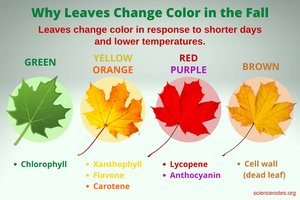
Chlorophylls: Structure and Function
Chlorophyll a: Absorbs violet-blue and red light; directly converts light energy to chemical energy.
Chlorophyll b: Expands the range of light wavelengths absorbed, transferring energy to chlorophyll a.
Light-Dependent Reactions
Photosystems and Electron Transport
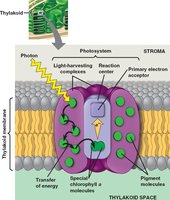
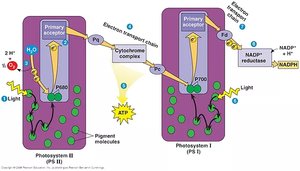
Light-dependent reactions occur in the thylakoid membranes and involve two photosystems (Photosystem II and Photosystem I) that work together to convert light energy into chemical energy.
Photosystem II (P680): Absorbs light, splits water to release O2, and transfers electrons through an electron transport chain.
Photosystem I (P700): Absorbs light, further energizes electrons, and reduces NADP+ to NADPH.
Noncyclic electron flow: Produces both ATP and NADPH.
Cyclic Electron Flow (in some bacteria)
Some photosynthetic bacteria use a cyclic electron flow, where electrons return to the photosystem, generating ATP but not NADPH or O2.
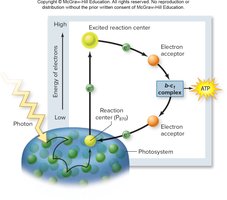
Chemiosmosis and ATP Synthesis
The movement of electrons through the electron transport chain creates a proton gradient across the thylakoid membrane, which drives ATP synthesis via ATP synthase.
ATP synthase: Enzyme complex that synthesizes ATP as protons flow back into the stroma.
Carbon Fixation: The Calvin Cycle
Phases of the Calvin Cycle
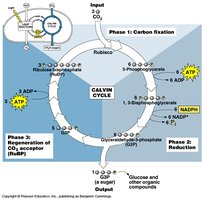
The Calvin cycle uses ATP and NADPH to fix CO2 into organic molecules. It consists of three main phases:
Carbon fixation: CO2 is attached to ribulose bisphosphate (RuBP) by the enzyme rubisco, forming 3-phosphoglycerate (PGA).
Reduction: PGA is reduced to glyceraldehyde 3-phosphate (G3P) using ATP and NADPH.
Regeneration: Some G3P is used to regenerate RuBP, enabling the cycle to continue.
Output of the Calvin Cycle
G3P: A three-carbon sugar that is the direct product of the Calvin cycle; two G3P molecules can be combined to form glucose.
Starch: Glucose polymers stored for later use.
Chloroplasts and Mitochondria: Energy Flow
Comparison of Photosynthesis and Cellular Respiration
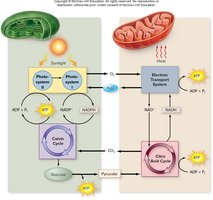
Chloroplasts and mitochondria are both involved in energy transformations in eukaryotic cells. Photosynthesis stores energy in glucose, while cellular respiration releases energy from glucose.
Photorespiration
Rubisco Activity and Environmental Effects
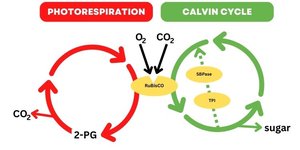
Rubisco, the enzyme that fixes CO2 in the Calvin cycle, can also react with O2, leading to photorespiration. This process is wasteful, as it consumes energy and releases fixed CO2.
Carboxylation: Addition of CO2 to RuBP (desired reaction).
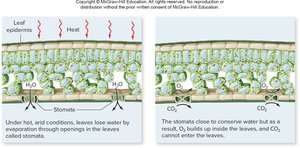
Oxygenation (Photorespiration): Addition of O2 to RuBP, favored in hot, dry conditions when stomata are closed.
Types of Photosynthesis: C3, C4, and CAM Pathways
C3 Photosynthesis
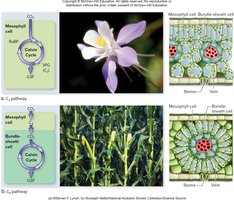
C3 plants use only the Calvin cycle for carbon fixation. This pathway is efficient under cool, moist conditions but is susceptible to photorespiration in hot, dry environments.
C4 Photosynthesis
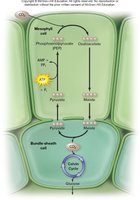
C4 plants have evolved a mechanism to minimize photorespiration by spatially separating initial CO2 fixation and the Calvin cycle.
PEP carboxylase: Enzyme with high affinity for CO2, fixes CO2 into a four-carbon compound (oxaloacetate) in mesophyll cells.
Oxaloacetate is converted to malate, transported to bundle-sheath cells, and decarboxylated to release CO2 for the Calvin cycle.
C4 pathway requires more ATP but is advantageous in hot, dry climates.
CAM Photosynthesis
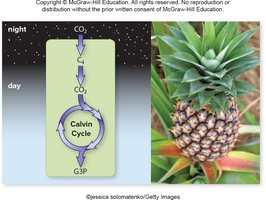
CAM (Crassulacean Acid Metabolism) plants adapt to arid environments by temporally separating CO2 uptake and fixation.
Stomata open at night to fix CO2 into organic acids, which are stored in vacuoles.
During the day, stomata close to conserve water, and CO2 is released from organic acids to drive the Calvin cycle.
Summary Table: Comparison of Photosynthetic Pathways
Pathway | Initial CO2 Fixation | Key Enzyme | Adaptation | Example Plants |
|---|---|---|---|---|
C3 | Calvin cycle (RuBP + CO2) | Rubisco | Efficient in cool, moist climates | Wheat, rice, most temperate plants |
C4 | PEP carboxylase in mesophyll cells | PEP carboxylase | Spatial separation; reduces photorespiration | Corn, sugarcane, sorghum |
CAM | PEP carboxylase at night | PEP carboxylase | Temporal separation; water conservation | Cacti, pineapples, succulents |
