 Back
Photosynthesis: Mechanisms, Structures, and Adaptations
Study Guide - Smart Notes
 Tailored notes based on your materials, expanded with key definitions, examples, and context.
Photosynthesis
Introduction to Photosynthesis
Photosynthesis is a fundamental biological process by which autotrophic organisms convert solar energy into chemical energy, sustaining nearly all life on Earth. The process can be summarized by the following equation:
6 CO2 + 6 H2O + Light energy → C6H12O6 + 6 O2
Photosynthesis nourishes almost the entire living world, either directly or indirectly.
Organisms That Photosynthesize
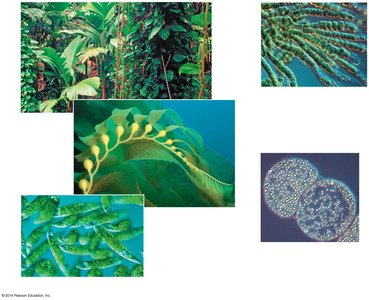
Photosynthesis occurs in a variety of organisms, including plants, algae, certain protists, and some prokaryotes. These organisms are known as autotrophs, which produce organic molecules from CO2 and other inorganic substances.
Autotrophs: Sustain themselves without eating anything derived from other organisms.
Photoautotrophs: Use sunlight to make organic molecules.
Heterotrophs: Cannot make their own food and rely on other organisms for nutrition.
Type | Description |
|---|---|
Autotroph | Produces own food from inorganic substances |
Heterotroph | Consumes other organisms for food |
Sites of Photosynthesis in Plants
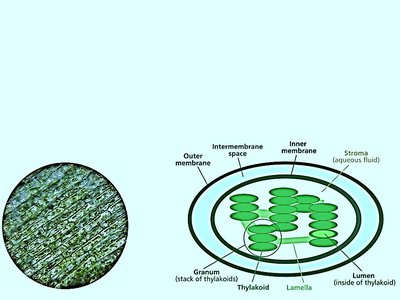
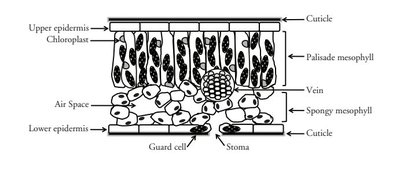
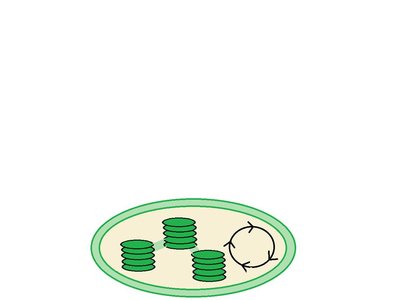
Photosynthesis primarily occurs in the chloroplasts of plant cells, which are most abundant in the mesophyll tissue of leaves.
Chlorophyll: The green pigment responsible for capturing light energy.
Thylakoids: Membranous sacs within chloroplasts, often stacked as grana.
Stroma: The dense fluid inside the chloroplast.
Stomata: Microscopic pores for gas exchange (CO2 in, O2 out).

Evolution of Photosynthesis
Photosynthesis is believed to have first evolved in prokaryotic organisms, particularly cyanobacteria, which played a crucial role in oxygenating Earth's atmosphere.
Prokaryotic photosynthetic pathways laid the foundation for eukaryotic photosynthesis.
Chloroplasts are structurally similar to photosynthetic bacteria, supporting the theory of endosymbiosis.
Photosynthesis as a Redox Process
Photosynthesis is an endergonic process, requiring energy input from light. It is a redox reaction, reversing the electron flow seen in cellular respiration.
Oxidation: Loss of electrons (H2O is oxidized).
Reduction: Gain of electrons (CO2 is reduced).
OIL RIG: Oxidation Is Loss, Reduction Is Gain.

Stages of Photosynthesis
Photosynthesis occurs in two main stages:
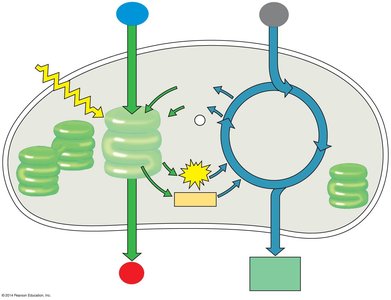
Light Reactions: Occur in the thylakoid membranes; convert solar energy to chemical energy (ATP and NADPH).
Calvin Cycle: Occurs in the stroma; uses ATP and NADPH to fix carbon and produce sugars.
Understanding Light and Pigments
Light is electromagnetic energy, composed of photons, and travels in waves. The wavelength determines the energy and type of light.
Visible light ranges from 380 nm to 750 nm.
Pigments absorb specific wavelengths; chlorophyll absorbs violet-blue and red, reflecting green.
Chlorophyll a: Primary pigment (blue-green).
Chlorophyll b: Accessory pigment (yellow-green).
Carotenoids: Accessory pigments (yellow-orange), provide photoprotection.
Pigment | Color | Function |
|---|---|---|
Chlorophyll a | Blue-green | Main light absorber |
Chlorophyll b | Yellow-green | Accessory pigment |
Carotenoids | Yellow-orange | Photoprotection |
Light Reactions (Light-Dependent Reactions)
The light reactions convert solar energy to chemical energy in the form of ATP and NADPH.
Occur in the thylakoid membrane within photosystems.
Split water, releasing O2.
Reduce NADP+ to NADPH.
Generate ATP by photophosphorylation.
Photosystems and Electron Flow
Photosystems are complexes of proteins and pigments that harvest light. There are two types:
Photosystem II (PS II): Absorbs 680 nm (P680).
Photosystem I (PS I): Absorbs 700 nm (P700).
Linear electron flow produces ATP and NADPH.
Summary of Light Reactions
Inputs: Light, H2O, ADP, NADP+
Outputs: O2, ATP, NADPH
Input | Output |
|---|---|
Light | O2 |
H2O | ATP |
ADP | NADPH |
NADP+ |
Calvin Cycle (Light-Independent Reactions)
The Calvin cycle uses ATP and NADPH to fix CO2 and produce sugars. It consists of three phases:
Carbon Fixation: CO2 is incorporated into RuBP by the enzyme rubisco, forming 3-phosphoglycerate.
Reduction: 3-phosphoglycerate is phosphorylated and reduced to G3P.
Regeneration: G3P is rearranged to regenerate RuBP.
Phase | Description |
|---|---|
Carbon Fixation | CO2 + RuBP → 3-phosphoglycerate |
Reduction | 3-phosphoglycerate → G3P (using ATP and NADPH) |
Regeneration | G3P → RuBP (using ATP) |
Adaptations in Photosynthesis
Plants in hot, dry climates have evolved alternative mechanisms to minimize water loss and maximize carbon fixation.
C3 Plants: Regular photosynthesis; susceptible to photorespiration.
C4 Plants: Spatial separation of steps; CO2 fixed in mesophyll cells, transferred to bundle sheath cells.
CAM Plants: Temporal separation; stomata open at night, CO2 fixed into organic acids, released during the day for Calvin cycle.
Type | Adaptation | Example |
|---|---|---|
C3 | Standard Calvin cycle | Wheat, rice |
C4 | Spatial separation | Maize, sugarcane |
CAM | Temporal separation | Pineapple, cacti |
The Importance of Photosynthesis
Photosynthesis stores solar energy as chemical energy in organic compounds.
Provides food and oxygen for most living organisms.
Excess sugars are stored as starch in various plant structures.
Key Equation: Summary Table: Inputs and Outputs of Photosynthesis
Stage | Inputs | Outputs |
|---|---|---|
Light Reactions | Light, H2O, ADP, NADP+ | O2, ATP, NADPH |
Calvin Cycle | CO2, ATP, NADPH | G3P (sugar), ADP, NADP+ |
Example: Maize (C4 plant) and pineapple (CAM plant) are adapted to hot, dry environments by modifying their carbon fixation pathways. Additional info: The notes include expanded explanations, definitions, and tables for clarity and completeness.
