 Back
Photosynthesis: Mechanisms, Structures, and Significance
Study Guide - Smart Notes
 Tailored notes based on your materials, expanded with key definitions, examples, and context.
Photosynthesis: Introduction and Overview
Definition and Importance
Photosynthesis is the process by which solar energy is converted into chemical energy, stored in complex organic molecules. This process sustains almost the entire biosphere, directly or indirectly feeding most living organisms. The energy stored by photosynthesis is later released by cellular respiration.
Photosynthetic Organisms
Distribution in Nature
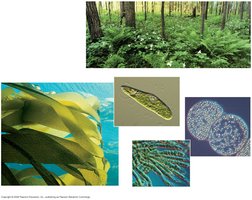
Photosynthesis occurs in plants, algae, some protists, and some prokaryotes. These organisms are collectively known as autotrophs because they produce their own organic molecules from inorganic sources.
Autotrophs vs. Heterotrophs
Autotrophs sustain themselves without consuming organic molecules from other organisms. They are the primary producers, converting CO2 and H2O into organic molecules using sunlight.
Heterotrophs obtain organic material by consuming other organisms. This group includes animals, fungi, some protists, and some bacteria. Heterotrophs are the consumers of the biosphere and depend on autotrophs for food and oxygen.
The Site of Photosynthesis: Chloroplasts and Leaf Structure
Chloroplast Structure
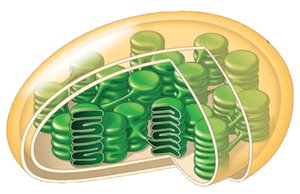
Photosynthesis in plants occurs mainly in the chloroplasts of leaf cells. Chloroplasts contain the pigment chlorophyll, which absorbs light energy to drive the synthesis of organic molecules.
Leaf Anatomy
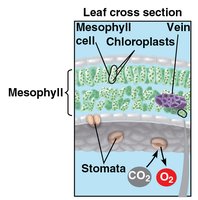
Leaves are the primary sites of photosynthesis. Stomata are microscopic pores that allow CO2 to enter and O2 to exit. Chloroplasts are concentrated in the mesophyll cells of the leaf.
Chloroplast Ultrastructure
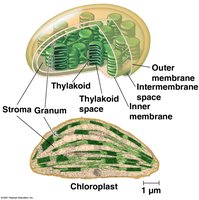
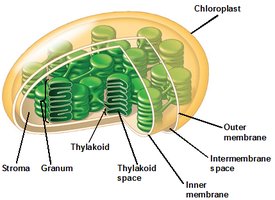
Chloroplasts have an outer and inner membrane, enclosing the stroma (a dense fluid). Inside are stacks of thylakoids (membranous sacs), which may be arranged in columns called grana. Chlorophyll is embedded in the thylakoid membranes.
The Photosynthesis Equation and Redox Nature
Overall Chemical Equation
The general equation for photosynthesis is:
Simplified:
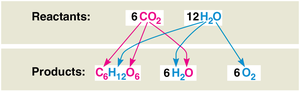
Photosynthesis is a redox process: H2O is oxidized and CO2 is reduced, resulting in the storage of energy in C-H bonds.
The Nature of Sunlight
Electromagnetic Energy
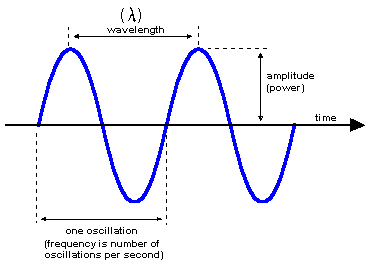
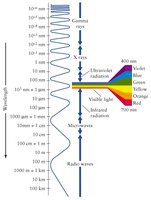
Light is a form of electromagnetic radiation, traveling in waves. The wavelength determines the type of electromagnetic energy, with visible light (about 380–750 nm) being the range used in photosynthesis.
Pigments and Light Absorption
Role of Pigments
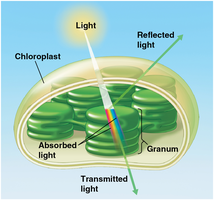
Pigments are substances that absorb visible light. Different pigments absorb different wavelengths; those not absorbed are reflected or transmitted, giving the pigment its color. Chlorophyll reflects green light, making leaves appear green.
Spectrophotometry
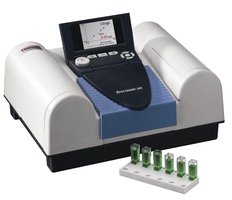
A spectrophotometer measures the absorption of light by pigments at different wavelengths, helping to determine which wavelengths are most effective for photosynthesis.
Absorption and Action Spectra
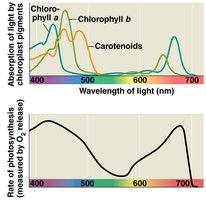
The absorption spectrum shows how much light is absorbed by each pigment at each wavelength. The action spectrum shows the effectiveness of different wavelengths in driving photosynthesis. Violet-blue and red light are most effective.
Types of Pigments
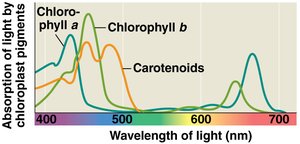
Chlorophyll a: Main photosynthetic pigment.
Accessory pigments: Such as chlorophyll b and carotenoids, expand the range of light absorbed and protect the cell from excess light.
The Two Stages of Photosynthesis
Light Reactions
Occur in the thylakoid membranes. Light energy is used to split water, releasing O2, reducing NADP+ to NADPH, and generating ATP by photophosphorylation (using an electron transport chain).
The Calvin Cycle
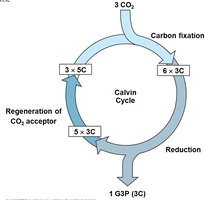
Occurs in the stroma. Uses ATP and NADPH from the light reactions to convert CO2 into sugar (G3P). The cycle must turn three times to fix three CO2 molecules and produce one G3P.
Photosystems and Electron Flow
Photosystems
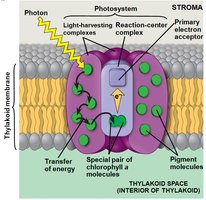
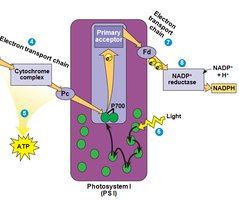
A photosystem consists of a reaction-center complex surrounded by light-harvesting complexes. When chlorophyll absorbs light, an electron is excited and transferred to a primary electron acceptor.
Types of Photosystems
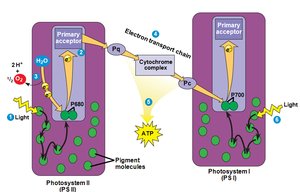
Photosystem II (PS II): Contains P680 chlorophyll a, best at absorbing 680 nm light.
Photosystem I (PS I): Contains P700 chlorophyll a, best at absorbing 700 nm light.
Linear Electron Flow (LEF)
LEF is the primary pathway, involving both photosystems. It produces ATP and NADPH using light energy. The steps include excitation of electrons, splitting of water, electron transport, and formation of ATP and NADPH.
Cyclic Electron Flow
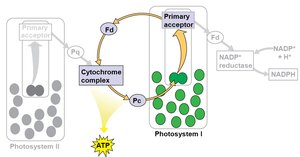
Involves only PS I and produces ATP but not NADPH. It is thought to be an evolutionary adaptation and may protect plants from light-induced damage.
Comparing Chemiosmosis in Chloroplasts and Mitochondria
ATP Generation by Chemiosmosis
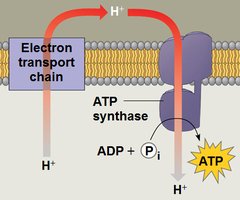
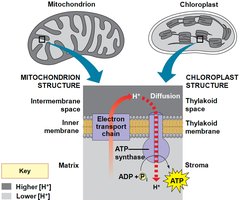
Both organelles use chemiosmosis to generate ATP, but the energy source differs: mitochondria use food-derived electrons, while chloroplasts use light energy. Protons are pumped into the intermembrane space (mitochondria) or thylakoid space (chloroplasts), and their diffusion back drives ATP synthesis.
The Calvin Cycle: Synthesis of Sugar
Phases of the Calvin Cycle
Carbon fixation: CO2 is attached to RuBP by the enzyme rubisco.
Reduction: ATP and NADPH are used to reduce 3-phosphoglycerate to G3P.
Regeneration: RuBP is regenerated for the cycle to continue.
Photosynthesis: Summary and Significance
The energy captured by chloroplasts as sunlight is stored as chemical energy in organic compounds. This sugar provides energy and carbon skeletons for the synthesis of other molecules. Excess sugar is stored as starch, and photosynthesis produces the oxygen in our atmosphere.
