 Back
Photosynthesis: Mechanisms, Structures, and Significance
Study Guide - Smart Notes
 Tailored notes based on your materials, expanded with key definitions, examples, and context.
Photosynthesis: Introduction and Overview
Definition and Importance
Photosynthesis is the process by which solar energy is converted into chemical energy, stored in complex organic molecules. This process sustains almost the entire biosphere, either directly or indirectly, by providing food and oxygen.
Photosynthesis stores energy that is later released by cellular respiration.
It is essential for the energy flow and carbon cycling in ecosystems.
Photosynthetic Organisms
Types of Organisms
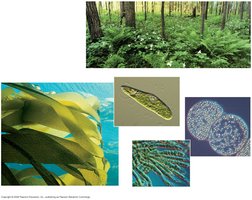
Photosynthesis occurs in plants, algae, some protists, and some prokaryotes. These organisms are collectively known as autotrophs.
Autotrophs produce organic molecules from inorganic CO2 and H2O using sunlight.
Most plants are photoautotrophs, using sunlight to synthesize food.
Heterotrophs
Heterotrophs obtain organic material by consuming other organisms. They include animals, fungi, some protists, and some bacteria.
Heterotrophs are the consumers of the biosphere.
Many depend on photoautotrophs for food and oxygen.
The Photosynthesis Equation
Overall Reaction
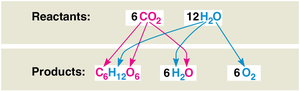
The general equation for photosynthesis is:
Simplified:
Chloroplasts: The Site of Photosynthesis
Leaf Structure and Gas Exchange
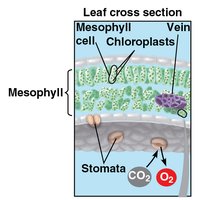
Photosynthesis primarily occurs in the leaves of plants. The green color is due to chlorophyll, the main pigment involved in capturing light energy.
CO2 enters and O2 exits through stomata, small pores on the leaf surface.
Chloroplasts are concentrated in the mesophyll cells of the leaf.
Chloroplast Structure
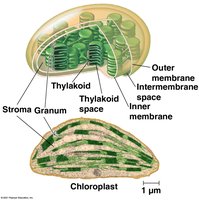
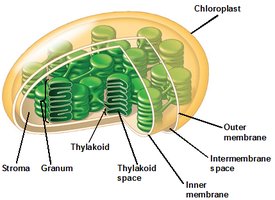
Chloroplasts contain internal membranes called thylakoids, which are often stacked into grana. The fluid surrounding the thylakoids is the stroma.
Chlorophyll is embedded in the thylakoid membranes.
Chloroplasts have their own DNA, supporting the endosymbiotic theory of their origin.
The Nature of Sunlight
Electromagnetic Energy
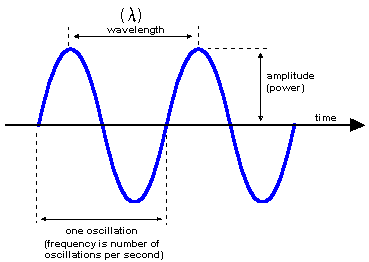
Light is a form of electromagnetic energy, traveling in waves and behaving as particles called photons.
Wavelength is the distance between wave crests and determines the type of electromagnetic energy.
The Electromagnetic Spectrum
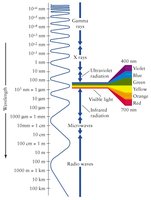
The electromagnetic spectrum encompasses all wavelengths of electromagnetic radiation. Visible light (about 380–750 nm) is the portion used in photosynthesis.
Pigments and Light Absorption
Pigments
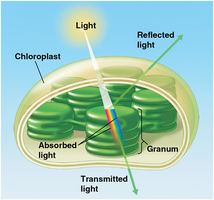
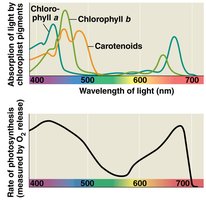
Pigments are substances that absorb visible light. Different pigments absorb different wavelengths, and the color we see is the wavelength that is reflected or transmitted.
Chlorophyll a: Main photosynthetic pigment.
Accessory pigments: Chlorophyll b and carotenoids expand the range of light absorbed and protect the cell from damage.
Spectrophotometry
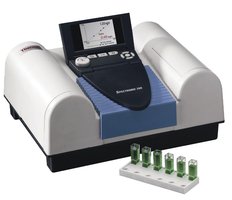
A spectrophotometer measures the absorption of light by pigments at different wavelengths, helping to determine which wavelengths are most effective for photosynthesis.
Absorption and Action Spectra
The absorption spectrum shows how much light is absorbed by each pigment at each wavelength. The action spectrum shows the effectiveness of different wavelengths in driving photosynthesis.
Violet-blue and red light are most effective for photosynthesis.
The Two Stages of Photosynthesis
Light Reactions
The light reactions occur in the thylakoid membranes and use light energy to split water, releasing O2, reducing NADP+ to NADPH, and generating ATP by photophosphorylation.
The Calvin Cycle
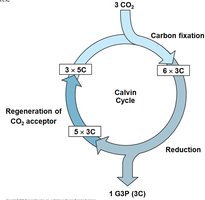
The Calvin cycle occurs in the stroma and uses ATP and NADPH to convert CO2 into sugar (G3P). The cycle regenerates its starting molecule, RuBP, and must turn three times to produce one G3P.
Three phases: Carbon fixation (catalyzed by rubisco), reduction, and regeneration of RuBP.
Photosystems and Electron Flow
Photosystems
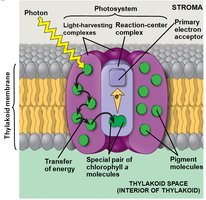
A photosystem consists of a reaction-center complex surrounded by light-harvesting complexes. The primary electron acceptor receives excited electrons from chlorophyll a.
Linear Electron Flow
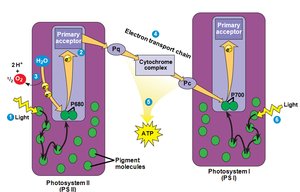
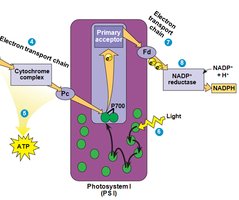
Linear electron flow is the main pathway in the light reactions, involving both Photosystem II (PS II) and Photosystem I (PS I). It produces ATP and NADPH.
Water is split, providing electrons to PS II and releasing O2.
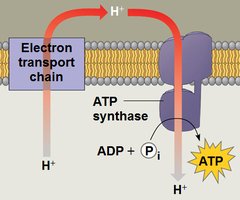
Electrons move through an electron transport chain, creating a proton gradient for ATP synthesis.
Electrons are transferred to NADP+ to form NADPH.
Cyclic Electron Flow
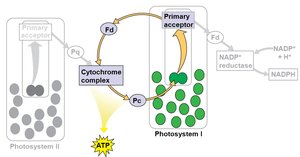
Cyclic electron flow involves only Photosystem I and produces ATP but not NADPH. Electrons cycle back to the photosystem instead of reducing NADP+.
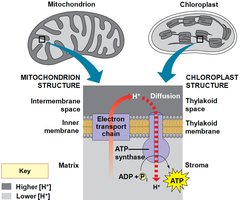
Comparing Chemiosmosis in Chloroplasts and Mitochondria
ATP Synthesis
Both chloroplasts and mitochondria generate ATP by chemiosmosis, but use different energy sources:
Mitochondria: Use energy from food molecules.
Chloroplasts: Use light energy.
The Calvin Cycle: Carbon Fixation and Sugar Production
Phases of the Calvin Cycle
Carbon fixation: CO2 is attached to RuBP by the enzyme rubisco.
Reduction: ATP and NADPH are used to convert 3-phosphoglycerate into G3P.
Regeneration: RuBP is regenerated for the cycle to continue.
For one G3P (3-carbon sugar) to be produced, the cycle must fix three CO2 molecules.
Photosynthesis: Summary and Significance
Photosynthesis captures solar energy and stores it as chemical energy in sugars. These sugars provide energy and carbon skeletons for the synthesis of other biomolecules. Excess sugar is stored as starch, and photosynthesis is responsible for the oxygen in our atmosphere.
Key Concepts for Review
Describe the structure of a leaf and chloroplast.
Explain the relationship between absorption and action spectra.
Trace the movement of electrons in linear and cyclic electron flow.
Compare oxidative phosphorylation in mitochondria and photophosphorylation in chloroplasts.
Describe the roles of CO2, rubisco, ATP, and NADPH in the Calvin cycle.
