 Back
Photosynthesis Model Labeling Guidance
Study Guide - Smart Notes
 Tailored notes based on your materials, expanded with key definitions, examples, and context.
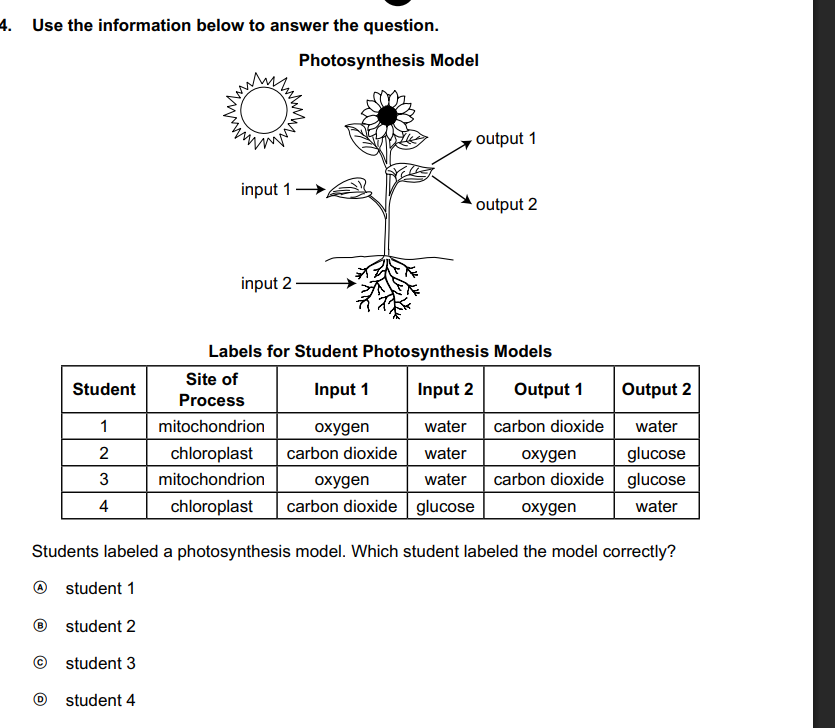
Q4. Students labeled a photosynthesis model. Which student labeled the model correctly?
Background
Topic: Photosynthesis
This question tests your understanding of the photosynthesis process, including the correct site (organelle), inputs, and outputs. Photosynthesis is a fundamental biological process in plants, converting light energy, carbon dioxide, and water into glucose and oxygen.
Key Terms and Formulas:
Chloroplast: The organelle where photosynthesis occurs in plant cells.
Inputs: Carbon dioxide () and water ().
Outputs: Glucose () and oxygen ().
Photosynthesis Equation:
Step-by-Step Guidance
Review the photosynthesis equation and identify the correct organelle: photosynthesis occurs in the chloroplast, not the mitochondrion.
Identify the correct inputs: plants take in carbon dioxide (from the air) and water (from the soil).
Determine the correct outputs: the process produces glucose (used for energy/storage) and oxygen (released into the air).
Compare each student's labels to the correct process: check if the site, inputs, and outputs match the photosynthesis equation and the diagram.
Try solving on your own before revealing the answer!
Final Answer: Student 2
Student 2 correctly labeled the process as occurring in the chloroplast, with carbon dioxide and water as inputs, and oxygen and glucose as outputs. This matches the photosynthesis equation and the model diagram.
