 Back
Photosynthesis: Origin of Plant Biomass and Experimental Evidence
Study Guide - Smart Notes
 Tailored notes based on your materials, expanded with key definitions, examples, and context.
Photosynthesis and the Origin of Plant Biomass
Introduction to Photosynthesis
Photosynthesis is the process by which plants convert light energy into chemical energy, producing glucose and oxygen from carbon dioxide and water. This process is fundamental to life on Earth, as it provides the primary source of organic matter for most organisms.
Key Point: Most of the dry biomass of a tree comes from the incorporation of carbon dioxide gas from the atmosphere into molecules by green leaves.
Key Point: Sunlight energy is essential for photosynthesis but does not contribute mass.
Example: The willow experiment demonstrates that soil is not the main source of plant mass.
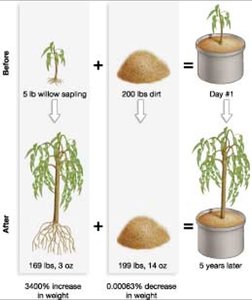
The Willow Experiment
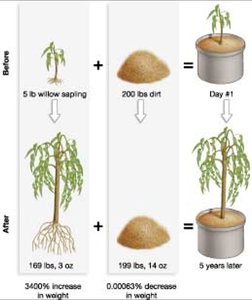
Jean Baptista van Helmont's 17th-century experiment involved growing a willow sapling in a pot with a known mass of soil and water. After five years, the tree's mass increased dramatically, while the soil's mass decreased only slightly.
Key Point: The majority of the tree's mass did not come from the soil.
Key Point: Soil contributes minerals, but not most of the biomass.
Example: The willow sapling grew from 5 lbs to 169 lbs, while the soil lost only 2 oz.
Conservation of Mass and Energy in Photosynthesis
Photosynthesis transforms mass and energy according to the law of conservation. The process can be summarized by the following equation:
Key Point: Sunlight energy is converted to chemical bond energy in glucose.
Key Point: Carbon dioxide and water are transformed into glucose and oxygen.
Tracing Atoms in Photosynthesis
Experimental evidence using isotopes has shown the origin of atoms in the products of photosynthesis:
Carbon in Glucose: Comes from carbon dioxide.
Hydrogen in Glucose: Comes from water.
Oxygen in Oxygen Gas: Comes from water, not carbon dioxide.
Photosynthesis Occurs in Chloroplasts
In eukaryotes, photosynthesis takes place in chloroplasts, specialized organelles found in plant cells. Chloroplasts contain chlorophyll, which absorbs light energy.
Key Point: Chloroplasts are abundant in leaf mesophyll cells.
Key Point: Leaves have stomata for gas exchange.
The Two Stages of Photosynthesis
Light Reactions
The light reactions are the first stage of photosynthesis, converting solar energy into chemical energy in the form of ATP and NADPH. These reactions occur in the thylakoid membranes of the chloroplast.
Inputs: Light energy, water, ADP + Pi, NADP+
Outputs: Oxygen gas, ATP, NADPH
Key Point: No sugar is produced in the light reactions.
The Calvin Cycle
The Calvin cycle is the second stage of photosynthesis, using ATP and NADPH from the light reactions to fix carbon dioxide and produce sugars. This cycle occurs in the stroma of the chloroplast.
Inputs: ATP, NADPH, CO2
Outputs: ADP + Pi, NADP+, sugars (such as glucose)
Key Point: The enzyme RuBisCo is essential for carbon fixation.
Experimental Evidence and Applications
Radish Experiment
An experiment with radish seeds demonstrated the importance of water and light for photosynthesis and biomass production.
Key Point: Plants with water and light produced the most biomass.
Key Point: Photosynthesis requires both water and light.
Example: Seeds contain stored food for initial growth, but sustained biomass increase requires photosynthesis.
Photosynthesis vs. Cellular Respiration
Photosynthesis and cellular respiration are complementary processes. Photosynthesis builds glucose and oxygen from carbon dioxide and water, while cellular respiration breaks down glucose to release energy, carbon dioxide, and water.
Photosynthesis:
Cellular Respiration:
Summary Table: Origin of Atoms in Photosynthesis
Atom | Source | Product |
|---|---|---|
Carbon | CO2 | Glucose |
Hydrogen | H2O | Glucose |
Oxygen | H2O | O2 (gas) |
Oxygen | CO2 | Glucose |
Strategies for Managing Test Anxiety
Before and During the Exam
Effective strategies can help reduce test anxiety and improve performance.
Put things in perspective and remind yourself of past successes.
Move your body to reduce nervous energy.
Get adequate sleep before the exam.
Choose a seat with few distractions.
Expect challenging questions and avoid negative thoughts.
Practice slow breathing to relax.
Work through questions carefully and avoid changing answers unnecessarily.
