 Back
Photosynthesis Part II: Light Reactions, Chemiosmosis, and the Calvin Cycle
Study Guide - Smart Notes
 Tailored notes based on your materials, expanded with key definitions, examples, and context.
Photosynthesis Part II
Linear Electron Flow in Light Reactions
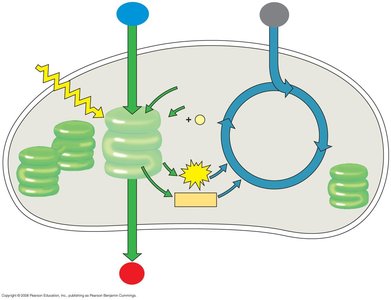
The light reactions of photosynthesis involve the transfer of electrons through a series of protein complexes embedded in the thylakoid membrane. This process is analogous to a mechanical system where energy is transferred stepwise, ultimately resulting in the synthesis of ATP and NADPH.
Photosystem II absorbs light and initiates electron flow.
Photosystem I receives electrons and further energizes them with light.
ATP and NADPH are produced as energy carriers.
Electrons are transferred from water, releasing oxygen as a byproduct.
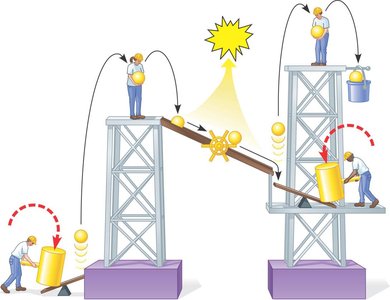
Cyclic Photophosphorylation
Cyclic photophosphorylation is a process plants use to generate extra ATP without producing NADPH. This occurs when Photosystem II is bypassed, and only Photosystem I is active. It is especially important under conditions where the cell requires more ATP than NADPH, such as high light intensity or low CO2 availability.
Only Photosystem I is involved.
ATP is produced, but NADPH is not.
No oxygen is released, as water is not split.
Electrons cycle back to the reaction center.
Protects cells from light-induced damage.
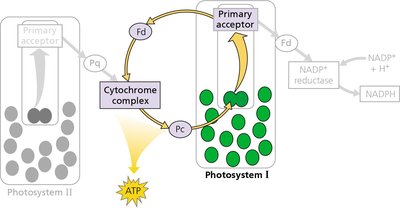
Comparison Table: Noncyclic vs. Cyclic Photophosphorylation
Feature | Noncyclic Photophosphorylation | Cyclic Photophosphorylation |
|---|---|---|
Photosystems Involved | PSI and PSII | Only PSI |
Water Split? | Yes | No |
Oxygen Released? | Yes | No |
NADPH Produced? | Yes | No |
Electron Path | Does not return to reaction center | Cycled back to reaction center |
Chemiosmosis and Photophosphorylation
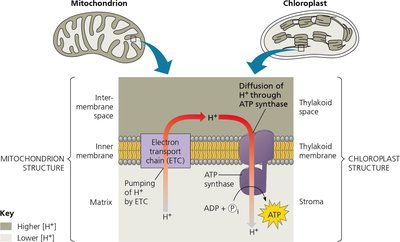
ATP synthesis in chloroplasts is driven by chemiosmosis, a process where a proton gradient across the thylakoid membrane powers ATP synthase. This is called photophosphorylation because the energy source is light.
Protons are pumped into the thylakoid space.
ATP synthase uses the proton gradient to convert ADP and inorganic phosphate (Pi) into ATP.
Similar to chemiosmosis in mitochondria, but the energy source differs: mitochondria use chemical energy from food, chloroplasts use light energy.
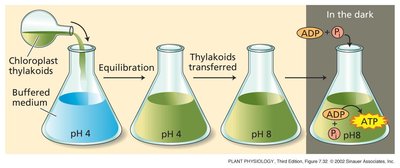
Jagendorf’s Experiment
Jagendorf’s experiment demonstrated that ATP synthesis in chloroplasts depends on a proton gradient across the thylakoid membrane. By manipulating pH, he showed that ATP could be produced in the dark if a gradient was established.
Thylakoids transferred from acidic to basic medium.
ATP produced when ADP and Pi are added.
Results of Light-Dependent Reactions
The light reactions occur in the thylakoid membrane and produce three main products:
Oxygen (O2) from the splitting of water.
NADPH from the reduction of NADP+.
ATP from photophosphorylation.
The Calvin Cycle (Light-Independent Reactions)
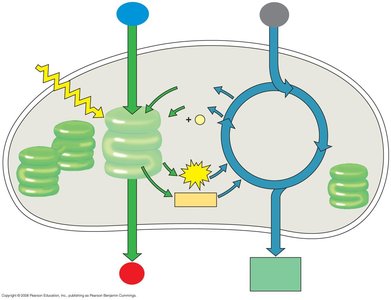
The Calvin Cycle is the set of reactions in the stroma of the chloroplast that use ATP and NADPH to fix carbon dioxide into organic molecules. It does not require light directly, but depends on the products of the light reactions.
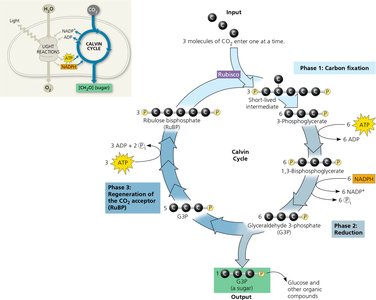
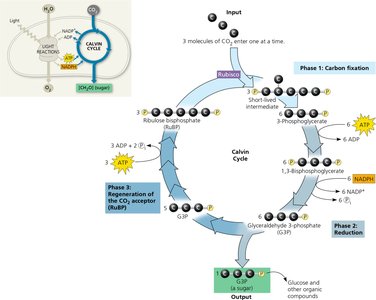
CO2 fixation is catalyzed by the enzyme Rubisco.
ATP provides energy, NADPH provides electrons.
Produces G3P (glyceraldehyde-3-phosphate), a 3-carbon sugar.
Phases of the Calvin Cycle
Phase 1: Carbon Fixation
Each turn of the cycle incorporates one CO2 molecule into ribulose bisphosphate (RuBP), forming an unstable 6-carbon intermediate that splits into two 3-carbon molecules (PGA). The enzyme Rubisco catalyzes this reaction.
Rubisco is the most abundant enzyme on Earth.
Three turns of the cycle fix three CO2 molecules.
Phase 2: Reduction
ATP and NADPH are used to convert PGA into G3P. One G3P molecule exits the cycle to be used in biosynthesis, while the remaining G3P molecules continue in the cycle.
6 ATP and 6 NADPH are consumed for every three CO2 fixed.
G3P is the main product, not glucose directly.
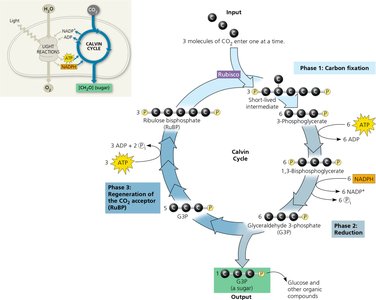
Phase 3: Regeneration of RuBP
Five G3P molecules are rearranged, using ATP, to regenerate three RuBP molecules, allowing the cycle to continue.
3 ATP are used in this phase.
Cycle must turn three times for one G3P, six times for one glucose.
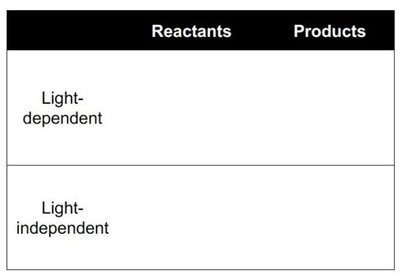
Summary Table: Light-Dependent vs. Light-Independent Reactions
Reactants | Products |
|---|---|
Light-dependent | ATP, NADPH, O2 |
Light-independent | G3P (sugar), ADP, NADP+ |
Key Concepts and Equations
Photophosphorylation:
Calvin Cycle (overall):
Additional info:
Glucose is not a direct product of the Calvin Cycle; G3P is used to synthesize glucose and other carbohydrates.
Both mitochondria and chloroplasts use chemiosmosis, but differ in energy sources and spatial organization.
