 Back
Photosynthesis: Structure, Function, and Laboratory Exploration PB8
Study Guide - Smart Notes
 Tailored notes based on your materials, expanded with key definitions, examples, and context.
Photosynthesis: Overview and Importance
Introduction to Photosynthesis
Photosynthesis is a fundamental biological process occurring in plants and photoautotrophic bacteria, enabling the conversion of light energy into chemical energy. These organisms, known as producers, form the base of the food web, supporting all other life forms either directly or indirectly. Photosynthesis primarily takes place in the leaves of plants, which are specialized organs with a large surface area to maximize light absorption.
Leaf and Chloroplast Structure
Microscopic Anatomy of the Leaf
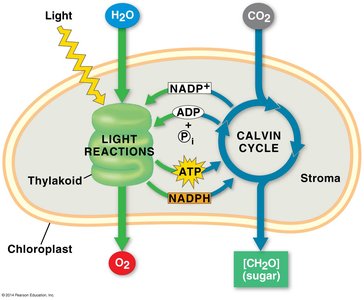
The leaf is composed of several distinct cell types and structures that facilitate photosynthesis. The main photosynthetic cells are mesophyll cells, which contain numerous chloroplasts. Chloroplasts are the organelles where the light-dependent and light-independent reactions of photosynthesis occur. The thylakoid membrane houses the light-harvesting machinery, while the stroma is the site of the Calvin cycle. Gas exchange occurs through stomata, which regulate the entry of carbon dioxide and the exit of oxygen.
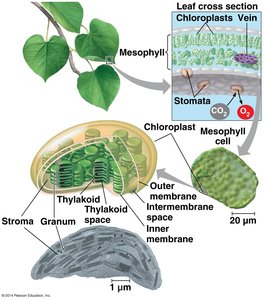
Leaf Cross Section and Cell Types
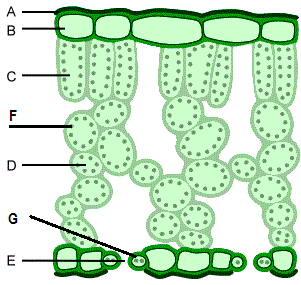
A cross section of a typical leaf reveals the arrangement of cell layers and structures:
Upper epidermis: Protective outer layer
Palisade mesophyll: Densely packed cells rich in chloroplasts, main site of photosynthesis
Spongy mesophyll: Loosely arranged cells with air spaces for gas exchange
Lower epidermis: Contains stomata and guard cells
Stomata: Openings for gas exchange
Guard cells: Regulate stomatal opening
Chlorophyll and Plant Pigments
Structure and Function of Chlorophyll
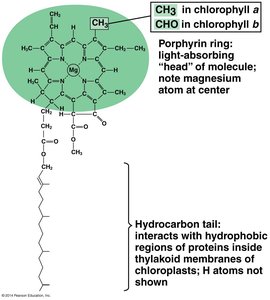
Chlorophyll is the primary pigment involved in light absorption. There are two main types: chlorophyll a and chlorophyll b. Both have a porphyrin ring structure with a central magnesium atom, but differ slightly in their side groups, affecting their absorption spectra. The hydrocarbon tail anchors chlorophyll in the thylakoid membrane.
Other Plant Pigments
In addition to chlorophylls, plants contain other pigments such as carotenoids and xanthophylls, which broaden the range of light absorption and protect against photooxidative damage.
Electromagnetic Radiation and Light Absorption
Visible Light and Photosynthesis
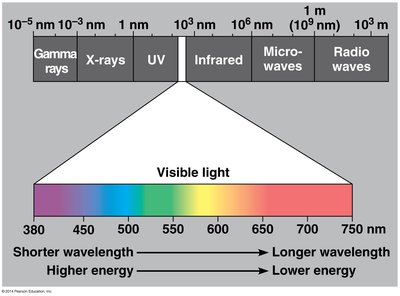
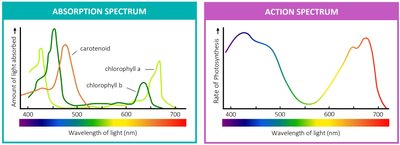
Photosynthetic pigments absorb light primarily in the visible spectrum (400–700 nm). The efficiency of photosynthesis is enhanced by the presence of multiple pigments, each absorbing at different wavelengths.
Absorption and Action Spectra
The absorption spectrum shows the wavelengths of light absorbed by different pigments, while the action spectrum indicates the rate of photosynthesis at each wavelength. Chlorophylls absorb mainly blue and red light, while carotenoids absorb in the blue-green range.
Photosynthetic Reactions
Light-Dependent Reactions
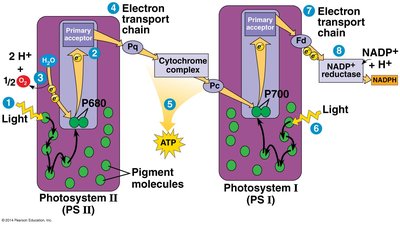
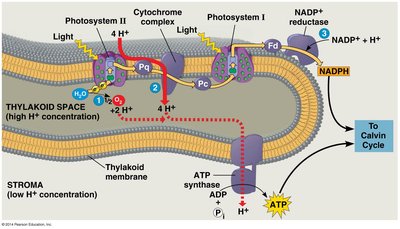
These reactions occur in the thylakoid membranes and require light. Energy from photons excites electrons in chlorophyll, initiating electron transport through two photosystems (PSII and PSI). The process generates ATP via photophosphorylation and reduces NADP+ to NADPH. Water is split (photolysis), releasing oxygen as a byproduct.
Photosystem II (PSII): Absorbs light, excites electrons, splits water
Electron transport chain: Transfers electrons, pumps protons to create a gradient
Photosystem I (PSI): Re-excites electrons, reduces NADP+ to NADPH
ATP synthase: Uses proton gradient to synthesize ATP
Calvin Cycle (Light-Independent Reactions)
The Calvin cycle occurs in the stroma and uses ATP and NADPH from the light-dependent reactions to fix carbon dioxide into organic molecules (sugars).
Laboratory Activities and Techniques
Osmosis in Elodea Cells
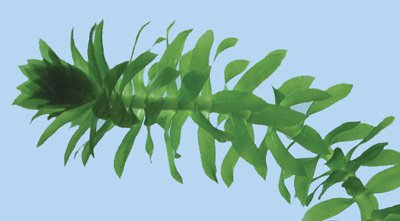
Elodea leaves are used to observe the effects of hypertonic, hypotonic, and isotonic solutions on plant cells. Changes in cell structure and chloroplast distribution can be visualized under a microscope.
Pigment Chromatography
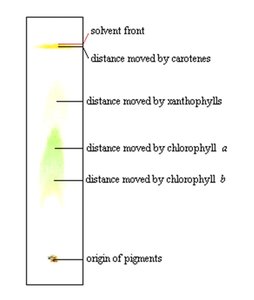
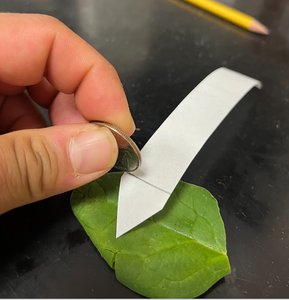
Chromatography separates plant pigments based on their solubility and affinity for the paper. The distance each pigment travels is used to calculate its Rf value (ratio of distance moved by pigment to distance moved by solvent front).
Rf value formula:
Absorption Spectrum Measurement
Using a spectrophotometer, students measure the absorbance of spinach pigment extracts at various wavelengths to determine which pigments are present and their light absorption properties.
Leaf Anatomy Comparison: Ligustrum and Elodea
Microscopic Observation
Prepared slides of Ligustrum and Elodea leaves allow comparison of cell types, chloroplast distribution, and overall leaf anatomy. Both exhibit similar structures, but Elodea is adapted for aquatic environments.
Storage of Starch in Plant Leaves
Starch Detection and Photosynthesis Requirements
Starch storage in leaves is detected using iodine staining (IKI solution). Experimental treatments (deprivation of water, light, or CO2) demonstrate the necessity of these factors for photosynthesis and starch production.
Summary Table: Plant Pigments and Their Properties
Pigment | Color | Absorption Range (nm) | Function |
|---|---|---|---|
Chlorophyll a | Blue-green | 430, 662 | Main photosynthetic pigment |
Chlorophyll b | Yellow-green | 453, 642 | Accessory pigment, broadens absorption |
Carotenoids | Orange/yellow | 400–500 | Protects against photooxidation, absorbs excess light |
Xanthophylls | Yellow | 400–500 | Accessory pigment |
Key Equations
Photosynthesis overall equation:
Rf value:
Additional info:
Some context and explanations were expanded for clarity and completeness, including pigment properties, laboratory techniques, and the importance of each step in the photosynthesis process.
