 Back
Photosynthesis: Structure, Function, and Light Reactions
Study Guide - Smart Notes
 Tailored notes based on your materials, expanded with key definitions, examples, and context.
Photosynthesis Overview
Introduction to Photosynthesis
Photosynthesis is the process by which photoautotrophic organisms, such as plants and certain bacteria, convert energy from sunlight into chemical energy stored in organic molecules. These organisms are known as producers because they form the base of the food chain, supporting all other life forms either directly or indirectly.
Photoautotrophs: Organisms that use sunlight and inorganic molecules to synthesize complex organic molecules.
Location: In plants, photosynthesis primarily occurs in the leaves.
Leaf Structure and Function
Leaf Anatomy and Gas Exchange
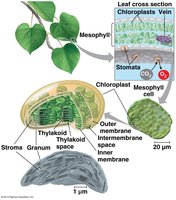
Leaves are specialized plant organs designed to maximize light capture and facilitate gas exchange. Their flat, broad shape increases surface area for sunlight absorption.
Mesophyll cells: Photosynthetic cells within leaves containing numerous chloroplasts.
Chloroplasts: Organelles where photosynthesis occurs, featuring thylakoid membranes and stroma.
Stomata: Pores in the leaf epidermis that regulate gas exchange (CO2 in, O2 out).
Leaf Tissue Types
The leaf contains several distinct tissue layers, each with specialized functions:
Cuticle: Waxy layer preventing water loss.
Epidermis: Protective outer layer.
Palisade mesophyll: Main site of photosynthesis due to high chloroplast density.
Spongy mesophyll: Contains air spaces for gas diffusion.
Guard cells & Stomata: Control gas exchange and water loss.
Chloroplast Structure and Pigments
Chloroplast Anatomy
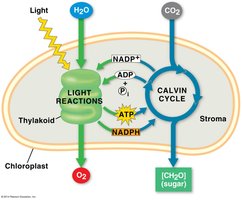
Chloroplasts are double-membraned organelles with internal thylakoid membranes where light reactions occur. The stroma is the fluid-filled space where carbon fixation (Calvin cycle) takes place.
Thylakoid membrane: Site of light-dependent reactions.
Stroma: Site of the Calvin cycle and other carbon reactions.
Photosynthetic Pigments
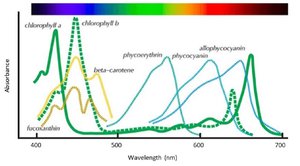
Multiple pigments allow plants to absorb light across a range of wavelengths, increasing photosynthetic efficiency.
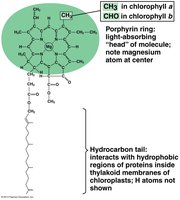
Chlorophyll a: Primary pigment, absorbs mainly blue and red light.
Chlorophyll b: Accessory pigment, absorbs additional wavelengths.
Carotenoids: Absorb blue and green light, protect against photooxidative damage.
Other pigments: Phycocyanin, phycoerythrin, etc., found in various plants and algae.
Light and Energy
Electromagnetic Spectrum and Light Absorption
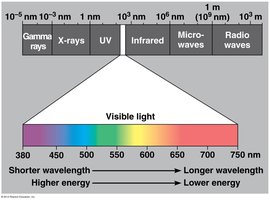
Light energy is part of the electromagnetic spectrum. The energy of light is inversely proportional to its wavelength: shorter wavelengths have higher energy.
Visible light: Range used in photosynthesis (approximately 400–700 nm).
Wavelength: Distance between crests of light waves.
Light-Dependent Reactions
Mechanism of Light Reactions
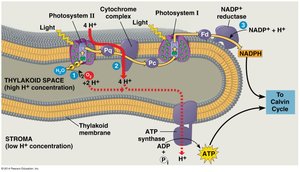
The light-dependent reactions occur in the thylakoid membrane and involve the conversion of light energy into chemical energy (ATP and NADPH).
Photooxidation of chlorophyll: Absorption of photons excites electrons, which are transferred to electron carriers.
Photolysis: Splitting of water to replace electrons lost from chlorophyll, producing O2 as a byproduct.
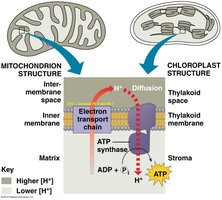
H+ gradient: Protons are pumped into the thylakoid lumen, creating an electrochemical gradient.
Photophosphorylation: ATP synthesis via chemiosmosis, driven by the H+ gradient.
Photosystems and Electron Transport
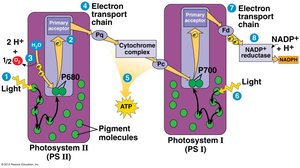
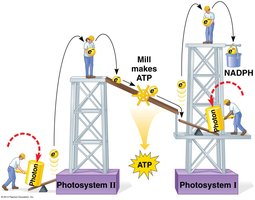
Two photosystems (PSII and PSI) work together to transfer electrons and generate ATP and NADPH.
Photosystem II (PSII): Absorbs light, excites electrons, splits water, and pumps protons.
Photosystem I (PSI): Re-excites electrons and transfers them to NADP+ to form NADPH.
Electron transport chain: Series of molecules that transfer electrons and facilitate proton pumping.
Summary Table: Leaf Structure and Function
Leaf Part | Function |
|---|---|
Cuticle | Prevents water loss |
Epidermis | Protection |
Palisade mesophyll | Main site of photosynthesis |
Spongy mesophyll | Gas exchange |
Stomata | Gas exchange (CO2, O2) |
Guard cells | Regulate stomatal opening |
Key Terms and Concepts
Photoautotroph: Organism that uses light energy to synthesize organic molecules from inorganic sources.
Photolysis: Splitting of water by light energy, producing electrons, protons, and oxygen.
Photophosphorylation: ATP synthesis driven by light-induced proton gradient.
Chlorophyll: Main pigment for light absorption in photosynthesis.
Photosystem: Protein complex that absorbs light and initiates electron transport.
Equations and Formulas
General Photosynthesis Equation
Photolysis of Water
ATP Synthesis (Chemiosmosis)
Additional info:
Having multiple pigments allows plants to utilize a broader spectrum of sunlight, increasing photosynthetic efficiency.
ATP and NADPH produced in the light-dependent reactions are used in the Calvin cycle to synthesize glucose.
Proton gradients are fundamental to energy conversion in both chloroplasts and mitochondria.
