 Back
Photosynthesis: Structure, Function, and Mechanisms
Study Guide - Smart Notes
 Tailored notes based on your materials, expanded with key definitions, examples, and context.
Photosynthesis: Overview
General Description
Photosynthesis is the process by which plants, algae, and some bacteria convert sunlight energy into chemical energy stored in sugars. This process is essential for life on Earth, as it provides the organic molecules and oxygen required by most organisms.
Overall Equation: The general equation for photosynthesis is:
Location: Photosynthesis occurs in the chloroplasts of plant cells, primarily within the leaves.
Chloroplast Structure and Function
Key Components
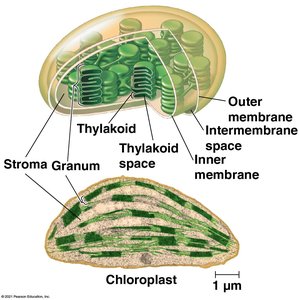
Chloroplasts are specialized organelles where photosynthesis takes place. They contain internal membrane structures that facilitate the two main stages of photosynthesis.
Thylakoid: Membranous sacs where light reactions occur.
Stroma: Fluid-filled space surrounding thylakoids; site of the Calvin cycle.
Granum: Stack of thylakoids.
Membranes: Chloroplasts have an outer and inner membrane, separated by an intermembrane space.
Stages of Photosynthesis
Light Reactions and Calvin Cycle
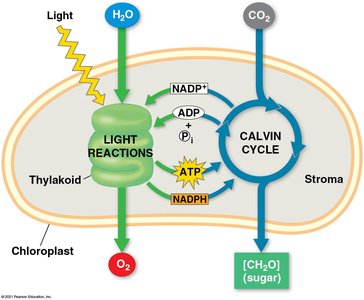
Photosynthesis consists of two main stages: the light reactions and the Calvin cycle.
Light Reactions: Occur in the thylakoid membranes; convert solar energy to chemical energy (ATP and NADPH), and produce O2 as a byproduct.
Calvin Cycle: Occurs in the stroma; uses ATP and NADPH to fix CO2 and synthesize sugars.
Light Reactions
Photosystems and Electron Flow
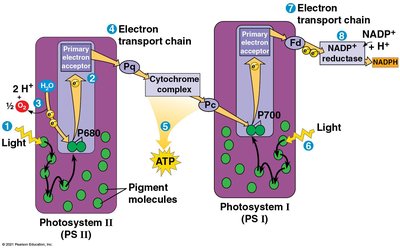
The light reactions involve two photosystems (PSII and PSI) that work together to drive electron flow and generate ATP and NADPH.
Photosystem II (PSII): Absorbs light, splits water, releases O2, and transfers electrons to the electron transport chain.
Photosystem I (PSI): Absorbs light, receives electrons, and reduces NADP+ to NADPH.
Linear Electron Flow: Electrons move from water through PSII, the electron transport chain, PSI, and finally to NADP+.
Chemiosmosis and ATP Generation
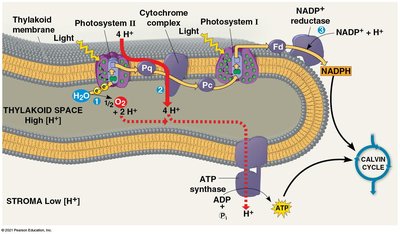
Chemiosmosis is the process by which ATP is generated during the light reactions.
Proton Gradient: Electron transport pumps protons into the thylakoid space, creating a gradient.
ATP Synthase: Protons flow back into the stroma through ATP synthase, driving the synthesis of ATP from ADP and inorganic phosphate.
Calvin Cycle
Phases and Key Steps
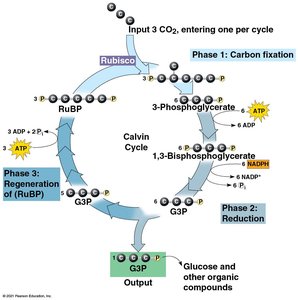
The Calvin cycle is the light-independent stage of photosynthesis, responsible for carbon fixation and sugar synthesis. It consists of three main phases:
Phase 1: Carbon Fixation: CO2 is attached to ribulose bisphosphate (RuBP) by the enzyme rubisco, forming 3-phosphoglycerate.
Phase 2: Reduction: ATP and NADPH are used to convert 3-phosphoglycerate into glyceraldehyde-3-phosphate (G3P).
Phase 3: Regeneration: Some G3P is used to regenerate RuBP, enabling the cycle to continue.
Key Products and Significance
G3P (Glyceraldehyde-3-phosphate): The main product of the Calvin cycle; one G3P exits the cycle per three CO2 fixed, while others are used to regenerate RuBP.
Rubisco: The enzyme responsible for carbon fixation; most abundant protein on Earth.
ATP and NADPH: Provide energy and reducing power for the cycle.

Summary Table: Photosynthesis Stages and Products
Stage | Location | Inputs | Outputs |
|---|---|---|---|
Light Reactions | Thylakoid membrane | Light, H2O, NADP+, ADP + Pi | O2, ATP, NADPH |
Calvin Cycle | Stroma | CO2, ATP, NADPH | G3P (sugar), ADP + Pi, NADP+ |
Additional Academic Context
Photosystems: Complexes of proteins and pigments that absorb light and initiate electron transfer.
Difference between PSI and PSII: PSII splits water and generates O2; PSI reduces NADP+ to NADPH.
Significance of G3P: G3P is a versatile molecule used to synthesize glucose and other organic compounds.
Additional info: The notes expand on brief points to provide a self-contained, exam-ready summary of photosynthesis, including definitions, examples, and diagrams directly relevant to the process.
