 Back
Photosynthesis Study Guide: Structure, Function, and Mechanisms
Study Guide - Smart Notes
 Tailored notes based on your materials, expanded with key definitions, examples, and context.
Photosynthesis: Structure, Function, and Mechanisms
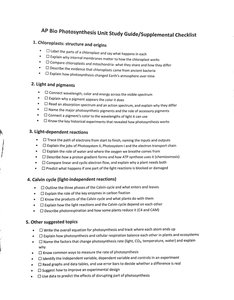
Chloroplasts: Structure and Origins
The chloroplast is the organelle responsible for photosynthesis in plant cells. Understanding its structure and evolutionary origins is essential for grasping how photosynthesis occurs.
Chloroplast Parts: Includes the thylakoid (site of light reactions), stroma (site of Calvin cycle), and outer/inner membranes.
Endosymbiotic Theory: Chloroplasts likely originated from photosynthetic bacteria engulfed by ancestral eukaryotic cells.
Function: Chloroplasts convert light energy into chemical energy, producing oxygen and organic molecules.
Impact: Photosynthesis in chloroplasts has changed Earth's atmosphere by increasing oxygen levels.
Light and Pigments
Photosynthesis begins with the absorption of light by pigments, which initiates energy conversion processes.
Light Absorption: Pigments such as chlorophyll absorb specific wavelengths of light.
Energy Transfer: Absorbed light energy is transferred to electrons, raising them to higher energy states.
Action Spectrum: The action spectrum shows which wavelengths are most effective for photosynthesis.
Pigment Types: Chlorophyll a, chlorophyll b, and carotenoids each absorb different wavelengths.
Example: Plants appear green because chlorophyll reflects green light.
Light-Dependent Reactions
These reactions occur in the thylakoid membranes and require light to produce ATP and NADPH, which are used in the Calvin cycle.
Photosystems: Light is absorbed by photosystem II and photosystem I, exciting electrons.
Electron Transport Chain: Electrons move through a series of proteins, generating ATP via chemiosmosis.
Water Splitting: Water is split to provide electrons, releasing oxygen as a byproduct.
Products: ATP and NADPH are produced and transported to the stroma.
Equation:
Calvin Cycle (Light-Independent Reactions)
The Calvin cycle uses ATP and NADPH to fix carbon dioxide into organic molecules in the stroma of the chloroplast.
Carbon Fixation: CO2 is incorporated into a 5-carbon sugar (RuBP) by the enzyme rubisco.
Reduction: ATP and NADPH are used to convert 3-phosphoglycerate into glyceraldehyde-3-phosphate (G3P).
Regeneration: RuBP is regenerated to continue the cycle.
Products: Glucose and other carbohydrates are synthesized.
Equation:
Other Photosynthesis Topics
Photosynthesis varies among plant types and is influenced by environmental conditions.
C3, C4, and CAM Plants: These plant types differ in their carbon fixation pathways and adaptations to environmental stress.
Photorespiration: Occurs when rubisco binds O2 instead of CO2, reducing efficiency.
Environmental Factors: Light intensity, temperature, and CO2 concentration affect photosynthetic rates.
Experimental Design: Experiments can measure photosynthetic output by tracking oxygen production or CO2 uptake.
Comparison of C3, C4, and CAM Pathways
The following table summarizes the main differences between C3, C4, and CAM photosynthetic pathways:
Pathway | Carbon Fixation | Adaptation | Example Plants |
|---|---|---|---|
C3 | Direct fixation by rubisco | Most common, less efficient in hot/dry climates | Wheat, rice |
C4 | CO2 fixed in mesophyll, then transferred to bundle sheath | Adapted to high light and temperature | Corn, sugarcane |
CAM | CO2 fixed at night, used during day | Adapted to arid environments | Cacti, pineapple |
Chloroplast Structure (Image)
The following image illustrates the structure of a chloroplast, highlighting the thylakoid membranes, stroma, and other key components relevant to photosynthesis.
Additional info: Expanded explanations and equations were added for completeness and clarity.
