 Back
Photosynthesis Study Guide: Structure, Function, and Mechanisms
Study Guide - Smart Notes
 Tailored notes based on your materials, expanded with key definitions, examples, and context.
Photosynthesis: Structure, Function, and Mechanisms
Chloroplasts: Structure and Origins
The chloroplast is the organelle responsible for photosynthesis in plant cells. Understanding its structure and evolutionary origins is essential for grasping how photosynthesis occurs.
Chloroplast Parts: Includes the thylakoid (site of light reactions), stroma (site of Calvin cycle), and outer/inner membranes.
Endosymbiotic Theory: Chloroplasts likely originated from photosynthetic bacteria engulfed by ancestral eukaryotic cells.
Function: Chloroplasts convert light energy into chemical energy, producing oxygen as a byproduct.
Impact: Photosynthesis in chloroplasts has changed Earth's atmosphere by increasing oxygen levels.
Light and Pigments
Light energy is captured by pigments in the chloroplast, initiating the process of photosynthesis. Different pigments absorb specific wavelengths of light.
Light Absorption: Pigments such as chlorophyll absorb light energy, primarily in the blue and red wavelengths.
Energy Transfer: Absorbed light energy is transferred to the photosystems, driving electron transport.
Pigment Types: Chlorophyll a, chlorophyll b, and carotenoids are key pigments in plants.
Action Spectrum: The action spectrum shows which wavelengths are most effective for photosynthesis.
Environmental Effects: Changes in light quality or quantity can affect photosynthetic efficiency.
Light-Dependent Reactions
The light-dependent reactions occur in the thylakoid membranes and require light to produce ATP and NADPH, which are used in the Calvin cycle.
Photosystems: Photosystem II and Photosystem I absorb light and transfer electrons through the electron transport chain.
Water Splitting: Water is split to provide electrons, releasing oxygen as a byproduct.
ATP and NADPH Production: Light energy is used to generate ATP (via chemiosmosis) and NADPH (via reduction of NADP+).
Electron Transport: Electrons move from water to NADP+, passing through a series of carriers.
Equation:
Calvin Cycle (Light-Independent Reactions)
The Calvin cycle occurs in the stroma and uses ATP and NADPH to fix carbon dioxide into organic molecules.
Carbon Fixation: CO2 is incorporated into organic molecules by the enzyme RuBisCO.
Reduction: ATP and NADPH are used to reduce 3-phosphoglycerate to glyceraldehyde-3-phosphate (G3P).
Regeneration: Some G3P is used to regenerate RuBP, allowing the cycle to continue.
Equation:
Other Photosynthesis Topics
Photosynthesis is influenced by environmental factors and can vary among different plant types.
Photosynthetic Pathways: C3, C4, and CAM plants have different adaptations for photosynthesis.
Limiting Factors: Light intensity, CO2 concentration, and temperature affect photosynthetic rates.
Photorespiration: Occurs when O2 is used instead of CO2, reducing efficiency.
Experimental Design: Experiments can test the effects of variables on photosynthesis.
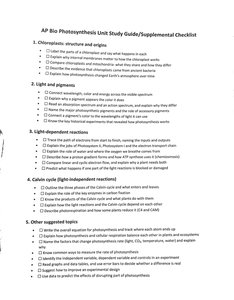 Additional info: The checklist format was expanded into full academic explanations for each topic, including definitions, examples, and relevant equations. The included image is directly relevant as it visually summarizes the main study topics for photosynthesis.
