 Back
BackPhotosynthesis: The Light Reactions and Calvin Cycle
Study Guide - Smart Notes
 Tailored notes based on your materials, expanded with key definitions, examples, and context.
Photosynthesis
Overview of Photosynthesis
Photosynthesis is the process by which plants, algae, and some bacteria convert light energy into chemical energy, producing glucose and oxygen from carbon dioxide and water. It occurs in two main stages: the light reactions and the Calvin cycle.
Light Reactions: Capture solar energy and convert it to chemical energy in the form of ATP and NADPH.
Calvin Cycle: Uses ATP and NADPH to fix carbon dioxide and synthesize sugars.
The Light Reactions
Photosystems and Electron Transport
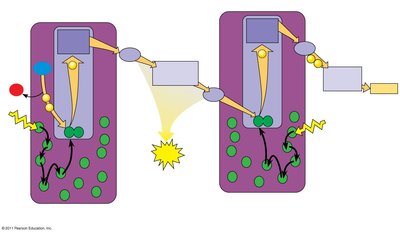
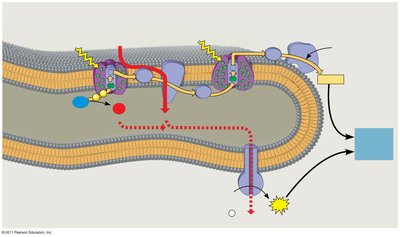
The light reactions take place in the thylakoid membranes of chloroplasts and involve two photosystems (Photosystem II and Photosystem I) connected by an electron transport chain.
Photosystem II (PS II): Absorbs light, exciting electrons that are transferred to the primary electron acceptor. Water is split to replace these electrons, releasing oxygen as a byproduct.
Electron Transport Chain: Electrons move from PS II to PS I via a series of carriers (such as plastoquinone (Pq), cytochrome complex, and plastocyanin (Pc)), generating a proton gradient across the thylakoid membrane.
Photosystem I (PS I): Absorbs light, re-exciting electrons, which are then transferred to NADP+ to form NADPH.
ATP Synthase: The proton gradient drives ATP synthesis as protons flow back into the stroma through ATP synthase.
Key Steps in the Light Reactions
Photolysis of Water:
Electron Flow: Electrons move from water to NADP+ via PS II and PS I.
ATP Formation: Proton gradient powers ATP synthase:
NADPH Formation:

The Calvin Cycle
Overview of the Calvin Cycle
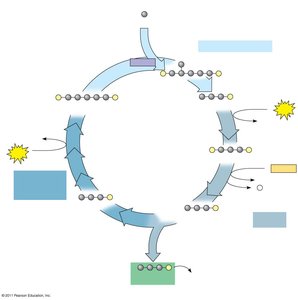
The Calvin cycle occurs in the stroma of the chloroplast and uses ATP and NADPH from the light reactions to fix carbon dioxide and produce sugars. The cycle regenerates its starting molecule, ribulose bisphosphate (RuBP), allowing continuous carbon fixation.
Phase 1: Carbon Fixation – CO2 is attached to RuBP by the enzyme rubisco, forming 3-phosphoglycerate (3-PGA).
Phase 2: Reduction – ATP and NADPH are used to convert 3-PGA into glyceraldehyde-3-phosphate (G3P), a three-carbon sugar.
Phase 3: Regeneration – Some G3P molecules are used to regenerate RuBP, enabling the cycle to continue.
Detailed Steps of the Calvin Cycle
Input: 3 CO2 molecules enter the cycle one at a time.
Carbon Fixation: Each CO2 is attached to a 5-carbon RuBP, forming a 6-carbon intermediate that splits into two 3-PGA molecules.
Reduction: 3-PGA is phosphorylated by ATP and reduced by NADPH to form G3P.
Regeneration: Five out of six G3P molecules are used to regenerate three RuBP molecules; one G3P exits the cycle to contribute to glucose and other organic compounds.
Phase | Input | Output | Key Enzyme |
|---|---|---|---|
Carbon Fixation | 3 CO2, 3 RuBP | 6 3-PGA | Rubisco |
Reduction | 6 ATP, 6 NADPH | 6 G3P (1 exits) | Various |
Regeneration | 5 G3P, 3 ATP | 3 RuBP | Various |
Summary of Photosynthesis
Overall Equation:
Light reactions generate ATP and NADPH, releasing O2 as a byproduct.
Calvin cycle uses ATP and NADPH to fix CO2 and produce sugars.
