 Back
Photosynthesis: The Process That Feeds the Biosphere
Study Guide - Smart Notes
 Tailored notes based on your materials, expanded with key definitions, examples, and context.
Photosynthesis: The Process That Feeds the Biosphere
Energy Cycling in the Biosphere
Photosynthesis is the fundamental process by which autotrophic organisms convert light energy into chemical energy, sustaining life on Earth. Autotrophs, such as plants, algae, and certain bacteria, produce organic molecules from carbon dioxide and other inorganic substances, while heterotrophs rely on consuming these organic molecules for energy.
Autotrophs: "Self-feeders" that synthesize their own food from inorganic sources.
Photoautotrophs: Autotrophs that use light energy to drive the synthesis of organic compounds (e.g., plants, algae).
Heterotrophs: Organisms that obtain organic material by consuming other organisms.
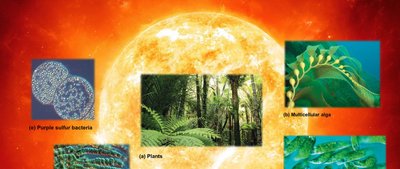
Example: Plants, algae, and cyanobacteria are primary producers in most ecosystems.
Chloroplasts: The Sites of Photosynthesis
Photosynthesis occurs in chloroplasts, specialized organelles found mainly in the mesophyll cells of plant leaves. The structure of the chloroplast is essential for the process, with distinct compartments facilitating different stages of photosynthesis.
Mesophyll: The interior tissue of the leaf where most chloroplasts are located.
Stomata: Microscopic pores on the leaf surface that allow gas exchange (CO2 in, O2 out).
Thylakoids: Membranous sacs forming a third membrane system within the chloroplast; stacked into grana.
Stroma: Dense fluid surrounding the thylakoids, site of the Calvin cycle.
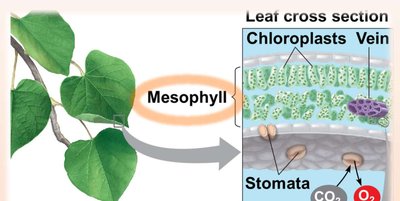
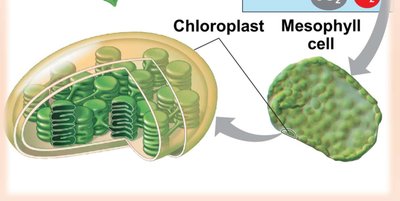
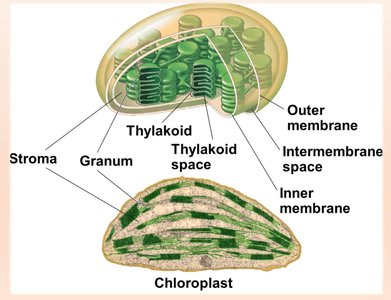
Example: CO2 enters through stomata and is fixed in the stroma during the Calvin cycle.
The Photosynthesis Equation and Redox Process
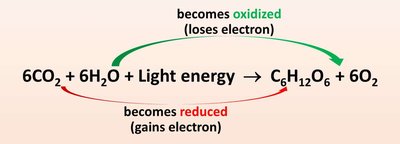
Photosynthesis is a redox process, where water is oxidized and carbon dioxide is reduced. The overall chemical equation summarizes the transformation of light energy into chemical energy stored in glucose.
Photosynthesis Equation:
Cellular Respiration Equation:
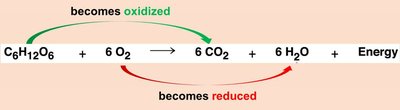
Example: Photosynthesis stores energy in glucose; cellular respiration releases energy from glucose.
Overview of Photosynthesis: Light Reactions and Calvin Cycle
Photosynthesis consists of two main stages: the light reactions and the Calvin cycle. The light reactions occur in the thylakoid membranes and require light, while the Calvin cycle occurs in the stroma and synthesizes sugars.
Light Reactions: Split water, release oxygen, reduce NADP+ to NADPH, and generate ATP by photophosphorylation.
Calvin Cycle: Uses ATP and NADPH to convert CO2 into glucose; begins with carbon fixation.
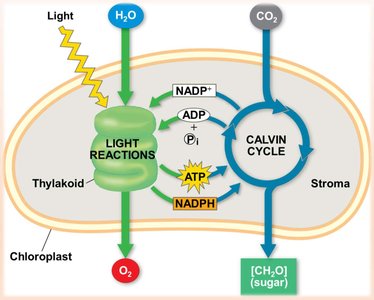
Example: ATP and NADPH produced in the light reactions are used in the Calvin cycle to build sugars.
The Nature of Sunlight
Sunlight is the energy source for photosynthesis. Light energy travels in waves, and its wavelength determines the type of electromagnetic energy. Visible light (380–750 nm) is most effective for photosynthesis.
Photons: Small packets of light energy.
Electromagnetic Spectrum: Range of wavelengths; visible light drives photosynthesis.

Example: Blue and red wavelengths are most efficiently absorbed by chlorophyll.
Pigments and Light Absorption
Pigments are molecules that absorb specific wavelengths of light. Chlorophyll is the main photosynthetic pigment, while accessory pigments expand the range of light absorption.
Chlorophyll a: Main pigment; absorbs blue/violet and red light, reflects green.
Chlorophyll b and Carotenoids: Accessory pigments; transfer energy to chlorophyll a.
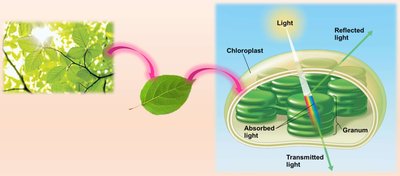
Example: Plants appear green because chlorophyll reflects and transmits green light.
Chlorophyll Excitation and Photosystems
When chlorophyll absorbs light, electrons are elevated to a higher energy state. Photosystems, composed of a reaction-center complex and light-harvesting complexes, facilitate the transfer of energy and electrons during the light reactions.
Photosystem II (PS II): Functions first; best at absorbing 680 nm wavelength (P680).
Photosystem I (PS I): Best at absorbing 700 nm wavelength (P700).
Example: Energy from photons is funneled to the reaction center, initiating electron transfer.
Light Reactions: ATP and NADPH Production
The light reactions use PS I and PS II to convert light energy into chemical energy. Water is split, oxygen is released, ATP is synthesized, and NADP+ is reduced to NADPH.
Photophosphorylation: ATP synthesis driven by light-induced electron flow.
NADPH: Electron carrier used in the Calvin cycle.
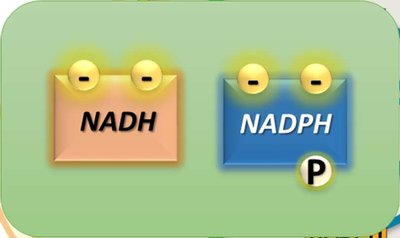
Example: ATP and NADPH are produced in the thylakoid membrane and used in the stroma.
The Calvin Cycle: Sugar Synthesis
The Calvin cycle is an anabolic pathway that builds glucose from CO2, using ATP and NADPH. It consists of three phases: carbon fixation, reduction, and regeneration of the CO2 acceptor (RuBP).
Carbon Fixation: CO2 is attached to RuBP by the enzyme Rubisco.
Reduction: ATP and NADPH are used to convert 3-phosphoglycerate to G3P.
Regeneration: RuBP is regenerated to continue the cycle.
Example: For net synthesis of one G3P, the cycle must fix three CO2 molecules.
Comparison Table: Photosynthesis vs Cellular Respiration
Process | Reactants | Products | Energy Flow |
|---|---|---|---|
Photosynthesis | CO2, H2O, Light | Glucose, O2 | Stores energy |
Cellular Respiration | Glucose, O2 | CO2, H2O, ATP | Releases energy |
Additional info: The Calvin cycle is named after Melvin Calvin, who elucidated its steps.
