 Back
Photosynthesis: The Process That Feeds the Biosphere
Study Guide - Smart Notes
 Tailored notes based on your materials, expanded with key definitions, examples, and context.
Photosynthesis: The Process That Feeds the Biosphere
Energy Cycling in the Biosphere
Photosynthesis is the fundamental process by which autotrophic organisms convert light energy into chemical energy, sustaining life on Earth. Autotrophs, such as plants, algae, and certain bacteria, produce organic molecules from carbon dioxide and other inorganic substances. Heterotrophs, including animals and fungi, rely on these organic molecules for nutrition.
Autotrophs: "Self-feeders" that synthesize their own food from inorganic sources.
Photoautotrophs: Autotrophs that use light as an energy source (e.g., plants).
Heterotrophs: Organisms that obtain organic material by consuming other organisms.
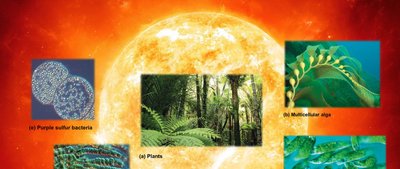
Chloroplasts: The Sites of Photosynthesis
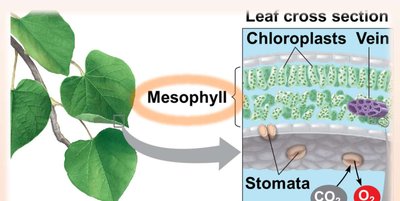
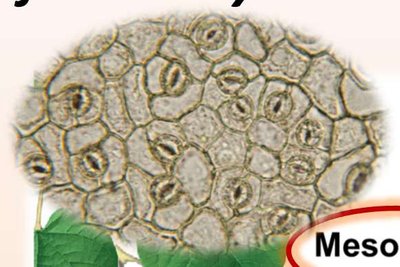
Photosynthesis occurs primarily in the leaves of plants, within specialized organelles called chloroplasts. Chloroplasts are most abundant in the mesophyll cells, which make up the interior tissue of the leaf. Gas exchange occurs through stomata, microscopic pores that allow CO2 to enter and O2 to exit.
Mesophyll: Leaf tissue rich in chloroplasts.
Stomata: Pores for gas exchange.
Structure of the Chloroplast
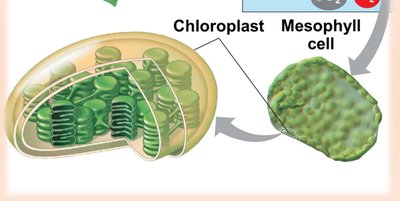
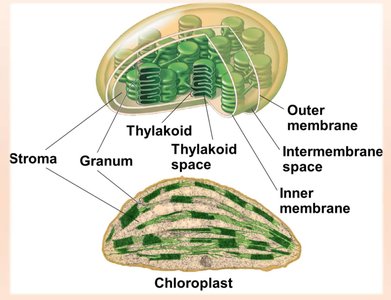
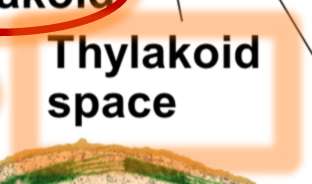
Chloroplasts have a complex structure, including an envelope of two membranes, a dense fluid called the stroma, and a third membrane system composed of thylakoids. Thylakoids are often stacked into grana, and their membranes contain chlorophyll, the pigment responsible for capturing light energy.
Stroma: Fluid-filled space inside the chloroplast.
Thylakoids: Flattened sacs forming the third membrane system.
Grana: Stacks of thylakoids.
Thylakoid space: Internal compartment of thylakoids.
The Photosynthesis Equation
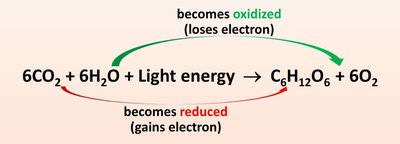
Photosynthesis is a redox process in which water is oxidized and carbon dioxide is reduced. It is an endergonic reaction, requiring energy input from light. The overall chemical equation is:
Photosynthesis:
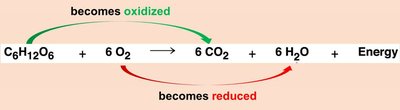
Cellular Respiration:
Overview of Photosynthesis: Light Reactions and Calvin Cycle
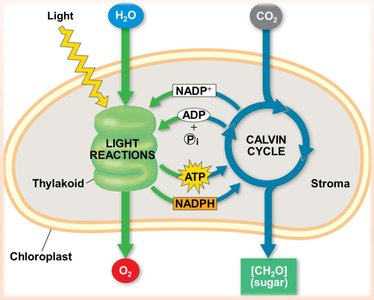
Photosynthesis consists of two main stages: the light reactions and the Calvin cycle. The light reactions occur in the thylakoid membranes and require light, while the Calvin cycle takes place in the stroma and is anabolic, building sugars from CO2.
Light Reactions: Split water, release O2, reduce NADP+ to NADPH, and generate ATP by photophosphorylation.
Calvin Cycle: Forms sugar from CO2 using ATP and NADPH; begins with carbon fixation.
The Nature of Sunlight
Light energy is a form of electromagnetic radiation, traveling in waves. The wavelength determines the type of electromagnetic energy. Visible light (380–750 nm) is the range that drives photosynthesis. Light also behaves as photons, discrete packets of energy.
Electromagnetic spectrum: Includes visible light, which is used in photosynthesis.
Photons: Particles of light energy.

Pigments and Light Absorption
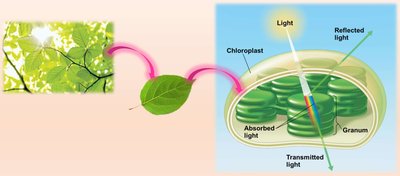
Pigments are molecules that absorb specific wavelengths of light. Chlorophyll is the main photosynthetic pigment, absorbing blue/violet and red light while reflecting green. Accessory pigments, such as chlorophyll b and carotenoids, broaden the spectrum of light that can be used for photosynthesis.
Chlorophyll a: Main photosynthetic pigment.
Chlorophyll b and carotenoids: Accessory pigments.
Why are plants green? They reflect and transmit green light.
Chlorophyll Excitation and Photosystems
When a pigment absorbs light, an electron is elevated to a higher energy state (excited state). This energy is transferred within photosystems, which are complexes of proteins and pigments. There are two types of photosystems: Photosystem II (PS II) and Photosystem I (PS I), each absorbing different wavelengths and working together to generate ATP and NADPH.
Photosystem II (PS II): Absorbs 680 nm, reaction center is P680.
Photosystem I (PS I): Absorbs 700 nm, reaction center is P700.
Function: Funnel energy to reaction center, drive light reactions.
Light Reactions: Mechanism and Products
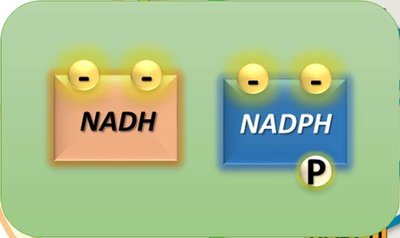
The light reactions use PS I and PS II to capture light energy, split water, release oxygen, generate ATP, and reduce NADP+ to NADPH. ATP and NADPH are then used in the Calvin cycle.
Key steps: Photon absorption, electron transfer, water splitting, ATP synthesis, NADPH formation.
ATP production: Occurs via chemiosmosis.
The Calvin Cycle: Building Sugars
The Calvin cycle is an anabolic pathway that builds glucose using ATP and NADPH. Carbon enters as CO2 and leaves as glyceraldehyde-3-phosphate (G3P). The cycle has three phases: carbon fixation (catalyzed by rubisco), reduction, and regeneration of the CO2 acceptor (RuBP).
Carbon fixation: Incorporation of CO2 into organic molecules.
Reduction: Conversion of 3-phosphoglycerate to G3P.
Regeneration: RuBP is regenerated to accept more CO2.
Rubisco: Enzyme catalyzing carbon fixation.
Summary Table: Comparison of Light Reactions and Calvin Cycle
Stage | Location | Inputs | Outputs | Key Functions |
|---|---|---|---|---|
Light Reactions | Thylakoid membrane | Light, H2O, NADP+, ADP | O2, NADPH, ATP | Energy capture, water splitting, ATP/NADPH synthesis |
Calvin Cycle | Stroma | CO2, ATP, NADPH | G3P (sugar), NADP+, ADP | Carbon fixation, sugar synthesis |
Example: C3 plants use the Calvin cycle to fix carbon and produce G3P, requiring three turns of the cycle to synthesize one G3P molecule.
Additional info: The notes include all major concepts required for understanding photosynthesis at the college level, including the structure and function of chloroplasts, the photosynthesis equation, the stages of photosynthesis, the role of pigments, and the Calvin cycle. Images were included only when directly relevant to the explanation.
